Choose a controller that supports your exact gaming device, then decide whether you want a physical arcade joystick or directional buttons. A lever stick suits players seeking cabinet-style controls; an all-button controller suits those who prefer button-based movement. In a bright room, assess screen glare separately rather than expecting controller lighting to solve it.
Who is an arcade controller for?
Players seeking traditional arcade controls
If you want a joystick and action buttons for retro titles, a lever stick offers that physical layout. Allow room for the controller on your desk or lap; MAYFLASH describes its F500 V2 as a large, weighted model.
Players using more than one system
If you move between a PC, Switch, console or emulation device, check the exact model and connection mode for each setup. Manufacturer compatibility lists can include conditions, such as a connected wired controller for some Mayflash console setups.
Players in bright, shared rooms
If several people use the same well-lit space, consider whether they can recognise the controls and whether a wired or wireless connection suits the room. Check display reflections separately from the controller.
What should you check before buying?
Start with the device and control layout you need. Once those fit, decide how much a cable-free setup matters in your room.
| Concern |
What to check |
Who this matters to |
| Platform compatibility |
Match the exact model to your device and intended connection mode. Check whether console use needs a connected wired controller. |
If I switch between gaming devices, I need one whose stated support covers the setup I will actually use. Around 42% of consumers put avoiding a compatibility mismatch first. |
| Control layout and space |
Choose between a physical lever and directional buttons; check the controller’s dimensions if desk, lap or storage space is limited. |
When I want the feel of a cabinet-style control panel, the joystick matters more to me than a slim shape. Around 33% of consumers make traditional controls and placement their main priority. |
| Shared-room practicality |
Check whether users can identify the controls in your lighting and whether the supported wired or wireless mode suits your setup. Assess screen reflections separately. |
In a bright shared room, I want controls others can recognise without an awkward cable arrangement. For around 25% of consumers, that everyday setup is the primary concern. |
Buying pitfalls to avoid
-
Assuming every model from a brand supports the same devices
8BitDo lists different compatibility for its Switch/Windows and Xbox arcade sticks. MAYFLASH also gives additional setup instructions for some console connections.
Check the full model name, your device and the connection instructions before ordering.
-
Expecting controller lighting to fix screen glare
Illuminated controls and a visible button layout do not establish whether you can see the game display in strong room light.
Check the controls under your usual lighting, then position the screen to reduce direct reflections where possible.
-
Buying an all-button controller for a joystick feel
Razer’s Kitsune uses directional buttons rather than a lever. That changes the physical input method players use for arcade-style movement.
Choose a lever stick if joystick movement is the part of the arcade layout you want; consider all-button controls if you prefer directional buttons.
Arcade-controller brands to consider
8BitDo
8BitDo offers separate arcade-stick models for Switch/Windows and Xbox setups, according to its product pages.
- Its Switch/Windows Arcade Stick lists Bluetooth, 2.4G and wired USB-C connection options.
- Check the precise version: support listed for one model should not be assumed for the other.
Mayflash
Mayflash’s F500 V2 is a full-size lever stick, while the F500 FLAT offers an all-button layout.
- Mayflash lists support for multiple systems across these product lines.
- Some console setups require a wired controller connected to the arcade controller; read the instructions for your device.
Razer
Razer identifies the Kitsune as a slim all-button arcade controller for PS5 and PC.
- Its directional-button layout offers a distinct option for players who want controls without a lever.
- It does not provide conventional joystick movement, and Razer states PS5 and PC support for this model.
HORI
PriceRunner UK lists a HORI Fighting Stick Alpha variant for PlayStation and PC; check the exact edition when comparing platform-specific sticks.
- The Fighting Stick Alpha is an identifiable lever-stick option for buyers seeking an arcade layout.
- Confirm the platform named on the individual product listing rather than assuming every Fighting Stick Alpha variant supports the same devices.
A Joybuy arcade-stick option
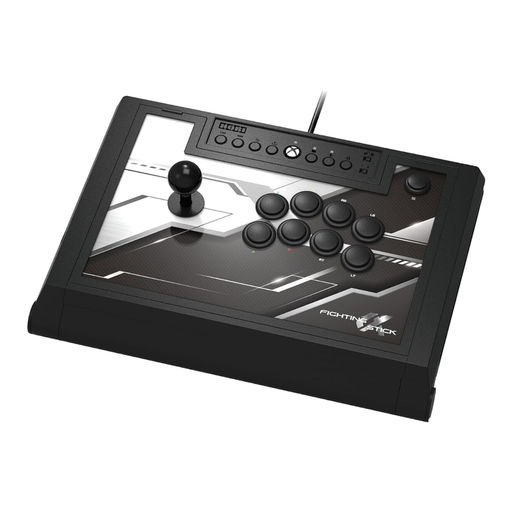
This lever-stick option is for players considering traditional arcade controls on Xbox Series X/S. Confirm the exact device and connection requirements before choosing it for another setup.
 No image available
HORI SERIES X Fighting Stick Alpha (Xbox Series X/S)
Consider this fighting stick if you want a lever-based arcade layout for Xbox Series X/S. It is described as a wired USB controller, so check that a wired connection suits your playing space and confirm compatibility before using it with another device.
View on Joybuy
Questions about retro arcade controllers
Do I need an illuminated controller in a bright room?
No: controller lighting is not a substitute for checking whether you can see the game screen. Assess screen reflections separately and make sure the physical controls are recognisable under your usual room lighting.
Will one arcade stick work with all my gaming devices?
Do not assume it will. 8BitDo lists separate Switch/Windows and Xbox arcade-stick models, while Mayflash’s instructions describe an additional wired-controller connection for some console setups. Match the exact model and connection mode to each device you plan to use.
Should I choose a joystick or an all-button controller?
Choose a lever stick if physical joystick movement is central to the retro arcade controls you want. An all-button controller replaces that movement with directional buttons, so it suits players who prefer that input method rather than serving as an automatic replacement for a joystick.
How should I dispose of an old arcade controller?
Check your local council’s electrical-recycling arrangements rather than assuming the controller belongs in general household waste. Oxfordshire County Council, for example, accepts household electrical items at waste recycling centres.


