Who these choices suit

Players who carry a compact handheld

If older console, arcade and handheld-style games are your focus, you may favour a small screen and low carry weight over a larger viewing area. Anbernic lists its RG35XX H with a 3.5-inch display, a 180 g weight and dual TF-card slots.

Players who want more screen space

If you mainly play at home, a larger display and HDMI output may matter more than pocketability. Powkiddy lists its X55 with a 5.5-inch screen, HDMI output and a 293 g weight.

Switch owners seeking a managed classics library

If you would rather browse Nintendo-provided games than manage files on an emulation handheld, check the Nintendo Classics catalogue for the games you want. Nintendo says access requires an active Nintendo Switch Online membership.

What matters when choosing

Decide which games matter most, then weigh the screen and carrying size against the setup you are willing to manage.

Concern What to check Who this matters to
Games and hardware List your must-play games and systems; seek evidence for the exact handheld model rather than relying on a format list. If newer systems are my priority, I need to know whether my particular games are playable before choosing a device. Around 36% of consumers would put game and system compatibility first.
Size and screen Compare screen dimensions, device weight and control layout for the way you intend to play. When I carry a handheld regularly, its size matters more to me than a broad feature list; if I play at home, I may want more viewing area. Around 29% of consumers would make physical fit their primary concern.
Setup and accessories Confirm the card capacity and contents of the bundle, plus the connections needed for your controller or display. I want room for a game library I can lawfully use, but I also need to be comfortable managing files and accessories. For around 21% of consumers, that setup is the deciding need.
Managed game access Check Nintendo’s current catalogue, compatible Switch hardware and membership requirement; check the rights attached to any separately obtained game files. I would rather use a supplied classics catalogue than organise game files myself, provided it contains the titles I want. Managed, licensed access would come first for around 14% of consumers.

Buying pitfalls

  • Taking a supported-format list as a guarantee

    A manufacturer’s format list does not establish how every game will play on that model. A larger specification sheet is not a substitute for checking the titles you care about.

    Make a short must-play list and look for model-specific evidence covering those games, their emulator settings and controls.

  • Assuming the handheld supplies game-file rights

    Owning an emulation device does not itself grant permission to copy or download copyrighted games. Section 17 of the Copyright, Designs and Patents Act 1988 treats copying as a restricted act, while GOV.UK describes copyright exceptions as limited.

    Use an official library or content for which you have clear permission; do not treat a seller’s preloaded-game count as proof of rights.

  • Overlooking the supplied charger and documentation

    The charging accessory and product documentation matter when ordering a handheld for delivery in Great Britain. The Office for Product Safety and Standards describes requirements for electrical equipment placed on the Great Britain market; Northern Ireland has a different framework.

    Confirm the supplied accessory, charging input, seller identity and applicable conformity information for your delivery destination.

    An unsuitable supplied charger could leave you needing a suitable replacement before use.

  • Comparing Nintendo Classics as though it were a separate handheld

    Nintendo Classics uses compatible Switch hardware and Nintendo’s offered catalogue. Nintendo says game access continues while the relevant membership remains active.

    Check that you have compatible hardware, that the current library includes your games and that the continuing membership suits you.

Brands to consider

Anbernic

Its RG35XX H and RG556 illustrate two different handheld formats: a compact Linux model and a larger Android model.

  • Anbernic lists the RG35XX H with a 3.5-inch 640×480 screen, dual TF slots, HDMI output and a 180 g weight.
  • Anbernic lists the RG556 with Android 13, 8 GB RAM, 128 GB storage and a 5.48-inch 1080×1920 AMOLED screen.
  • The manufacturer’s supported-format lists do not establish performance for every game.

Powkiddy

Its X55 is a reference point if you are considering a larger-screen Linux handheld rather than a pocket-sized device.

  • Powkiddy lists the X55 with a 5.5-inch IPS screen, dual TF-card support, HDMI output and a 293 g weight.
  • The larger body means more to carry; its specifications alone do not establish how a particular game will run.

Nintendo

Nintendo Classics offers Switch owners a managed alternative to setting up a general-purpose emulation handheld.

  • Nintendo lists NES, Super NES and Game Boy libraries with standard Switch Online, with further libraries available through Expansion Pack.
  • Access depends on compatible Switch hardware, the offered catalogue and an active membership; Nintendo says GameCube classics are for Switch 2.

Joybuy handhelds for retro play

This Linux handheld is a choice to consider if you want a 4-inch screen and built-in controls for retro play. Check compatibility with your intended games and the rights attached to any supplied files separately.
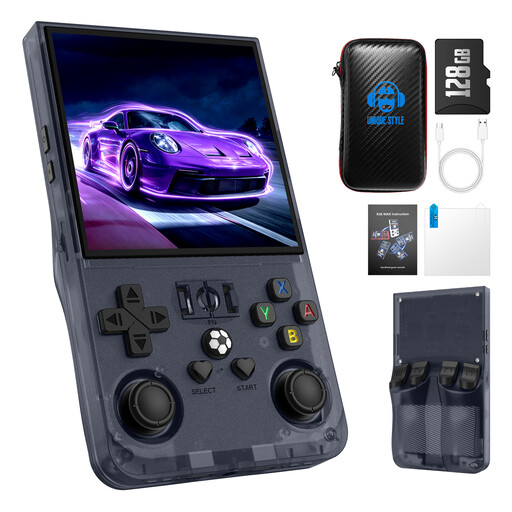
Grey AISLPC R36MAX retro handheld with a 4-inch display

AISLPC R36MAX retro handheld, 64GB, grey

Consider this Linux handheld if its 4.0-inch screen suits the way you want to carry and play retro games. The listed IPS display has a 720×720 resolution, and the title specifies 64GB storage and a 4000mAh battery; capacity does not establish playing time. Check your must-play games individually and confirm the lawful source of any included game files before relying on them.

View on Joybuy

Common questions

Should I choose a 3.5-inch or 5.5-inch retro handheld?

Choose by how much you value carrying size against viewing area. Anbernic lists the 3.5-inch RG35XX H at 180 g, while Powkiddy lists the 5.5-inch X55 at 293 g; those figures cannot tell you which controls will feel comfortable in your hands.

Does a supported-system list mean every game will play well?

No: a manufacturer’s supported-system list is not a result for every game on that handheld. Check evidence for your exact model and must-play titles, including the relevant emulator settings and controls.

Are games supplied with a retro handheld automatically lawful to use in the UK?

No blanket conclusion follows from their being supplied with a device. Section 17 of the Copyright, Designs and Patents Act 1988 treats copying as a restricted act, and GOV.UK describes exceptions as limited; check the source and rights for the particular game files.

What safety information should I check when ordering a handheld?

For delivery in Great Britain, check the exact product, supplied charger, charging information, seller details and applicable conformity information. GOV.UK’s guidance on electrical equipment sets out requirements for products placed on the Great Britain market and says CE marking remains recognised alongside UKCA for applicable product rules there; Northern Ireland follows a different framework.