
24/7 Customer Support

Free returns

Same-day & Next-day Delivery

Quality Guaranteed

Unlock Your Welcome Offers: FREE Delivery | Up to 80% OFF | Free 30-day JoyPlus trial
Download the APP
A reusable lunch box can reduce disposable packaging and make packed meals easier to manage, but the wrong design may quickly become inconvenient. A lid that loosens in a work bag, compartments that allow sauces to mix, or a container that is awkward to clean can turn a seemingly good purchase into wasted money.
This guide explains the practical features to check before buying reusable lunch boxes, including stainless steel construction, divided layouts, leak resistance and insulated food storage. It also matches selected options to different UK lifestyles, from school lunches and office commutes to larger hot meals and meal prep.
The word leakproof lunch box can be misleading if the seal, clips or internal dividers are not suitable for liquid foods. A container may cope well with sandwiches and dry snacks but still leak when filled with soup, yoghurt or a runny dressing.
Before purchasing, check whether the product has:
Even with a tight seal, it is sensible to carry liquid-heavy food upright unless the manufacturer clearly states otherwise.
A bento lunch box or divided lunch box can separate fruit, snacks and a main meal, but small sections may not suit larger portions. Fixed dividers can also make the box harder to clean, while removable dividers may shift during transport.
Consider your normal meal rather than choosing the highest number of compartments. One large section may work better for pasta, salads or sandwiches, while multiple sections can be useful for children or snack-based lunches.
A stainless steel lunch box is generally selected for its rigid construction and resistance to retaining food odours, but a standard metal lunch box does not automatically keep food hot or cold. Thermal retention requires a vacuum-insulated, double-wall design, such as an insulated food jar or food thermos.
If you need a warm meal several hours after leaving home, look specifically for vacuum insulated lunch container construction and follow the pre-heating instructions.
Capacity should match both appetite and carrying space. A larger container may suit meal-prep portions but can be heavy in a small school bag or crowded commuter backpack. Check the stated measurements, not only the volume.
For example, the PURECOOK rectangular options listed here measure approximately 18 × 15 × 6.7 cm and have a stated capacity of 61.2 fl oz. This gives a useful reference point for comparing a larger lunch box with a compact everyday container.
A 1.4-litre or 1.5-litre food thermos is designed for substantially larger servings, such as soup, stew or pasta. It may be more appropriate for heavy users, outdoor activities or long days away from home than for a light office lunch.
Common stainless-steel grades include 304 stainless steel and 316 stainless steel. Both are widely used in food containers, but the grade alone should not be treated as proof of overall product quality. Also check the lid material, silicone seal, finish, capacity and cleaning instructions.
The Maxcook 304 food jar lists 304 stainless steel, polypropylene and silicone in its materials. The Maxcook 316 model is described as using 316 stainless steel with vacuum insulation. These details help you compare construction, but they do not replace checking the individual product information and care guidance.
For products sold in the UK, look for clear food-contact information and supplier details. Avoid relying solely on vague terms such as “food grade” without supporting specifications.
A dishwasher-safe lunch box can reduce daily maintenance, but dishwasher compatibility may apply only to certain components. Removable seals should be taken out, washed and dried fully to reduce trapped food residue and odours.
The PURECOOK product descriptions specify dishwasher-safe construction and removable silicone seals. By contrast, the Maxcook insulated food jars advise hand washing and caution against prolonged immersion of the lid seal area. Always follow the instructions for the specific model rather than applying assumptions across a product range.
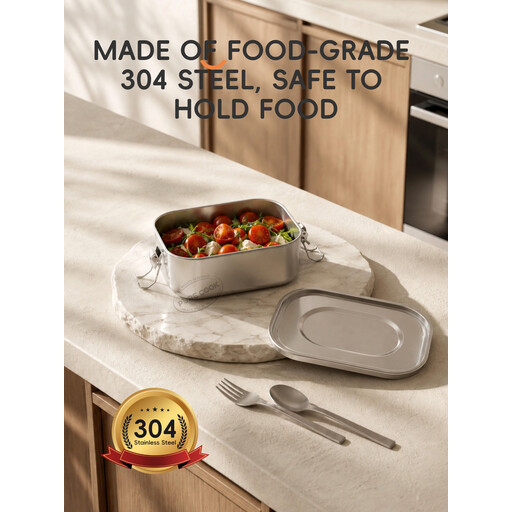
Why This Fits Their Persona: A straightforward option for adults, schoolchildren or office workers who prefer one roomy section for sandwiches, salads or a prepared meal.
The rectangular metal design avoids relying on fragile fixed dividers, while the listed lockable clips and removable silicone seal address common lid and cleaning concerns.
304 stainless steel construction; stated 61.2 fl oz capacity; removable silicone seal and dishwasher-safe listing.

Why This Fits Their Persona: Suited to commuters, travellers and outdoor users who prioritise an insulated format for hot or cold meals rather than separate dry-food compartments.
Its vacuum-insulated construction is clearly distinguished from a standard stainless steel lunch box, and the wide mouth makes filling and cleaning more practical.
316 stainless steel construction; vacuum insulation; wide mouth; listed 4–6-hour thermal retention range.
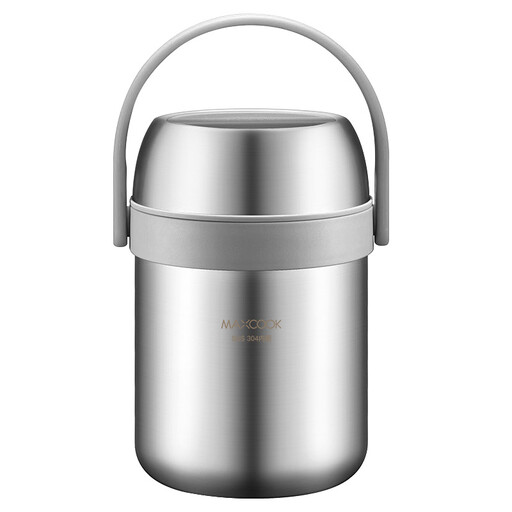
Why This Fits Their Persona: The 1.5-litre capacity is aimed at larger portions, shared meals, long shifts or days outdoors where a compact lunch box may be insufficient.
The listing provides a defined 1.5-litre capacity and advises pre-heating or pre-chilling, helping users understand how to use an insulated container rather than expecting instant temperature control.
304 stainless steel; 1.5-litre capacity; wide mouth; listed 4–6-hour thermal retention range.
If your lunch includes several components, compare a single-compartment container with a dual-compartment or five-compartment bento design. The PURECOOK dual-compartment model is listed with the same approximate external dimensions and capacity as the single-compartment version, making it worth considering when separating foods is more important than maximising open space.
For children, snack-heavy meals or portion planning, the Meoky 54oz single-latch divided lunch box and Meoky five-compartment bento lunch box provide different layouts. Check the exact product page for the colour and compartment configuration, and consider whether the latch can be operated comfortably by the intended user.
We have compiled a complete, real-time list of products that fully satisfy these strict selection criteria and UK safety regulations.
Standard reusable lunch boxes can carry warm food, but they are not necessarily insulated. For soup, stew or other meals that need to remain warm, choose an insulated food jar with vacuum insulation and follow the pre-heating instructions.
Lifespan depends on material, frequency of use, washing method and the condition of the seal. Stainless steel bodies may remain usable for a long time, but silicone seals and plastic lid components can need replacement sooner if they become damaged or fail to close securely.
Both are specified stainless-steel grades used in food-container construction. The more useful comparison is the complete product specification: capacity, seal design, insulation, lid materials, care instructions and portability. A 316 stainless steel food jar may appeal to shoppers prioritising that stated material grade, while a 304 stainless steel food jar can offer a practical option at a different size or price.