
24/7 Customer Support

Free returns

Same-day & Next-day Delivery

Quality Guaranteed

Unlock Your Welcome Offers: FREE Delivery | Up to 80% OFF | Free 30-day JoyPlus trial
Download the APP
Adding colour-changing illumination to a cabin can transform a standard interior, but choosing the wrong RGB car interior ambient lighting kit can leave you with uneven brightness, difficult wiring or strips that do not fit the trim gaps. Joybuy Product Recommendation Officer guidance focuses on the specifications that matter rather than simply repeating marketing language.
Many kits are designed for 12V passenger cars, SUVs, pick-ups and vans. That does not automatically include 24V trucks, buses or heavy machinery. A 24V vehicle requires a suitable 12V step-down converter, and using the wrong voltage can damage the controller or lights.
Interior design also varies considerably. Acrylic fibre optic car lights may be too thick for narrow dashboard or door gaps. The listed acrylic strips are approximately 2–3mm thick, so measure the intended channels before ordering.
A product may advertise a total length such as 175 inches, but the kit could contain several pre-cut sections for different zones. Check what is actually included: dashboard strips, footwell lamps, door handle lights, storage-box lights and door trim lights are separate components.
A six-piece strip kit may suit a simple dashboard and console installation, while a 22-in-1 arrangement is more appropriate if you want lighting across four doors, footwells and door storage areas.
Music-sync car LED lights generally respond to sound captured by a built-in microphone. They can react to music, speech and other cabin noise, but the effect may vary with volume and placement. If you prefer consistent illumination, check that the app also offers static colour, brightness and speed controls.
For most UK DIY installations, a 12V DC kit connected through a suitable vehicle power source is the practical starting point. Some products list a wider 10–16V operating range, while others specify 12V only. Do not connect a kit to a higher-voltage system without the correct conversion equipment.
Test all components before tucking them into trim. If you plan to hardwire the system to an ACC fuse rather than use the 12V socket, consider professional installation if you are unfamiliar with automotive electrical connections.
Acrylic light guides spread illumination along the strip and can create a continuous-looking line when installed in a trim gap. However, they should not be folded sharply or bent in half. A kit with an approximately 11.7mm-wide acrylic strip may need a larger channel than a thin flexible LED tape.
Check whether the strip can be cut and where. Cut only at the stated cut points, leaving enough length to avoid resistors or terminal sections. Incorrect cutting can cause part of the strip to lose colour consistency or stop synchronising.
Look for the number of controllers and independent zones. A main controller with sub-controllers can help distribute lighting around a cabin while keeping the effects synchronised. Depending on the model, the app may offer:
Bluetooth range is often listed at around 0–10 metres, which is generally suitable inside a vehicle. Confirm whether the kit uses the Lotus Lantern, LotusLamp X or LED LAMP app before installation, and check that your phone runs a compatible iOS or Android version.
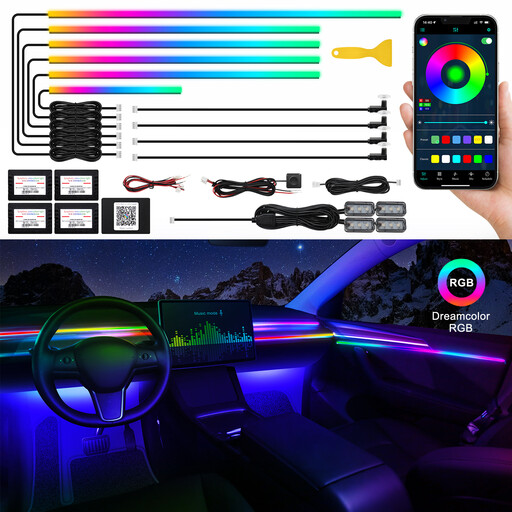
Why This Fits Their Persona: A practical entry point for drivers wanting dashboard, door-handle and footwell lighting without selecting a larger multi-zone package.
The contents specify six acrylic strips, four footwell lamps and four door-handle lights, rather than relying on one continuous strip for the whole cabin.
12V operation, Bluetooth app control, static and dynamic modes, plus a hidden touch button.
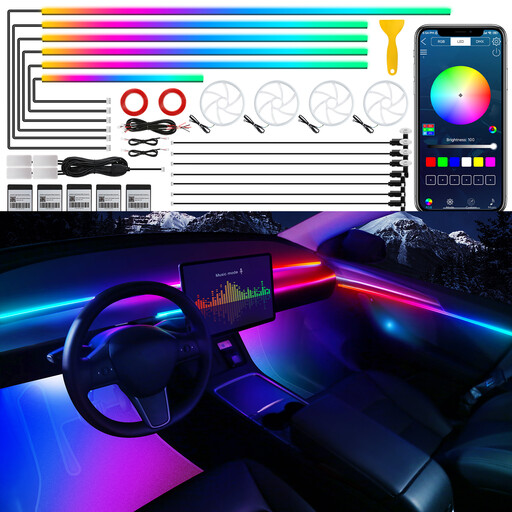
Why This Fits Their Persona: Suited to owners of larger cabins or carefully customised interiors who want separate visual treatment for several areas.
It lists additional door-horn lights alongside door, handle and footwell components, helping buyers assess coverage before installation.
593 LEDs, RGB Smart IC effects, sound sensing and a claimed 16-million-colour palette, with components distributed through main and sub-controllers.
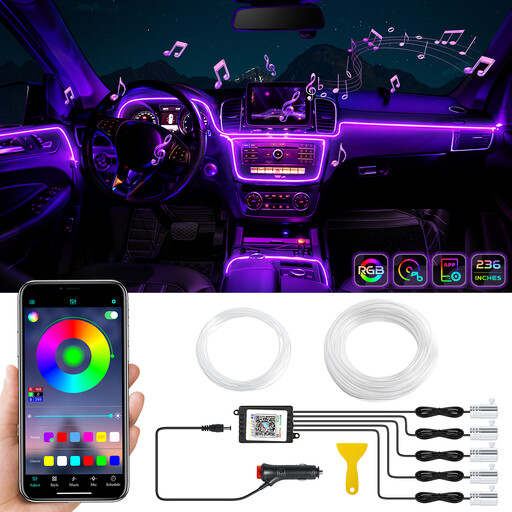
Why This Fits Their Persona: A flexible option for DIY vehicle modifiers who want to route a longer fibre optic line through selected trim areas and customise the layout.
The 6-metre optical fibre and transparent tube are measured separately, so the buyer can plan cut lengths and LED positions before fitting.
10–16V specification, Lotus Lantern app control, sound sensing and supplied pry tool, charger and installation instructions.
Test the lights before removing trim. Plan the controller position, keep wiring away from pedals and moving seat rails, and secure loose cables. Use the supplied pry tool carefully to avoid marking soft-touch plastics.
Lighting should remain suitable for private use and must not distract the driver, obstruct visibility or imitate emergency vehicle lighting. Avoid highly animated settings while driving on public roads, and check your vehicle’s requirements if you are carrying out permanent electrical modifications.
We have compiled a complete, real-time list of products that fully satisfy these strict selection criteria and UK safety regulations.
Plug-in kits can be manageable for a careful DIY installer, particularly when they include a pry tool and adhesive tape. The more zones and controllers a kit has, the more time is needed to conceal wiring neatly. Hardwiring to an ACC fuse requires greater electrical knowledge.
Lifespan varies with component quality, heat, voltage stability and installation. Avoid exceeding the stated voltage, folding acrylic fibre and placing controllers where they may be exposed to excessive heat. Testing before installation can also identify faulty components before they are hidden behind trim.
LED lighting generally draws modest power compared with many vehicle accessories, but actual consumption depends on the number of lamps, brightness and animation mode. Switch the system off when the vehicle is parked for extended periods, especially if it is connected directly to the battery rather than an ignition-controlled supply.