For rhythm games at a small desk, start by checking whether a 23.8- to 24.5-inch Full HD monitor and its stand will leave enough room for your controls. Choose a higher refresh-rate tier when fast note motion is a priority and your PC and connection can use the advertised mode; a larger, sharper screen is worth considering only if its dimensions and higher rendering demands suit your setup. Neither a headline refresh rate nor a quoted pixel response time establishes total play latency.
Who is this for?
Timing-focused rhythm-game players
If fast-moving notes make motion clarity and timing your priorities, check the refresh mode your PC can actually use and look for model-specific input-lag measurements. Pixel response-time claims alone will not answer the latency question.
Players with little desk space
If a keyboard, controller or arcade-style input device shares your desk, measure the space left for the complete monitor and stand. Screen diagonal alone will not tell you how much usable depth the base occupies.
Players who also use their PC for everyday tasks
If gaming is only one use for the screen, a compact 180Hz option may meet your needs without pursuing the highest refresh-rate tier. Check how its panel, connections and stand suit the rest of your setup.
What matters when choosing?
Measure the desk and space for your controls first; then decide which refresh mode your PC can use and whether extra screen area matters more to you than a compact footprint.
| Concern | What to check | Who this matters to |
|---|
| Timing and refresh |
Check the maximum refresh rate at your intended resolution and input, and seek model-specific input-lag measurements where available. |
When notes move quickly, I want the display to keep up with the frames my PC produces without relying on a response-time claim as proof of low lag. Around 45% of consumers put timing and refresh first. |
| Desk fit |
Compare the full dimensions with stand against your usable desk width and depth; check mounting and clamp clearance if you plan to use an arm. |
I need room for my controls as well as a screen I can position comfortably. For around 36% of consumers, fitting the monitor around that layout is the primary concern. |
| Mixed-use balance |
Compare a compact 180Hz option with higher-refresh models, checking panel type, connections and the response-time mode behind any quoted figure. |
If the same screen handles rhythm games and ordinary PC tasks, I may value a suitable all-round setup over the highest advertised Hz. That balance comes first for around 19% of consumers. |
What should you avoid?
-
Reading a 1ms claim as total play latency
Pixel response time describes a screen transition under particular conditions. Monitor input lag concerns signal processing, while the PC, game, controller and audio path also affect what you experience.
Look for input-lag measurements for the exact model and check the refresh mode you intend to use. Treat quoted grey-to-grey response times as mode-specific specifications.
-
Choosing by screen diagonal alone
A compact panel can still have a base that takes up space needed for cables or a rhythm-game controller.
Measure the usable desk surface and compare the monitor’s dimensions with its stand attached. For an arm, check the mounting pattern, monitor weight and available desk-edge clearance.
If the supplied base occupies too much desk depth, using an arm or different compatible stand adds another item to your setup.
-
Assuming every input reaches the headline refresh rate
Dell specifies 320Hz over DisplayPort but 255Hz over HDMI for the Alienware AW2525HM.
Check the input table for your exact monitor, graphics output and cable, then select the intended refresh rate in your device settings.
-
Assuming an archived model is a current buying option
ViewSonic’s UK page for the XG2431 is archived, so its published specifications alone should not settle a current purchase decision.
Confirm the exact variant, current availability, included cables and the seller’s warranty and returns information before ordering.
Relevant brands to consider
ASUS TUF Gaming
The VG259QMR5A is an ASUS example of a 24.5-inch Full HD Fast IPS monitor with a high-refresh mode.
- ASUS lists a 310Hz overclocked mode, FreeSync Premium, G-SYNC compatibility and ELMB Sync for this model.
- Check how to enable the overclocked mode and which connection it requires. ASUS’s 0.3ms minimum grey-to-grey figure is not a measurement of total rhythm-game latency.
Alienware
The AW2525HM is a 24.5-inch Full HD Fast IPS option for buyers who want stand adjustment alongside a high-refresh mode.
- Dell lists 110mm height adjustment, pivot, swivel and tilt, with up to 320Hz through DisplayPort.
- Dell lists up to 255Hz through HDMI. Its quoted pixel response times do not establish input lag or total play latency.
AOC / AGON
AOC’s 24.5-inch Full HD Fast IPS 25G4ZR offers a native 240Hz mode and an overclocked 260Hz mode.
- AOC lists Adaptive Sync and a Low Input Lag mode for the 25G4ZR.
- Confirm how to enable 260Hz and seek model-specific testing if measured input lag will decide your purchase; the mode name is not a measurement.
LG UltraGear
LG’s 23.8-inch 24GS65F-B represents a compact Full HD IPS route at 180Hz.
- LG lists G-SYNC Compatible and FreeSync support for this model.
- The cited stand is tilt-only. LG’s 1ms grey-to-grey specification applies in Faster mode, so check both positioning needs and the mode behind response-time claims.
ViewSonic
The archived UK XG2431 page provides dimensions and adjustment details for a compact 240Hz monitor.
- ViewSonic lists a 540mm chassis width and 90mm height adjustment for the XG2431.
- Because the page is archived, confirm availability, the applicable warranty and the exact specifications before treating it as a current option.
Joybuy products for these setups
These two monitors take different approaches to the desk-space decision: a 24-inch curved Full HD VA model at 180Hz and a larger 27-inch-class WQHD QD-OLED model at 240Hz. Check their full dimensions against your desk before choosing either format.
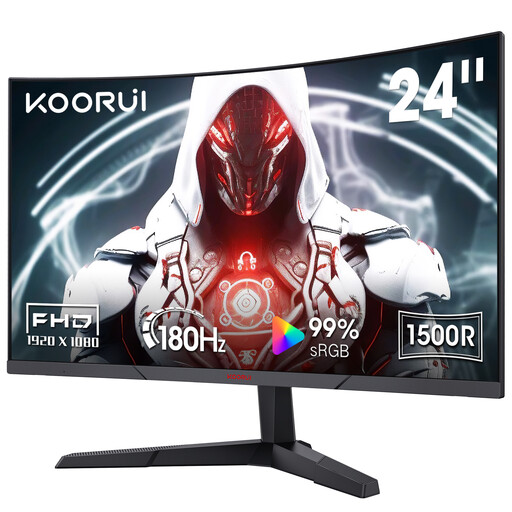 Image unavailable
KOORUI MG24A12FV2 24-inch 180Hz curved VA monitor
Consider this 24-inch Full HD option if a smaller screen suits your desk and you prefer a curved VA panel. It is listed with a 1500R curve, Adaptive Sync, two HDMI inputs, DisplayPort, tilt adjustment and VESA compatibility. Check which input supports the refresh mode you intend to use; the curved VA format is distinct from the flat IPS options discussed above.
View on Joybuy
 Image unavailable
MAG 274QP QD-OLED X24 27-inch 240Hz WQHD monitor
Consider this larger screen if you want 2560 × 1440 resolution alongside a listed 240Hz mode and have room for its stand and controls. The product name specifies QD-OLED and Adaptive-Sync. Check your desk measurements and your PC’s ability to run the intended resolution and refresh rate; the quoted 0.03ms response time does not establish input lag.
View on Joybuy
Frequently asked questions
Do I need 240Hz for rhythm games at a small desk?
No: a compact 180Hz monitor is also a high-refresh option. A 240Hz-or-higher model provides more screen updates, but prioritise it when your PC and connection can use that mode and fast-motion clarity matters more to you than the other differences between models.
Why might my monitor not reach its advertised refresh rate?
The available mode can depend on the input and settings: Dell lists 320Hz through DisplayPort but 255Hz through HDMI for the AW2525HM. Check your exact monitor’s input specifications, graphics output, cable and selected refresh-rate setting.
Which conformity marking should I check for a monitor in Great Britain?
GOV.UK says Great Britain continues to recognise CE marking alongside or in place of UKCA marking for products within the relevant rules. Check the marking and documentation applicable to the exact product and delivery market, as well as its supplied power arrangement; do not assume that a listing intended for another market has the same configuration.


