Families planning an after-school snack
A rice cake can be a packaged snack or a base for a topping. Compare the whole snack you plan to serve, not just the fat figure on the cake.


For a routine after-school snack, a plain no-added-salt or lightly salted rice cake gives you a simpler base for choosing a topping. Compare fat per 100g, then check salt, sugars and allergens on the exact pack: flavoured cakes can have different sugar or salt figures even when their fat content is similar.
A rice cake can be a packaged snack or a base for a topping. Compare the whole snack you plan to serve, not just the fat figure on the cake.
No-added-salt and lightly salted products are distinct choices. The label lets you compare salt alongside fat and sugars for the serving you have in mind.
Check the exact cake’s ingredients, gluten statement and precautionary allergen information, as well as the school’s food policy. Kallo labels its Organic Lightly Salted cakes gluten free but also says they may contain milk, sesame and soya.
Start with the type of cake your child would eat, then compare the exact product’s nutrition and allergen information. In a British Nutrition Foundation survey published in 2025, more than 2,500 UK schoolchildren answered questions about snacking; the figures below describe their responses, not rice-cake preferences.
| Priority | What to check | Your needs |
|---|---|---|
| After-school use | Decide whether the cake will be eaten on its own or with a topping or side. Check that anything packed meets the school’s food policy. | I need something practical for the after-school window. In the British Nutrition Foundation’s 2025 survey of more than 2,500 UK schoolchildren, 76% said they normally had a snack after school during the week; that figure describes timing, not a preference for rice cakes. |
| Fat and labels | Compare fat per 100g on the exact product, then read salt and sugars using the same per-100g or per-cake basis. Check flavoured varieties individually. | I want the label to make comparisons straightforward. In the same British Nutrition Foundation survey, 33% of the schoolchildren thought choosing a healthy snack from a shop was easy; this was a question about ease of choice, not rice-cake buying. |
| Salt and flavour | Distinguish no-added-salt cakes from lightly salted ones. For flavoured cakes, compare the listed salt and sugars for the specific flavour. | If I want a plain base for a topping, a no-added-salt cake may suit that plan. If flavour matters more, I’ll check what changes on the flavoured cake’s label. |
| Allergens | Read the current ingredients, gluten statement and any ‘may contain’ advice. Check the school’s policy before packing the snack. | I need to know whether this exact product fits the child’s allergen requirements; a gluten-free statement does not answer questions about other allergens. |
Snack a Jacks lists 3.6g sugars per cake for its Jumbo caramel flavour and 0.26g salt per cake for Jumbo salt and vinegar. A fat figure alone does not describe either product’s full nutrition panel.
Compare the exact flavour’s fat, salt and sugars, keeping the per-cake and per-100g figures distinct.
Kallo Organic Lightly Salted, Sainsbury’s No Added Salt and M&S Lightly Salted cakes are labelled gluten free, but that does not establish the status of another product. Kallo also carries ‘may contain’ advice for milk, sesame and soya.
Read the current pack for each product and check the school’s food policy before packing it.
Ingredients, nutrition and allergen information can change. An earlier product listing may not describe the pack in hand.
Use listings to narrow your options, then check the label before serving or packing the cakes.
A plain rice cake leaves the topping or side to be chosen separately. NHS snack ideas include rice cakes with lower-fat cream cheese and cucumber.
Plan any topping or side alongside the cake, taking the child’s allergens and the school’s policy into account.
These figures describe the named products, not every cake or flavour in each brand’s range.
Kallo Organic Lightly Salted Wholegrain Rice Cakes are a plain, lightly salted option.
Sainsbury’s No Added Salt Rice Cakes offer a plain option when added salt is the deciding factor.
Tesco Lightly Salted Rice Cakes contain brown rice and sea salt, according to Tesco’s ingredient list.
Asda Slightly Salted Rice Cakes are another plain, salted option.
M&S sells lightly salted rice cakes alongside flavoured and chocolate varieties.
Snack a Jacks Jumbos provide flavoured rice-cake choices rather than a plain topping base.
These options cover a plain lightly salted cake and a Marmite-flavoured cake. Compare their labels for the particular after-school snack you plan to serve.
 No image available
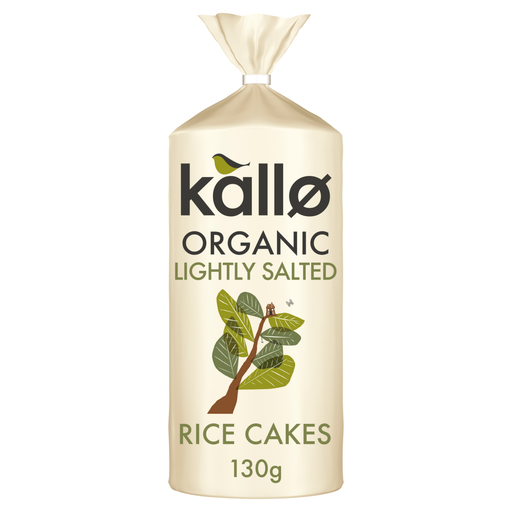
A lightly salted cake to consider if you plan to add your own topping. For this product, ASDA lists 2.7g fat per 100g and 0.2g per cake. Kallo labels it gluten free but says it may contain milk, sesame and soya; check the current pack and any school policy.
 No image available
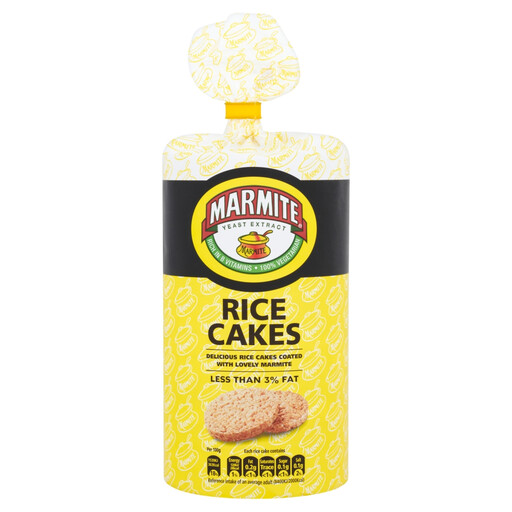
A savoury-flavoured alternative when a plain cake is less appealing. Its product information identifies barley, wheat, oats, rye and celery, so it is not a choice for gluten avoidance. Check the current pack’s allergen information and its salt and sugars when comparing it with a plain cake.
Start with fat per 100g on the exact pack, then compare salt and sugars on a consistent basis. Sainsbury’s, Marks & Spencer, Kallo, Tesco and ASDA list 2.4g to 2.9g fat per 100g for the named plain or lightly salted products; those figures should not be applied to their other varieties.
No: check the exact product. Kallo Organic Lightly Salted, Sainsbury’s No Added Salt and M&S Lightly Salted cakes are labelled gluten free, but that does not establish the status of every rice cake. Kallo’s product also says it may contain milk, sesame and soya.
Check the school’s food policy and the current pack’s ingredients and allergen statements. If an allergy is involved, consider any ‘may contain’ advice in line with the child’s individual guidance rather than relying on the product category alone.
A suitable topping or side can make it a more varied snack. NHS snack ideas include rice cakes with lower-fat cream cheese and cucumber; choose additions that fit the child’s allergen requirements.
No. Snack a Jacks lists 3.6g sugars per cake for its Jumbo caramel flavour and 0.26g salt per cake for Jumbo salt and vinegar. Compare the flavour you intend to buy with a plain cake using the figures on their respective packs.