Who is choosing?
The useful distinction is not simply between reduced-fat and standard rice cakes: it is between a baby’s stage of self-feeding, the type of cake and the ingredients on its label.
Parents starting self-feeding
The NHS advises starting solids at around six months, when the baby shows the signs of readiness. A product’s age statement helps narrow the choice but does not replace checking how the child manages finger foods or supervising them while they eat.
Parents comparing baby snacks with plain rice cakes
A baby-range rice cake has a stated stage, while a general rice cake may offer a short ingredient list or no added salt. Compare those details alongside texture and the child’s ability to handle it, rather than treating either product type as suitable for every baby.
Families checking gluten and other allergens
Rice-cake labels differ. Tesco Unsalted Multigrain Rice Cakes contain spelt, while Kallo Organic Unsalted rice cakes are labelled gluten free but carry a precautionary warning for milk, sesame and soya. Check the exact pack for the allergens that matter to your household.
What should you check?
Start with readiness and supervised eating, then compare labels on the same basis. A reduced-fat description does not answer the questions about salt, ingredients or the product’s stated stage.
| Priority | What to check | Your needs |
|---|
| Readiness and texture |
Check the NHS signs of readiness for solids, generally around six months. Compare any stated product age with the child’s stage; have them sit down and supervise them while eating. |
My baby is beginning to pick up finger foods, so I need a snack they can manage at their current stage, not one chosen solely by its nutrition claim. |
| Salt |
Read the ingredients for added salt and compare salt figures per 100g on the same basis. “Lightly salted” does not mean unsalted; the NHS advises that babies should not eat much salt. |
If I am choosing a rice cake for a baby, I want to distinguish an unsalted option from one with added salt. |
| Fat claim |
Check what a reduced-fat claim describes, but assess the stated age, ingredients and salt separately. NHS guidance does not make reduced fat a general goal for babies starting solids. |
A lower-fat label alone would not tell me whether this rice cake fits my baby’s stage or the rest of their food. |
| Gluten and allergens |
Read the named grains, gluten-free statement and precautionary allergen wording on the exact pack. Tesco’s unsalted multigrain cakes contain spelt; Kallo Organic Unsalted carries a may-contain warning for milk, sesame and soya. |
Where an allergen matters in our household, I need the current label for the particular product rather than an assumption about all rice cakes. |
| Variety |
Consider how often rice-based snacks feature alongside other foods. GOV.UK says rice takes up more arsenic than other cereal crops but can be part of a balanced diet; the NHS advises offering a variety of foods from around six months. |
I can include a suitable rice cake without making it the only regular cereal snack. |
Brand and product-line references
These product lines illustrate why the stated age, salt declaration and allergen wording need checking separately, even within the same category.
Organix
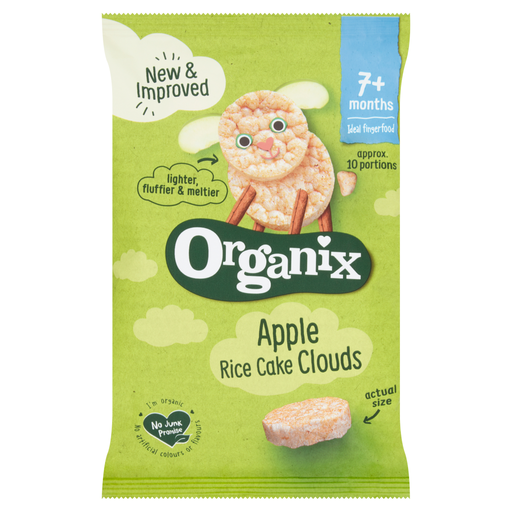
Organix presents rice cakes in a 7-months-plus baby range, including Apple Rice Cake Clouds.
- The brand lists Apple Rice Cake Clouds as gluten free, with 0.08g salt per 100g, and instructs carers to have children sit down and be supervised.
- The Apple version contains apple juice concentrate. Its stated age does not replace checking the individual child’s readiness.
Kallo
Kallo Organic Unsalted Wholegrain Rice Cakes are a general rice-cake product with organic wholegrain rice listed as the ingredient.
- Kallo labels this version gluten free and lists salt as trace.
- It has no stated baby stage and carries a may-contain warning for milk, sesame and soya. The NHS also advises against giving under-2s only wholegrain starchy foods.
Tesco
Tesco Unsalted Multigrain Rice Cakes provide an example of why “unsalted” and “gluten free” are separate label checks.
- Tesco lists less than 0.01g salt per 100g for this product.
- Its ingredients include spelt, so it is not an option for someone avoiding gluten. Check the current pack information before buying.
Sainsbury’s
Sainsbury’s Lightly Salted Wholegrain Rice Cakes are a general household snack rather than an age-stated baby product.
- Sainsbury’s labels the product gluten free and lists 0.24g salt per 100g.
- It contains added salt, and Sainsbury’s states that it is not suitable for people with a milk allergy because of manufacturing methods.
Rice cakes on Joybuy
These options cover an age-stated baby rice cake and a general lightly salted rice cake. Compare their different intended uses and labels; neither product’s presence here makes reduced fat the deciding factor.
 No image available
Organix Apple Rice Cake Clouds 7+ Months 40g
An age-stated baby-range option to consider once the child is ready for solids and can manage finger foods. Organix lists 0.08g salt per 100g and includes apple juice concentrate; have the child sit down and supervise them while eating.
View on Joybuy
 No image available
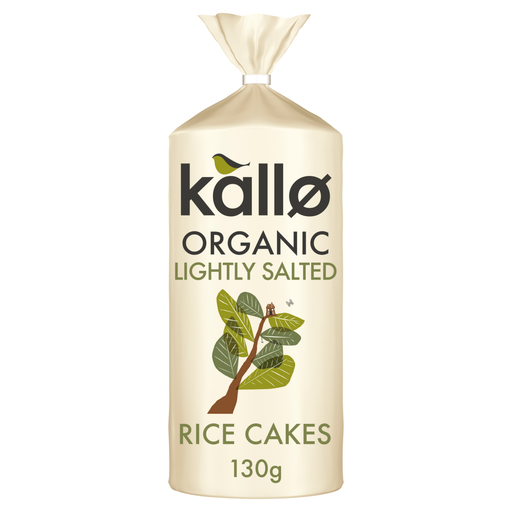
Kallo Organic Lightly Salted Rice Cakes 130g
This general rice cake is a different choice from an age-stated baby snack; check that the child can manage its texture before considering it for self-feeding. Kallo lists wholegrain brown rice and sea salt, with 0.3g salt per 100g. It is lightly salted, not unsalted.
View on Joybuy
Questions about rice cakes for babies
Should I look for reduced-fat rice cakes for baby-led weaning?
No reduced-fat claim establishes that a rice cake suits a baby beginning solids. The NHS guidance cited here does not make reduced fat a general goal at this stage; check readiness, supervision, salt, ingredients and allergens instead.
When can a baby try a rice cake?
Consider finger foods when the baby shows the NHS signs of readiness for solids, generally around six months: sitting with a steady head, coordinating eyes, hands and mouth, and swallowing food rather than pushing it out. Also follow any stated product age, and have the child sit down and be supervised while eating.
Is a lightly salted rice cake the same as an unsalted one?
No. Lightly salted products contain added salt: Kallo lists 0.3g per 100g for its Lightly Salted Wholegrain Rice Cakes, while its Organic Unsalted version lists salt as trace. The NHS advises that babies should not eat much salt, so read the current ingredient list and compare salt figures on the same basis.
Are all rice cakes gluten free?
No. Tesco Unsalted Multigrain Rice Cakes contain spelt, while Kallo Organic Unsalted and Organix Apple Rice Cake Clouds are labelled gluten free. Check the exact pack’s ingredients and precautionary allergen wording, which can differ even between gluten-free-labelled products.
What should I check before sending rice cakes to nursery?
Check the nursery’s own food and allergy arrangements and the exact product label; do not assume that every rice cake contains gluten or that every variety is acceptable in that setting. Department for Education guidance says early-years providers must take steps to keep children safe and that babies and young children must not be left alone while eating.


