Campers packing a no-cook snack
Dry rice cakes can be eaten without preparation. Protect the pack from crushing, and follow its cool, dry storage instructions; retailers advise an airtight container after opening.


For a no-cook camping snack, compare fat per 100g on the current pack: Sainsbury’s No Added Salt, Tesco Lightly Salted and Asda Slightly Salted rice cakes have listed values within the 3g-per-100g criterion described in Department of Health and Social Care guidance on GOV.UK for a solid food labelled low fat. Choose a no-added-salt version if salt matters to you, or a lightly salted version if you prefer its flavour. Keep the cakes dry, check allergen warnings and take other suitable food if you need more than a snack.
Dry rice cakes can be eaten without preparation. Protect the pack from crushing, and follow its cool, dry storage instructions; retailers advise an airtight container after opening.
Compare the nutrition panel per 100g rather than calories per cake. Sainsbury’s No Added Salt lists 2.4g fat per 100g, while the Tesco and Asda plain salted examples each list 2.9g per 100g. Department of Health and Social Care guidance on GOV.UK describes 3g per 100g as the maximum for a solid food labelled low fat.
Kallo describes its Lightly Salted rice cakes as gluten free and suitable for vegans, but also says they may contain milk, sesame and soya. Read the warning on the specific pack before choosing it.
Start with the per-100g fat figure, then compare salt, ingredients and storage instructions for the food you plan to take.
| Priority | What to check | Your needs |
|---|---|---|
| Fat content | Check fat per 100g, not just calories per cake. Department of Health and Social Care guidance on GOV.UK sets out a maximum of 3g fat per 100g for a solid food labelled low fat. | I want a rice cake that meets the low-fat criterion, even if I choose a flavoured pack. |
| Salt and flavour | Compare salt per 100g and per cake or bag; serving sizes differ. Sainsbury’s No Added Salt lists less than 0.01g salt per cake, while Tesco and Asda list 0.02g per cake for their salted examples. | If salt is important to me, I would choose by the label rather than assume every plain or lightly salted cake is alike. |
| Other food to pack | Check protein per cake if it matters to your plans. The examined plain rice cakes provide small amounts per cake; Kallo’s lentil cakes are a different format, listed by Sainsbury’s at 1.8g protein per cake. | I need more than a plain snack for a longer day, so I’ll plan other food that suits my storage arrangements. |
| Allergens and storage | Read the current ingredients and precautionary allergen warning. Keep rice cakes cool and dry, and check the pack’s instructions for storage after opening. | I need food that fits my dietary requirements and stays protected from damp and crushing in my bag. |
Tesco lists 80 kcal per 19g bag for the examined Snack a Jacks Salt & Vinegar multipack, but also lists 9.9g fat per 100g. That exceeds the 3g-per-100g low-fat criterion described in Department of Health and Social Care guidance on GOV.UK.
Compare fat per 100g first, then check the serving size and salt separately.
The examined plain cakes provide little protein per individual cake, so they serve a different purpose from a planned meal.
Pack other food suited to your trip and its storage conditions if you need more than a snack.
Kallo labels its Lightly Salted rice cakes gluten free and suitable for vegans, while warning that they may contain milk, sesame and soya.
Check the exact pack’s allergen statement instead of relying on a broader dietary label.
The examined retailer listings call for cool, dry storage and an airtight container after opening.
Keep the pack closed until needed and protect opened cakes from damp and crushing.
These examples describe particular product lines, not every rice cake sold under each name; check the current pack when choosing.
Kallo’s Lightly Salted rice cakes offer a branded plain-snack option; its lentil cakes are a separate cake format.
The examined No Added Salt Rice Cakes are a plain option when salt and fat figures both matter.
The examined Lightly Salted Rice Cakes are a brown-rice-and-sea-salt option.
The examined Slightly Salted Rice Cakes provide another plain salted option to compare by its nutrition panel.
The examined Salt & Vinegar multipack is a flavoured, individually bagged rice-and-corn snack.
This flavoured rice cake is an option to assess for a no-cook camping snack. Check its current fat, salt and allergen information against your requirements rather than assuming it has the same profile as the plain cakes discussed above.
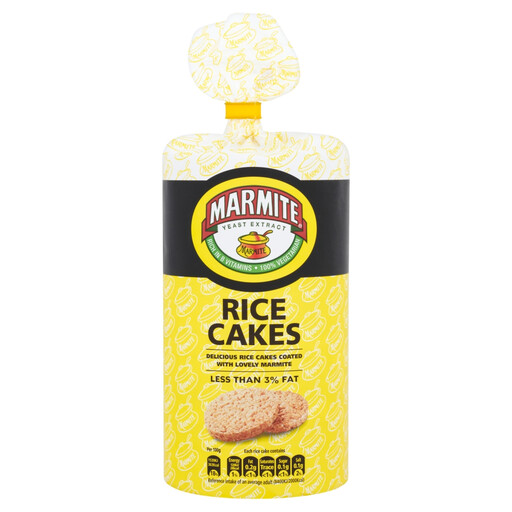 No image available
A flavoured rice cake to consider if you want a no-cook snack rather than a plain or lightly salted cake. The product information flags gluten, including barley, wheat, oats and rye; check the current pack if you avoid these ingredients. Compare its fat and salt figures on the pack with your requirements.
Department of Health and Social Care guidance published on GOV.UK states that a solid food making a low-fat claim must contain no more than 3g fat per 100g. Use the per-100g panel to compare rice cakes; calories per cake or bag answer a different question.
The examined dry rice-cake listings specify cool, dry storage rather than refrigeration, and advise airtight storage after opening. If you add chilled toppings, plan how to keep those foods cool; The Camping and Caravanning Club recommends a cool box or insulated cool bag when tent camping without a fridge.
Kallo says its Lightly Salted rice cakes may contain milk, sesame and soya despite being labelled gluten free and suitable for vegans. Check the precautionary warning on the specific pack and choose a product compatible with your requirements.
Plan other food rather than relying on plain rice cakes alone for a meal. The examined plain cakes provide little protein per individual cake; if you are comparing cake formats, Sainsbury’s lists 1.8g protein per cake for Kallo Protein Packed Lentil Cakes, which are not conventional rice cakes.