Choose a labelled organic chilled rice pudding if organic production is your priority and you can keep it refrigerated; Rachel’s Organic Divine Rice comes in pots, not a tin, and must be kept at 1–5°C. An Ambrosia 400g tin suits a plan built around cupboard storage and shared servings, but should not be assumed to be organic. For a baby, check an age-labelled product separately rather than treating ordinary party pudding as interchangeable with baby food.
Who is each format for?
Hosts prioritising organic labelling
You want an organic-labelled dessert and can make room for refrigerated pots. Check the storage instructions as well as the organic information: the Rachel’s Organic product listed by Tesco Groceries must be kept at 1–5°C.
Hosts serving from the cupboard
You want a tin that can be stored before the party and portioned for a group. Ambrosia describes its 400g rice pudding as suitable for hot or cold serving, but an ordinary tin should not be treated as organic without checking its label.
Hosts accounting for babies or dietary requirements
You need to check each child’s age and dietary requirements before choosing a pudding. Anaphylaxis UK advises establishing children’s requirements for organised food events; product labels then provide the ingredients, allergen and age information needed for selection.
What matters when buying?
For a kids’ party, decide which requirement comes first: an organic label, a tin that is convenient to store and serve, or an attending child’s age and dietary suitability.
| Concern |
What to check |
Who this matters to |
| Organic status and format |
Check the organic labelling, then check separately whether the product is chilled or tinned and how it must be stored. |
If organic production matters more to me than buying a tin, I need to allow for refrigerated pots. About 42% of consumers put a verified organic claim first. |
| Portions and storage |
Check pack size, stated servings and what to do with the pudding after opening. |
When I am serving a group, cupboard storage and portioning from one tin may simplify the plan. Roughly 33% of consumers prioritise that serving arrangement. |
| Age and dietary suitability |
Ask parents or carers about requirements; read the current pack’s age guidance, ingredients and allergen statements. |
If a child needs age-specific food or has a dietary restriction, that suitability comes before the serving format. Around 25% of consumers make it their primary concern. |
What should you avoid assuming?
-
Assuming organic rice pudding comes in a tin
The Rachel’s Organic product listed by Tesco Groceries is chilled and must be kept at 1–5°C. Ambrosia’s 400g tin can be stored in a cool, dry place before opening, but is not presented as organic.
Choose the storage arrangement you can manage, then check the individual product’s organic labelling rather than relying on its format.
-
Treating organic as an allergen guarantee
Tesco Groceries lists milk and egg in Rachel’s Organic Divine Rice and notes that it may contain wheat or gluten. The organic HiPP baby jar listed by ASDA contains milk.
Confirm children’s requirements with their parents or carers, read the current physical pack and take care to avoid cross-contact while serving.
-
Reading total sugars as added sugar
The NHS explains that naturally occurring milk sugars appear in the total-sugars figure but are not free sugars. A total-sugars number alone therefore does not show how much sugar was added.
Read the ingredients list alongside the nutrition panel when comparing milk-based puddings.
-
Leaving an opened tin out without a plan
Ambrosia instructs customers to refrigerate the remaining contents of its 400g tin after opening and consume them within three days.
Portion what you intend to serve and follow the pack’s instructions for anything left over.
Brands and retailers to consider
Rachel’s Organic
Tesco Groceries lists Divine Rice as an organic chilled dessert in two 150g pots.
- The listing identifies organic milk and cream.
- The pots require storage at 1–5°C, contain milk and egg, and may contain wheat or gluten. They are not tins.
Ambrosia
Ambrosia describes its 400g rice-pudding tin as a cupboard-stored option with two stated portions, served hot or cold.
- The tin provides a shared-serving format without refrigeration before opening.
- It contains milk and is not presented as organic; remaining pudding needs refrigeration after opening.
HiPP Organic
ASDA Groceries lists an organic apple-and-pear rice-pudding jar labelled for babies from 7 months.
- The 160g jar provides an age-labelled baby-food format.
- It contains milk and is not a general tinned party dessert; follow its feeding and leftover instructions.
Tesco
Tesco Groceries lists tinned rice puddings and, separately, chilled Rachel’s Organic rice pudding.
- The separate listings let shoppers check tin and chilled-pot formats.
- An organic chilled listing does not make a tinned product organic; check the label of the product you choose.
ASDA
ASDA Groceries lists conventional 400g rice-pudding tins alongside separately listed organic rice-pudding products.
- Its listings include conventional tins and an age-labelled organic HiPP baby jar.
- The listed own-label tins contain milk and are not labelled organic; the baby jar is not an equivalent shared dessert.
Joybuy product for an age-specific need
If the party includes a baby who needs an age-labelled rice-pudding portion, the product below is a pouch rather than a shared-serving tin.
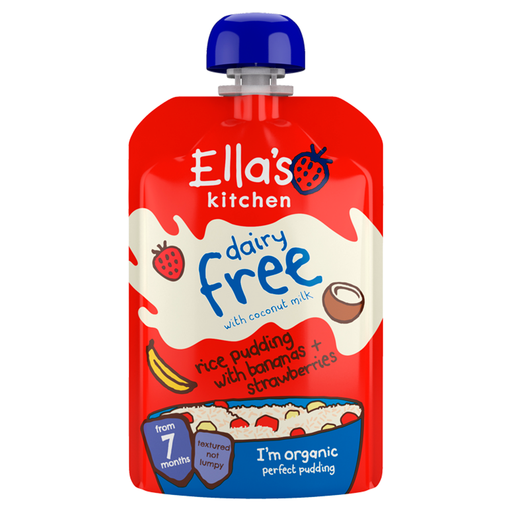 Image unavailable
Ella’s Kitchen Dairy Free Rice Pudding with Bananas/Berries, 7+ Months, 80g
This 80g baby-food pouch is labelled for children from 7 months, not for serving a group from a tin. Before relying on its dairy-free or organic positioning for a child’s requirements, check the current pack’s ingredients, allergen information and organic certification details.
View on Joybuy
Questions about serving rice pudding
Does “organic” have a defined meaning on a UK food label?
Yes. Department for Environment, Food & Rural Affairs guidance says food may be labelled organic only when it meets organic production rules. Check the product’s organic labelling rather than treating words such as “natural” as equivalent.
Can I assume a tinned rice pudding is organic?
No. Tesco Groceries lists conventional products in its tinned rice-pudding category, while its Rachel’s Organic rice pudding is a chilled product. Check the particular tin’s label if both organic status and cupboard storage matter to your party plan.
Are these puddings suitable for children with milk, egg or gluten-related requirements?
Do not assume they are. Ambrosia’s 400g tin contains milk; Tesco Groceries lists milk and egg in Rachel’s Organic pots and says they may contain wheat or gluten. Confirm each child’s requirements with a parent or carer and read the current pack before serving.
What should I do with rice pudding left after opening a tin?
Follow the instructions on that tin. Ambrosia says to refrigerate the remaining contents of its 400g rice pudding after opening and consume them within three days; plan where you will keep leftovers before serving begins.
Is an organic baby rice pudding a substitute for the party dessert?
Not as a general shared dessert. ASDA Groceries lists the HiPP Organic apple-and-pear rice pudding jar as baby food for ages 7 months and over. Match an age-labelled product to the child it is intended for, and check its allergens and feeding instructions.


