Organisers offering a lower-sugar choice
Compare the sugar figures on the biscuits you intend to serve. A reduced-sugar claim has a particular comparator; it does not mean the biscuit meets a low-sugar guide.


If offering a lower-sugar rich tea biscuit is the priority, McVitie’s Rich Tea The Light One lists 12.8g sugars per 100g, compared with 16.0g to 19.3g per 100g on the standard rich tea labels checked. Compare sugars both per 100g and per biscuit when planning portions, and keep the current packaging available so attendees can check ingredients and allergens. McVitie’s reduced-sugar claim uses a typical semi-sweet biscuit as its comparator; at 12.8g per 100g, The Light One does not meet the NHS guide of 5g or less per 100g for a low-sugar food.
Compare the sugar figures on the biscuits you intend to serve. A reduced-sugar claim has a particular comparator; it does not mean the biscuit meets a low-sugar guide.
Keep the packaging with the refreshments so attendees can read the ingredients and precautionary allergen statements for the product actually supplied.
Use the count on the intended pack and the number of biscuits you plan to offer each person. Check sugars per biscuit as well as per 100g, because biscuit sizes differ.
Start with the sugar figure for the exact biscuit, then check serving size, allergens and the quantity you can obtain for the meeting.
| Priority | What to check | Your needs |
|---|---|---|
| Sugar content | Compare sugars per 100g across exact products, then read any reduced-sugar claim against its stated comparator. McVitie’s lists 12.8g per 100g for The Light One and says its 30% reduction is against a typical semi-sweet biscuit. The NHS low-sugar guide for food is 5g or less per 100g. | I want to offer a biscuit with a documented lower sugar figure without assuming that “reduced sugar” means “low sugar”. |
| Portions | Check sugars per biscuit and the count for the exact pack. McVitie’s lists 1.1g per biscuit and approximately 36 biscuits in a 300g pack of The Light One; Waitrose lists 1.0g per finger and approximately 50 fingers in a 250g pack. | If I am putting out biscuits for a group, I need enough for the servings planned. A smaller sugar figure per biscuit alone does not tell me which recipe contains less sugar per 100g. |
| Allergens | Read the ingredients and precautionary statements on the current pack. McVitie’s lists wheat and barley ingredients for The Light One and says it may contain soya; M&S says its rich tea biscuits are not suitable for people with milk, nut or peanut allergies. | Attendees need access to the information for the biscuit I actually serve, rather than an assumption based on the rich tea name. |
| Pack quantity | Check pack size, stated servings and availability when ordering. Asda suggests approximately 39 servings from its 300g rich tea pack; the checked Sainsbury’s 200g own-label listing was marked out of stock. | I need enough available packs for the planned servings, with time to choose another product if the intended one cannot be ordered. |
Tesco lists 20.1g sugars per 100g for its reduced-fat rich tea, compared with 16.0g per 100g for its standard rich tea.
If sugar is the deciding measure, compare the sugars line on the exact packs rather than relying on a different nutrition claim.
Waitrose lists 1.0g sugars per rich tea finger and 19.3g per 100g. McVitie’s lists 1.1g per biscuit for The Light One but 12.8g per 100g; the individual biscuits are not the same size.
Use per-100g figures to compare the recipes, then per-biscuit figures to plan what you will put out.
The checked products carry different ingredients and precautionary statements. A reduced-sugar description does not answer an attendee’s allergen question.
Check the current pack before serving and leave its packaging available alongside the biscuits.
The checked Sainsbury’s own-label rich tea listing was marked out of stock, which matters if that pack was part of the meeting plan.
Confirm availability and the quantity needed with the intended retailer before settling on the serving count.
These figures describe the named biscuits, not every product made or sold by each brand.
Its Rich Tea The Light One is the named reduced-sugar biscuit in this comparison.
Tesco lists both standard and reduced-fat own-label rich tea biscuits.
Asda lists a 300g standard rich tea pack with a suggested serving count.
Its own-label 200g rich tea and its listing for McVitie’s Light are distinct products.
M&S lists a 300g pack of round rich tea biscuits.
Its rich tea fingers provide a smaller individual biscuit format.
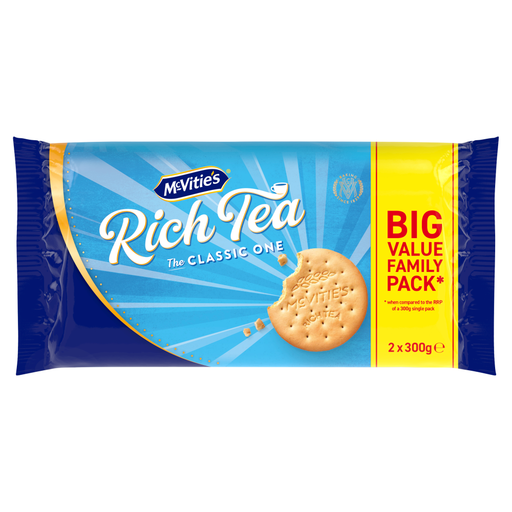
This McVitie’s twin pack is an option for serving rich tea at a meeting. Check the sugar figures for this exact pack if a reduced-sugar choice is part of your plan.
 No image available
The two 300g packs provide a format for meeting refreshments. Check the packaging for sugars per 100g, sugars per biscuit, allergens and biscuit count before choosing it for a lower-sugar brief or planning individual servings.
No. McVitie’s says Rich Tea The Light One has 30% less sugar than a typical semi-sweet biscuit, and lists 12.8g sugars per 100g. The NHS guide describes 5g total sugars or less per 100g of food as low.
Work from the number of servings you plan to offer and the count for the exact pack. McVitie’s lists approximately 36 biscuits in a 300g pack of The Light One, while Waitrose lists approximately 50 fingers in its 250g pack; neither count predicts how many attendees will take one.
Check the ingredients and precautionary statements on the current pack, and keep it available when serving. McVitie’s, Tesco and M&S list different allergen information for the biscuits discussed here; “reduced sugar” is not an allergen assurance.
Not necessarily. The Food Standards Agency says food businesses producing food prepacked for direct sale must provide the food’s name and a full ingredients list with allergenic ingredients emphasised. Whether that rule applies depends on how and where the food is packed and offered; setting out biscuits from a retail pack does not by itself establish that arrangement.