Families sharing one hotel room
A 2 x 300g Rich Tea pack is worth considering when several people will have tea more than once. McVitie’s lists this format, and Asda describes it as a 600g pack.


Choose a 2 x 300g Rich Tea twin pack when several people will share hotel-room tea over repeated sittings: Asda lists the McVitie’s pack as 600g with a typical 72 biscuits. For one or two people on a short stay, a 200–300g pack or 250g finger pack may leave less unused; whichever format you choose, check the exact pack’s allergen and storage information before serving it.
A 2 x 300g Rich Tea pack is worth considering when several people will have tea more than once. McVitie’s lists this format, and Asda describes it as a 600g pack.
A 200–300g standard pack or 250g finger pack may be easier to use during a brief stay. Choose by how many tea breaks you expect, rather than assuming a larger pack will be finished.
Check the packaging and allergen information for the exact product. If staff repack biscuits, how and where they package and present the portions affects which food-labelling rules apply.
Start with the number of people and tea breaks, then check whether the packaging, label and storage directions suit how the biscuits will be served.
| Priority | What to check | Your needs |
|---|---|---|
| Pack quantity | Compare total weight and pack configuration. McVitie’s lists a 2 x 300g format; Asda gives its total as 600g and the typical biscuit count as 72. Smaller listed formats include 200g, 250g and 300g. | Will several of us share tea across the stay, or am I likely to leave much of a large pack unused? |
| Serving format | Check the actual inner packaging if you need separate guest portions. A 2 x 300g label identifies two pack units, not individually wrapped biscuits; a finger shape does not establish wrapping either. | For a shared room, a pack to open together may suit us. For separate guest trays, I need to inspect how each portion is packaged. |
| Allergen information | Read the current label for the exact product. Asda lists wheat and barley, with possible soya, for the McVitie’s twin pack. M&S gives milk, nut and peanut allergy cautions for its own 300g Rich Tea. | If I’m serving someone with an allergy, the biscuit type alone cannot tell me whether that particular pack is suitable. |
| Storage | Follow the selected pack’s directions. Asda says to keep the McVitie’s twin pack in a cool, dry place; M&S and Sainsbury’s finger-biscuit listings advise airtight storage after opening. | Can I keep an opened pack as its label directs between tea breaks, especially if the stay lasts several days? |
Two 300g pack units do not establish that each biscuit is separately wrapped. That distinction matters when biscuits are being laid out on individual guest trays.
Inspect the packaging before using a twin pack for that purpose, or choose a product explicitly packaged in the portions you need.
Asda lists a typical 72 biscuits in the McVitie’s twin pack, which may be more than one person expects to use on a short trip.
Count the people and likely tea breaks first; consider a 200–300g pack or 250g finger pack if the larger quantity is unlikely to be used.
Allergy advice differs between products: the McVitie’s twin-pack listing names wheat and barley and possible soya, while M&S gives additional allergy cautions for its own biscuits.
Read the current label of the exact pack and keep its packaging available when serving biscuits to others.
M&S advises customers to read the label because product information can change. An earlier listing should not be the final ingredient record for a guest with an allergy.
Check ingredients, allergy advice and storage directions on the pack received.
McVitie’s lists Rich Tea Classic in 200g and 300g sizes, including a 2 x 300g format.
Tesco lists the McVitie’s Rich Tea 2 x 300g twin pack.
Sainsbury’s lists a 200g Rich Tea pack and a 250g Rich Tea Fingers pack.
M&S lists a 300g Rich Tea pack.
Waitrose lists a 250g Rich Tea Finger Biscuits pack.
These options include a McVitie’s Rich Tea twin pack for shared tea breaks and a larger Parle-G glucose-biscuit pack. Parle-G is a different type of biscuit, so it is an alternative only if Rich Tea is not essential.
 No image available
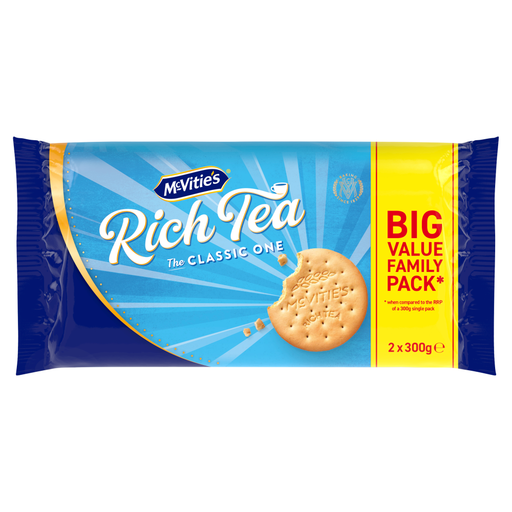
The two 300g packs suit shared tea breaks when the group is likely to use a 600g supply. Asda lists a typical 72 biscuits for this McVitie’s format and declares wheat and barley, with possible soya. Check the current label before serving; a twin pack does not establish individual biscuit wrapping.
 No image available
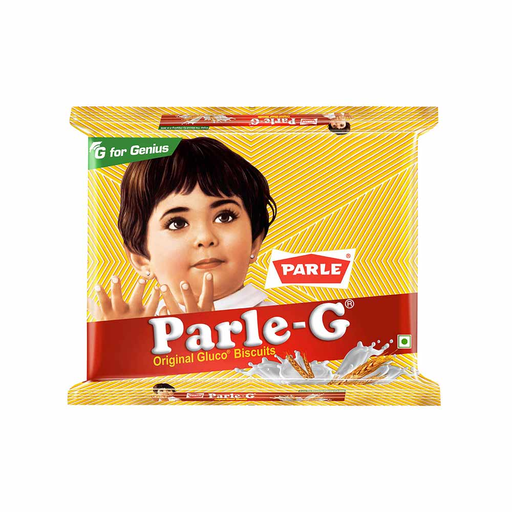
This 799g family pack is a glucose-biscuit option for sharing with tea, not a Rich Tea pack. Check the current ingredients and allergen label before serving it to guests.
It can suit a room where several people will share tea over repeated sittings: Asda lists the McVitie’s pack as 600g with a typical 72 biscuits. For one person on a brief stay, consider whether a smaller pack would be used more fully.
No: 2 x 300g identifies two pack units, not the wrapping of each biscuit. Inspect the actual packaging if you need separate guest portions.
Follow the directions on the chosen pack. Asda’s McVitie’s twin-pack listing calls for a cool, dry place, while the M&S Rich Tea and Sainsbury’s Rich Tea Fingers listings advise airtight storage after opening.
The labelling requirement depends on how and where the hotel packages and presents the biscuits. The Food Standards Agency says that food businesses producing prepacked for direct sale food in England, Wales and Northern Ireland must label it with the food name and a full ingredients list with allergenic ingredients emphasised. Food Standards Scotland describes a corresponding requirement for food made on site and prepacked for direct sale in Scotland, in place since 1 October 2021. Check the relevant regulator’s guidance for the actual serving arrangement rather than treating an unopened retail pack and a repacked portion as identical.
No. Asda lists wheat and barley and possible soya for the McVitie’s twin pack; M&S says its own 300g Rich Tea is not suitable for people with milk, nut or peanut allergies. Read the current label of the exact product before serving it to someone with an allergy.