Hosts planning several family teas
A 2 × 300g twin pack lets you open one packet while leaving the other sealed for a later occasion. Compare its total quantity with the number of single packets you would actually use.


Choose a 2 × 300g twin pack if you expect several afternoon teas and want to keep one packet sealed until later. For a smaller gathering, consider a single packet; before serving any Rich Tea biscuit, check the exact pack and any guest-specific allergy, carbohydrate or swallowing requirements rather than making assumptions based on age.
The useful quantity depends on how many teas you are planning and whether an opened packet will be used.
A 2 × 300g twin pack lets you open one packet while leaving the other sealed for a later occasion. Compare its total quantity with the number of single packets you would actually use.
A 200g packet, or a 250g packet of finger biscuits if that shape is preferred, may be closer to the quantity needed. Follow the chosen packet’s storage directions after opening.
Ask guests about known allergies and any advice they follow about carbohydrate or swallowing. Being an older guest does not, by itself, establish any of these requirements.
Start with the number of occasions you are serving, then check the particular biscuit and its label against your guests’ requirements.
| Priority | What to check | Your needs |
|---|---|---|
| Pack quantity | Compare a 2 × 300g twin pack with the available 200g, 250g and 300g formats. Count how many packets you expect to open across your planned teas. | I’m serving biscuits more than once and would like to leave a packet sealed; for one small gathering, I may only need a single packet. |
| Allergens | Read the ingredients and precautionary statements on the exact pack. The Tesco, Asda and M&S Rich Tea listings carry different allergen wording. | Before offering biscuits to a guest with an allergy, I want to check the product they will actually be served. |
| Carbohydrate information | If it is relevant to a guest’s individual plan, use the exact product’s carbohydrate figure and serving size rather than its sugar figure alone. Tesco Groceries lists 6.9g carbohydrate per 9.6g biscuit for its 300g Rich Tea packet. | For a guest who tracks carbohydrate, I need the figure for this biscuit, not a per-biscuit figure borrowed from a different size or brand. |
| Swallowing texture | Kent Community Health NHS Foundation Trust identifies dry biscuits among textures that can be difficult for people with dysphagia. Follow the individual’s swallowing guidance; finger shape and dunking do not establish suitability. | If a guest has swallowing difficulties, I’ll check what they have been advised to eat before putting out crisp biscuits. |
| Storage after opening | Follow the selected pack’s directions, including any airtight-container instruction. Waitrose recommends consuming its Rich Tea fingers within seven days of opening for best quality. | Biscuits might be left after tea, so I want a quantity I can store and use in line with that pack’s directions. |
For someone with dysphagia, a dry biscuit can be a difficult crunchy or crumbly texture, according to Kent Community Health NHS Foundation Trust.
Ask about that person’s swallowing guidance before serving. Do not treat a finger shape or dunking as a substitute for it.
Biscuits also contain carbohydrate beyond the amount listed as sugars, and per-biscuit figures can refer to different biscuit sizes.
If carbohydrate matters to a guest’s individual plan, check the exact packet’s carbohydrate figure and serving size.
The Tesco, Asda and M&S product listings give different precautionary or suitability statements. One brand’s label cannot establish what is in another brand’s biscuit.
Ask the guest about their allergens and read the physical label of the exact pack before serving.
These packet details help distinguish formats and labels; they do not mean that every product in each brand’s range has the same ingredients or storage directions.
Its conventional Rich Tea twin pack contains two 300g packets for serving across more than one occasion.
Its own-label Rich Tea comes in a 300g packet, allowing hosts to choose how many packets to buy.
Its own-label Rich Tea is a 300g packet; Asda suggests approximately 39 servings.
Its own-label Rich Tea comes in a 200g packet for a smaller anticipated quantity.
Its 300g Rich Tea packet is described by M&S as an accompaniment to afternoon tea.
Its Rich Tea fingers offer a different biscuit shape in a 250g packet.
This twin-pack option is relevant if you are planning several teas and want to open its two 300g packets at different times.
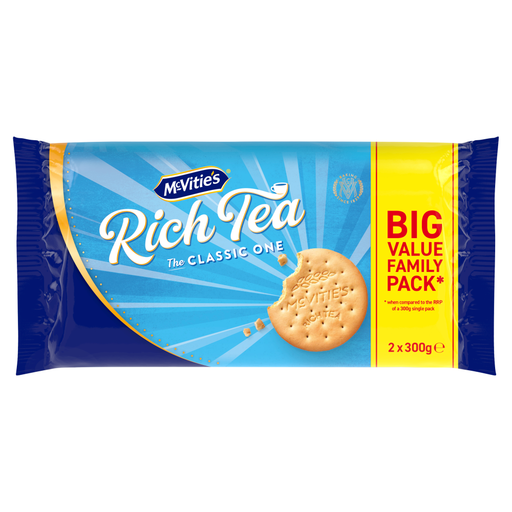 Image unavailable
The two-packet format lets you keep one 300g packet sealed for a later afternoon tea.
This product contains wheat and barley and may contain soya; check the physical pack for current allergen information. If a guest has swallowing difficulties, follow their individual guidance before serving a dry biscuit.
Follow the chosen packet’s instructions. The Tesco, Asda and Sainsbury’s listings give airtight-container directions after opening; Waitrose also recommends consuming its Rich Tea fingers within seven days of opening for best quality.
Do not assume an ordinary dry biscuit is suitable. Kent Community Health NHS Foundation Trust identifies dry biscuits as potentially difficult crunchy or crumbly textures for people with dysphagia; follow the person’s swallowing guidance. The NHS advises seeking medical help for symptoms such as coughing or choking while eating.
Use the carbohydrate information and serving size on the exact Rich Tea packet alongside the guest’s individual plan. Per-biscuit figures can differ when biscuit sizes or recipes differ, so a figure from another packet may not apply.
Read the ingredients and any precautionary statement on the exact physical pack. UK food-labelling guidance from the Department for Environment, Food & Rural Affairs and the Food Standards Agency requires ingredients, including allergens, to be listed for prepacked food; the checked Rich Tea products have different allergen statements.