Households sharing a daily tea break
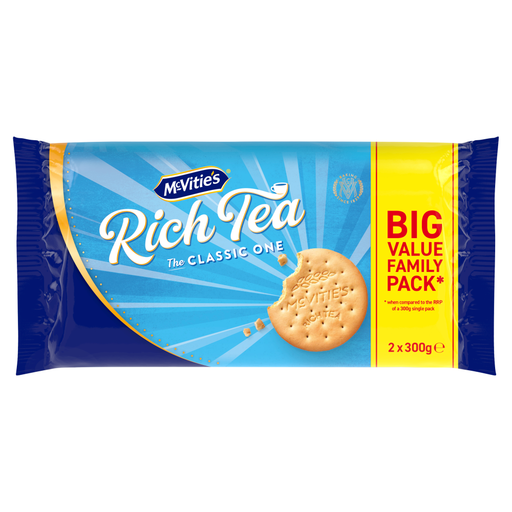
A 2 × 300g twin pack gives you two separate packets for repeat morning breaks. Plan how you will store the first packet after opening it.


Choose a 2 × 300g twin pack if your household regularly shares Rich Tea biscuits and will use both packets; the second can stay unopened while you use the first. If biscuits are an occasional part of your morning tea break, consider a single 300g packet or a smaller 200g or 250g option. Whichever size you choose, check its storage instructions, compare nutrition per 100g and read the packet’s allergen information before sharing.
A 2 × 300g twin pack gives you two separate packets for repeat morning breaks. Plan how you will store the first packet after opening it.
A 200g round-biscuit packet or 250g finger-biscuit packet may be a more manageable quantity than a twin pack. Check the chosen packet’s after-opening guidance.
Compare the ingredients and precautionary allergen statements on the exact packet you intend to share. The listed standard Rich Tea recipes contain wheat and barley; a gluten-free alternative may contain other allergens.
Start with the quantity your household is likely to use, then check storage, nutrition and ingredients for the particular biscuits you are considering.
| Priority | What to check | Your needs |
|---|---|---|
| Packet quantity | Compare two separate 300g packets with a single 300g, 200g or 250g packet. Check whether a smaller option has the round or finger shape you want. | For regular shared breaks, I could use one packet while keeping the other unopened. If we eat biscuits less often, I would rather open a smaller supply. |
| Storage after opening | Read the chosen packet’s storage instructions. Waitrose & Partners recommends an airtight container and consumption within seven days of opening its Rich Tea Fingers for best quality. | If a packet will last several mornings, I need a practical way to store it and to follow any product-specific quality guidance. |
| Nutrition comparison | Compare sugars and other nutrition figures per 100g when biscuit sizes differ. Use per-biscuit figures to understand the amount in the biscuits you serve. | Different-sized biscuits make per-biscuit numbers hard to compare directly; I want to compare recipes on the same weight basis. |
| Ingredients and allergens | Check the exact packet’s ingredients and precautionary statements. The listed standard recipes contain wheat and barley; the listed Schär gluten-free alternative contains egg and milk. | Everyone sharing the biscuits needs an option that fits their own ingredient and allergen requirements, not one chosen by product name alone. |
Biscuits can differ in size, so a smaller per-biscuit sugar figure does not establish a lower-sugar recipe by equal weight.
Compare the labels per 100g first, then use per-biscuit figures for the number you plan to serve.
Products sold as Rich Tea can have different ingredients and precautionary warnings. Asda’s listed vegan Rich Tea, for example, carries a precautionary milk warning.
Read the ingredients and allergen information on the particular packet before sharing it.
McVitie’s lists Classic Rich Tea in single-packet and 2 × 300g formats, as well as a separate The Light One recipe.
Tesco lists a 300g packet of round Rich Tea biscuits.
Sainsbury’s lists a 200g packet of round Rich Tea biscuits.
Asda lists a 300g Rich Tea packet with a vegan designation.
M&S lists a 300g packet of Rich Tea biscuits.
Waitrose lists 250g Rich Tea Fingers, a different shape from round Rich Tea biscuits.
This twin-pack option is for households considering two separate packets for regular morning tea breaks.
 No image available
Two 300g packets let a household open one for morning tea breaks while keeping the other unopened. Check the delivered packet’s allergen information and storage instructions before serving.
Follow the instructions on your chosen packet. Waitrose & Partners recommends an airtight container and consumption within seven days of opening its Rich Tea Fingers for best quality; check other packets for their own guidance.
No. A vegan designation does not replace an allergen check: Asda’s listed vegan Rich Tea carries a precautionary milk warning, while M&S states that its Rich Tea is unsuitable for people with a milk allergy. Read the particular packet before serving.
Check both the ingredients and any precautionary statements on the exact packet. The listed standard Rich Tea recipes contain wheat and barley, while the listed Schär gluten-free alternative contains egg and milk; one product’s label cannot stand in for another’s.