A ring light is a practical choice for a close bookbinding demonstration when the camera can sit near its centre and the light covers the work without obstructing your hands. Check dimming, colour settings, mounting and stand stability; for a wider table or troublesome reflections, a separately positioned light with a compatible modifier gives you more control over placement, but needs a larger setup.
Who needs which setup?
Overhead close-up tutors
If stitches, folds, glue application or cutting fill the frame, consider how clearly the light lets the camera show materials and hand movements. Declared colour-rendering information and adjustable colour settings are more useful checks than wattage alone.
Solo phone-first instructors
If you record alone with a phone near the light, check that its holder and stand support the framing you need. A camera-centred kit can simplify the arrangement, provided the mount does not block your view of the book.
Workshop-scale demonstrators
If the work spreads across a larger table or reflections interfere with the shot, consider a light positioned separately from the camera. A COB video light with a compatible modifier offers placement choices, while requiring more space and mounting equipment.
What matters when choosing?
Camera-centred ring light
Choose it when: Your bookbinding work stays in a close frame and the phone or camera can sit near the ring's centre.
Allow for: A centred light position may need adjusting if hands cast shadows or materials reflect the ring.
Off-axis light with modifier
Choose it when: A broad work surface or reflective materials make separate light placement more important.
Allow for: A compatible modifier, stand and room around the table need planning.
| Concern | What to check | Who this matters to |
|---|
| Material colour and detail |
Declared CRI or TLCI, available colour temperatures and dimming. |
If I demonstrate subtle differences between paper, thread and leather, I need those details to remain distinguishable on camera. Around 40% of consumers would put colour and close-up detail first. |
| Shadows, reflections and coverage |
Camera and light positions, work-area size and whether an off-axis modifier can be mounted. |
When my hands move across a wide or reflective surface, I need a lighting position that does not obscure the work. Controlling direction and coverage would come first for around 30% of consumers. |
| Solo setup and stability |
Included holder and stand, tripod footprint, and power for the recording duration. |
If I film alone, I need the phone and light to stay secure through a lesson without repeatedly rebuilding the setup. Around 30% of consumers would make ease of setup and stability their primary concern. |
Setup mistakes to avoid
-
Assuming a portrait ring light fits an overhead demonstration
Phone and camera mounts are useful only if they allow the book, tools and both hands to remain in frame. Centred lighting can also produce unwanted reflections on some materials.
Mock up the camera angle over your worktable before choosing a mount. If you need to move the light away from the lens, assess a separate light and modifier instead.
That change of position may also call for an additional arm, stand or compatible modifier.
-
Comparing brightness figures without their test conditions
NEEWER quotes up to 5,500 lux for the RL-18 at 0.5 m, while SmallRig gives RC 120B figures at 1 m both bare and with its supplied reflector. Those readings do not establish a like-for-like brightness order.
Compare illuminance at the same distance and with the modifier condition stated. Then check whether that light position stays outside your shot.
-
Overlooking power and stand placement
A battery-powered light and a mains-powered stand kit place different demands on a long recording. Godox quotes approximately 1.5 hours at full brightness for the SR20R; NEEWER advises fully widening its kit stand's tripod legs.
Check the supplied power arrangement against your lesson length, open the stand as instructed and route cables away from the working area.
Relevant brands for reference
NEEWER
A reference point for a large ring-light kit with a stand and camera or phone mounting accessories.
- NEEWER UK lists a 45 cm RL-18 ring, 0–100% dimming, CRI 95 and a UK-plug kit configuration.
- Its stated 3200 K and 5600 K choices use filters rather than a continuous colour-temperature range; the stand legs should be fully spread.
Godox
A reference point for compact, phone-oriented lighting rather than a large floor-standing ring kit.
- Godox lists 2800 K–6500 K adjustment, CRI and TLCI of at least 96, and USB-C charging during shooting for the Litemons SR20R.
- Its quoted full-brightness battery runtime is approximately 1.5 hours, so longer lessons need a power plan.
SmallRig
A reference point for a separately positioned COB light when the camera-centred shape of a ring is restrictive.
- SmallRig lists 2700 K–6500 K control and a Bowens mount for the RC 120B, allowing a compatible light-shaping accessory to be considered.
- It is not a compact ring kit; a stand and suitable modifier need planning for softened tabletop lighting.
amaran
A reference point for a colour-capable COB fixture in a separately rigged lighting setup.
- Aputure's amaran 150c specifications list a 2500 K–7500 K range and CRI and TLCI ratings of at least 95.
- Lighting a bookbinding table with this fixture requires separate choices about mounting and light shaping.
Joybuy products for close-up filming
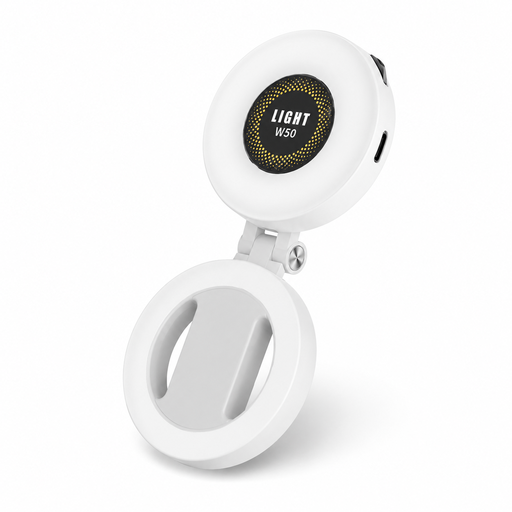
This compact, phone-oriented light is a choice to assess for a close bookbinding shot. Its mounting position matters especially if you plan to film from overhead.
 No image available
VoxorAI M28 White Magnetic Selfie Fill Light with Mirror
Consider it for close, phone-centred filming where you can position the light without blocking the book or your hands.
The product name describes magnetic attachment, a mirror, iPhone and Android compatibility, and a stated CRI 95+ rating. Check how you would secure it for an overhead shot, and confirm the supplied version's battery capacity and recording runtime.
View on Joybuy
Questions about filming bookbinding
Is an 18-inch ring light enough for a bookbinding lesson?
It can suit a close, camera-centred demonstration if its mount holds the required framing and the light reaches the work area. NEEWER lists a 45 cm RL-18 ring with dimming, but its size alone does not establish even coverage across your table; frame the book and both hands before recording a full lesson.
Are colour-temperature filters enough, or should I look for continuous adjustment?
Filters can suit a simple warm-or-daylight arrangement; continuous adjustment offers intermediate settings if the room lighting does not visually match either choice. NEEWER lists 3200 K and 5600 K filters for the RL-18, while Godox lists 2800 K–6500 K adjustment for the SR20R.
How should I position a ring-light stand beside the worktable?
Place the stand on a level surface with its legs and cable clear of your working position. NEEWER instructs users to widen the RL-18 kit stand's tripod legs fully for stability; also check that the mounted camera can show the book, tools and both hands.
Must a light bought for Great Britain carry a UKCA mark rather than a CE mark?
Not necessarily: Department for Business and Trade guidance dated 21 August 2026 says Great Britain continues to recognise CE marking alongside or instead of UKCA marking for covered product requirements. Check the requirements applicable to the exact electrical light supplied; this Great Britain position covers England, Scotland and Wales, while Northern Ireland has separate arrangements.


