Dinner-party host focused on a thorough check
If you want to confirm that the chicken is cooked through rather than judge it by timing or colour alone, prioritise a probe you can place cleanly in the centre and read clearly.


Choose an instant-read digital probe if you need a final core-temperature check before serving roast chicken; choose a purpose-built leave-in or wireless thermometer if you want to monitor the bird as it cooks. Check the exact model’s oven-use instructions, because an ordinary hand-held probe must not be assumed safe to leave in the oven. GOV.UK’s food-business guidance advises checking the centre with a clean probe and gives 70°C for two minutes or 75°C for 30 seconds as safe cooking combinations.
If you want to confirm that the chicken is cooked through rather than judge it by timing or colour alone, prioritise a probe you can place cleanly in the centre and read clearly.
If you mainly want a quick check near the end of cooking, an instant-read probe offers manual measurements without app setup. Consider whether its display and storage design will suit your kitchen.
If you need to follow the temperature while preparing other dishes or greeting guests, look for a thermometer explicitly designed to remain with the chicken during cooking. Remote readings are an additional option if you are happy to use a compatible device.
Choose it when: You plan to check the chicken manually near the end of roasting.
Trade-off: You must take each reading yourself and wait for it to stabilise; do not leave the probe in the oven unless its instructions expressly allow it.
Choose it when: You want to watch the chicken’s temperature rise without taking repeated manual readings.
Trade-off: The probe, cable and their placement must follow that model’s oven-use instructions.
Choose it when: Viewing the roast’s temperature on a compatible phone or tablet would help while you attend to other dishes or guests.
Trade-off: You must account for charging, app compatibility and the model’s limits for meat temperature and cooking conditions.
| Concern | What to check | Who this matters to |
|---|---|---|
| Core-temperature check | Look for Celsius readings covering the cooking temperature you intend to check, a legible display and probe-care instructions. | I want to know the chicken is cooked through before serving guests, so a reading from its centre matters more to me than its colour or cooking time. Around 36% of consumers put that core-temperature check first. |
| Monitoring during cooking | Confirm explicit oven-safe instructions for a leave-in model; for wireless use, check device compatibility and the stated temperature limits. | While I prepare the rest of dinner, I want to follow the roast without returning to the oven for each reading. For around 29% of consumers, monitoring during cooking is the primary need. |
| Quick final readings | Compare the stated response time, display angle and whether a cover, folding probe or hold function would help you read it. | I expect to take one or two readings just before serving and want the number to be easy to see while handling a hot roasting tin. Quick manual checks come first for around 21% of consumers. |
| Occasional use | Check for a suitable Celsius range, a cleanable probe and practical storage before paying for monitoring features you may not use. | If roast dinners are occasional, I would rather choose a straightforward manual thermometer than set up a connected one for a final check. Around 14% of consumers chiefly prioritise that simpler purchase. |
An instant-read thermometer is not necessarily built for prolonged oven exposure. Food Standards Agency guidance says general digital probes are not suitable to go in the oven.
Leave a probe in the chicken only if the exact model’s instructions explicitly permit that use.
A surface reading does not establish the chicken’s core temperature, and an unclean probe can transfer contamination between foods.
Following GOV.UK and Food Standards Agency guidance, clean and disinfect the probe, insert it into the centre of the thickest part, wait for the reading to stabilise, and clean and disinfect it again after use.
A manufacturer’s quick-reading claim does not establish that you have measured the chicken’s centre correctly or that the thermometer can remain in the oven.
Check the display, temperature range and intended use as well as the stated response time.
Remote readings offer little extra help if you only want a final check. A wireless model also has device and cooking-condition requirements.
Before choosing one, confirm app compatibility, charging requirements, temperature limits and permitted cooking methods for the exact model. MEATER says MEATER Plus is not recommended for grilling over an open fire.
Thermapen ONE is a hand-held instant-read option for cooks who value a fast stated response and a display that can be viewed from different angles.
Salter’s foldaway instant-read model is suited to manual checks of roasts and other food.
The Taylor Pro digital probe offers a manual reading with an extended handle and a reading-freeze function.
OXO’s Chef’s Precision Digital Instant Read Thermometer focuses on viewing the reading from different angles.
MEATER Plus is a wireless route for monitoring a roast through a compatible device.
This instant-read option is relevant if you plan to check roast chicken manually near the end of cooking, rather than monitor it throughout the roast.
 No image available
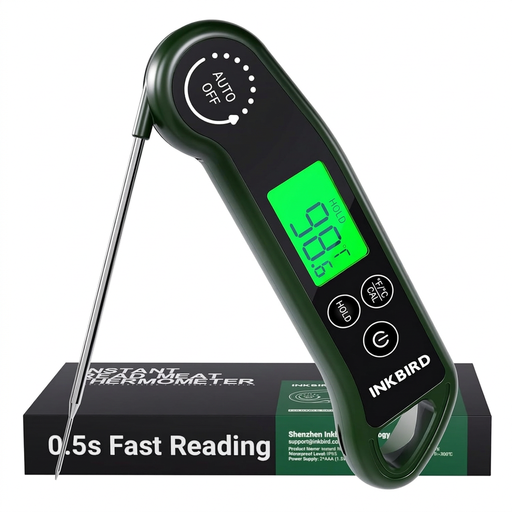
For a manual check near the end of roasting, this digital meat thermometer is presented for roasting use.
Its product title advertises a 0.5-second instant reading and an LCD screen. Before using it to check the chicken’s centre, confirm that it reads in Celsius, covers the temperature you need and has suitable probe-cleaning instructions.
Do not leave it in the oven unless the instructions for this exact model explicitly permit it.
GOV.UK’s food-business guidance gives a core temperature of 70°C for two minutes, with 75°C for 30 seconds as another safe time-and-temperature combination. Use a clean probe in the centre of the thickest part of the chicken and check that it is cooked all the way through.
No: an ordinary digital probe should not be assumed oven-safe. Food Standards Agency guidance says general digital thermometers are not suitable for oven use, so choose a leave-in or wireless model only when its exact instructions permit the intended cooking conditions.
Clean and disinfect the probe before inserting it into food and again after use, following Food Standards Agency guidance. Follow the thermometer manufacturer’s instructions for checking its accuracy and for cleaning the particular model.
Choose wireless monitoring if seeing the temperature while you prepare other dishes or greet guests would be useful; an instant-read probe is a simpler fit for a final manual check. For a wireless model, confirm app compatibility, charging needs, temperature limits and permitted cooking methods before buying.