
24/7 Customer Support

Free returns

Same-day & Next-day Delivery

Quality Guaranteed

Unlock Your Welcome Offers: FREE Delivery | Up to 80% OFF | Free 30-day JoyPlus trial
Download the APP
A robot lawn mower can keep grass under control without pushing a machine around every weekend. However, choosing the wrong model may leave you with incomplete coverage, unreliable navigation or a device that struggles with your garden layout.
Before buying an automatic lawn mower, look beyond app screenshots and headline coverage figures. Three common traps deserve particular attention:
The right choice depends on your lawn’s size, shape, surface and how much setup you are prepared to manage.
Start by measuring the actual grass area rather than the entire plot. Paths, patios, flower beds and sheds should not be included in the mowing area.
For a lawn mower for small gardens, a compact model with a 300–600 m² rating may be more practical than a larger machine. For medium-sized lawns, consider models rated for 800–1,200 m², but allow capacity for irregular layouts and slower mowing around obstacles.
If you have front and rear lawns, separated sections or narrow side passages, check for multi-zone management. A smart lawn mower may allow different schedules or virtual boundaries for each area, but not every model supports this.
A traditional robotic mower often relies on a perimeter wire. This can provide a clearly defined mowing zone, but installation takes time and the cable may require adjustment after landscaping work.
A wire-free robot lawn mower may use one or more of the following:
When comparing a robotic lawn mower UK shoppers can use throughout changing weather and daylight conditions, read the operating requirements carefully. A system that performs well in an open lawn may need more planning in a garden with overhanging trees, dense borders or poor signal coverage.
Check the manufacturer’s stated slope limit and compare it with your garden. A mower rated for a 40% slope is not necessarily appropriate for every uneven surface, especially where the ground is wet or rutted.
Cutting height is also important. Adjustable settings allow you to adapt mowing for seasonal growth and grass condition. Edge-cutting functions can reduce the strip left beside walls and borders, but most robotic models may still leave some areas requiring occasional manual trimming.
For safety, keep children and pets away while the mower is operating, follow the supplied instructions and switch the machine off before clearing grass or inspecting the blades. Also check the product’s stated weather resistance rather than assuming that every automatic lawn mower can remain outside in all conditions.
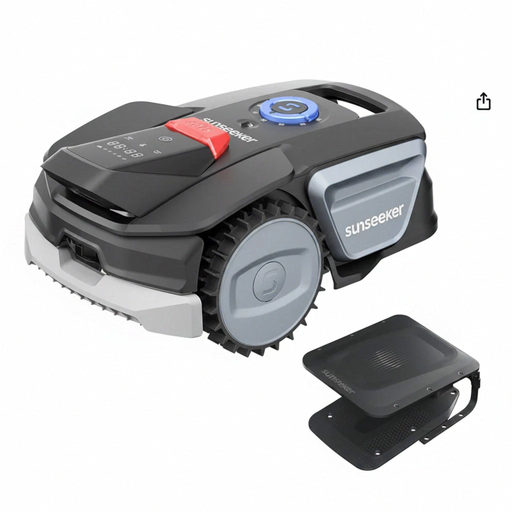
Why This Fits Their Persona: Designed for smaller lawns up to 300 m², this compact option suits UK homeowners wanting automated mowing without moving straight to a large, complex system.
Its stated capacity gives small-garden buyers a clearer comparison point, while AI vision and smart obstacle avoidance address common concerns about collisions and navigation.
Wireless boundary operation, app control, charging base and a stated slope capability of up to 27%.
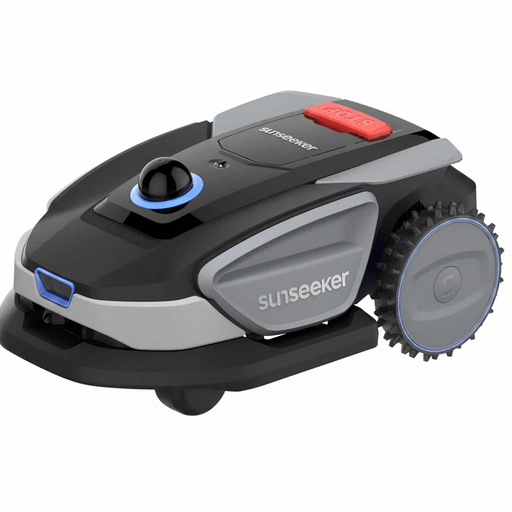
Why This Fits Their Persona: Suitable for buyers who want a more advanced mapping setup for a lawn up to 1,000 m², especially where app control and divided mowing areas are useful.
Its combination of 360° LiDAR, AI vision and auto-mapping gives buyers specific navigation technologies to assess rather than relying only on a generic “smart” label.
Stated 1,000 m² coverage, multi-zone support, AI obstacle avoidance and app control.
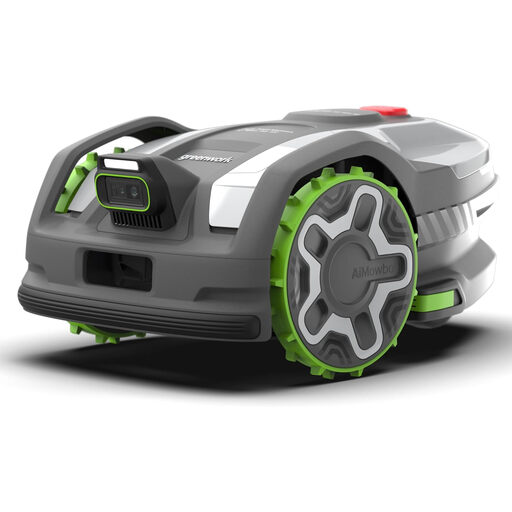
Why This Fits Their Persona: A practical match for owners of irregular or moderately challenging lawns who want virtual boundaries, no-go zones and scheduled mowing through an app.
RTK plus vision navigation provides a defined alternative to relying on cameras alone, while the installation instructions make clear that the RTK mast needs suitable positioning.
200 mm cutting width, 20–90 mm height adjustment, 3D ToF obstacle avoidance and IPX5-rated housing.
We have compiled a complete, real-time list of products that fully satisfy these strict selection criteria and UK safety regulations.
A robot mower suits people who prefer regular automated maintenance. A cordless lawn mower may be more suitable when you want to cut long grass quickly, collect clippings or control the exact mowing pattern yourself.
For narrow lawns and gardens with a small footprint, the Gtech SLM50 has a 25 cm cutting width, weighs 3.5 kg and offers up to 30 minutes’ runtime per charge. For larger manual mowing tasks, the Stanley FatMax 18V model has a 51 cm cutting deck, 40-litre collection bag and stated coverage of up to 750 m².
Corded and petrol models remain alternatives where continuous operation or higher manual cutting power matters. A corded model avoids battery charging but requires cable management. A petrol mower can suit larger or rougher areas, although it brings fuel storage, engine maintenance and noise considerations.
Yes, provided the mower’s minimum operating requirements match the space. Check the rated coverage, turning space, slope limit and whether it can manage narrow passages. A smaller model may be easier to position and store.
It depends on the model. Some use Wi-Fi for app control, while others support 4G or RTK equipment. If your garden has weak Wi-Fi, check whether mobile data requires a separate subscription and whether basic mowing remains available without a connection.
Regularly clear grass from the deck and wheels, inspect the blades and keep charging contacts clean. Follow the supplied guidance for winter storage and battery care. Even a smart lawn mower benefits from occasional checks of its map, boundaries and mowing schedule.