
24/7 Customer Support

Free returns

Same-day & Next-day Delivery

Quality Guaranteed

Unlock Your Welcome Offers: FREE Delivery | Up to 80% OFF | Free 30-day JoyPlus trial
Download the APP
Choosing robot toys for children can be surprisingly difficult. Product listings often highlight lights, sounds and “smart” functions, while leaving out details that matter in everyday family use: battery requirements, small parts, floor space and whether the activity suits the child’s actual interests.
A robot that looks exciting in a photograph may spend most of its time in a cupboard if the controls are too complicated or the play pattern is repetitive. Before buying, check these common pitfalls.
LED eyes, music and dance modes can attract attention, but they may offer limited replay value if children cannot create, programme or control anything themselves. Look for functions that encourage decision-making, construction, sequencing or problem-solving alongside visual effects.
For example, a programmable robot toy may offer more varied play than a model with only pre-set movements. However, programming through a remote control is not the same as coding with software, so read the product description carefully.
“Educational toys for ages 3 to 14” cover a very wide range of abilities. A three-year-old may need simple, supervised controls, while an older child might expect construction, chess strategy or programmable actions.
Always check the manufacturer’s stated age guidance, warnings and included components. Small parts can present a choking hazard, and some STEM kits require direct adult supervision. Remove all packaging before use and keep button or rechargeable batteries away from young children.
A product may include a rechargeable robot battery but still require separate AA batteries for the remote control. Other toys may require replacement batteries more frequently, particularly when motors, lights and speakers are used together.
Before purchase, check:
Decide whether the child would prefer buttons, gestures, an app or physical construction. A gesture-sensing robot can provide immediate movement through an infrared sensor, whereas a remote control offers more precise commands. For younger children, fewer controls may be easier to understand; older children may appreciate action programming or app connectivity.
If considering an AI chess robot, electronic chessboard or smart chess set, check exactly what “AI” means in the listing. It may refer to automated move detection, app connectivity or a robotic arm that moves pieces. Look for information about power, board size, portability and whether the app is required.
A STEM robotics kit should clearly state what children assemble and what the finished model does. Check whether the kit involves gears, motors, sensors or simple snap-together parts. A build-your-own robot can be rewarding, but it may require patience and adult help.
For moving kits, consider the intended surface. A climbing robot toy that travels along a rope needs a suitable setup and enough vertical clearance. It is not automatically suitable for unsupervised play or every household layout.
Look for clear product information covering dimensions, battery safety and age recommendations. Where applicable, buyers should check that toys carry the appropriate UK market markings and have clear importer or manufacturer information. These details should not be inferred from photographs alone.
For electronic toys, inspect charging instructions and stop using the product if the battery becomes swollen, unusually hot or damaged. Keep cables and loose accessories away from younger children.
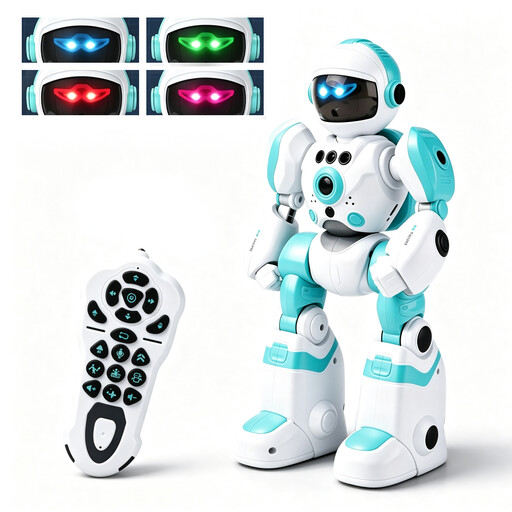
Why This Fits Their Persona: A practical starting point for children who want movement, music and remote-controlled play without assembling a complex kit. It is suitable for parent-child play at home, subject to the stated age warning.
It provides more than one interaction method: remote control and gesture sensing. Action programming and recording also add variety beyond lights and pre-set dancing.
Includes a 3.7V 200mAh rechargeable robot battery, four-colour LED eyes, music, dance, recording and programmable actions. The remote requires two AA batteries, which are not included.

Why This Fits Their Persona: A suitable choice for households where chess is the main interest and a compact, portable smart chess set would be used by children or adults.
Its purpose is clearly defined around chess rather than relying only on lights or sound. Check the required app connection and playing setup before ordering.
Features a robotic arm, electronic chessboard, app connection, portable format and support for 3D-printed DIY chess pieces. The listing indicates in-stock, next-day delivery.
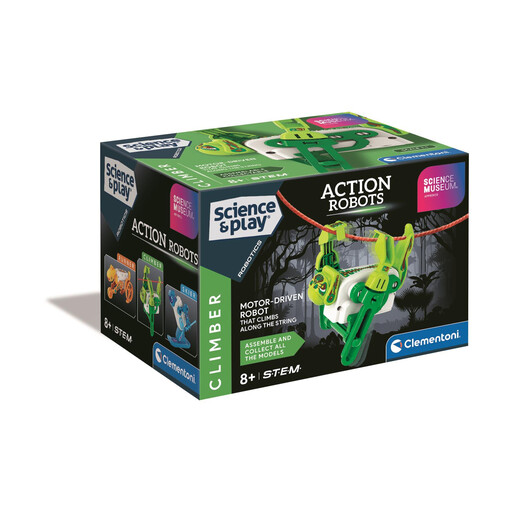
Why This Fits Their Persona: Designed for children aged 8 to 14 who enjoy building, mechanical movement and screen-free STEM activities rather than simply pressing movement buttons.
The play involves assembling the mechanism and setting up a rope or wire, so the child has a defined engineering challenge instead of a short novelty routine.
Includes a central electronic module, gears and an illustrated assembly manual. It requires two AA batteries, not included, and adult supervision is recommended. The kit contains small parts and is not suitable under age 8.
We have compiled a complete, real-time list of products that fully satisfy these strict selection criteria and UK safety regulations.
Use the child’s existing interests as the starting point:
Many are intended for indoor play, but the required space varies. Dancing and remote-controlled robots need a clear floor, while a climbing robot toy requires a secure rope or wire setup. Keep moving toys away from stairs, water, heat sources and fragile objects, and supervise younger children.
Running costs depend mainly on battery type and usage. A rechargeable robot battery can reduce the need for disposable cells, but remote controls may still use AA batteries. Construction kits that require two AA batteries will need replacements over time. Check whether charging cables and batteries are included before comparing prices.
There is no universal lifespan. Durability depends on construction, frequency of use, storage and whether the toy is operated on the correct surface. To improve longevity, follow the charging instructions, remove batteries from toys that will be stored for extended periods, keep small components together and avoid forcing moving joints or gears.