Decide whether a pet will be assigned to one resident or managed across shared activities before choosing its animal form or responses. Shared use depends on whether the exact product’s cleaning instructions fit the setting’s infection-prevention procedure and staff workflow; for care homes in Scotland, differences from the national manual require safe systems of work and documented risk assessments approved through local governance.
Who is choosing a companion pet?
Shared-activity organisers
You need a pet that staff can distribute, clean and put away between day-centre or care-home sessions. Lancashire County Council has reported local use of robotic cats in a day centre and care homes; that account does not establish that every resident will respond alike.
Resident-allocation buyers
You are considering a pet mainly for one resident’s repeated interaction, so their animal preference and the practicalities of individual allocation matter more than passing it between users. Joy for All says individual ownership is ideal.
Infection-prevention leads
You need to assess the exact product’s cleaning instructions, hand-offs and staff workflow against your setting’s procedures. In Scotland, ARHAI Scotland’s care-home manual sets out requirements for safe systems of work and documented risk assessments when a care home uses products or practices that differ from the manual.
What should buyers prioritise?
Decide the allocation model first, then check whether the cleaning routine and interaction features are workable for that use.
| Concern |
What to check when buying |
Who this matters to |
| Cleaning for shared use |
Check the exact model’s permitted cleaners, application method and drying instructions against the setting’s approved procedure and planned hand-offs. |
If staff will pass a pet between residents, I need a cleaning method that fits our approved routine and available time. Around 33% of consumers put cleaning compatibility first. |
| Fit for activities |
Consider the animal form, volume and responses; check whether staff can start, mute and end an interaction as needed. |
For a group or short activity, I want responses that staff can manage and residents are comfortable with. Around 27% of consumers prioritise interaction that fits a shared activity. |
| Resident allocation |
Discuss animal preference and allocation with the resident and care team; consider how sharing would affect hand-offs and cleaning. |
If one resident wants repeated access to a particular pet, I would consider individual allocation rather than assuming it will circulate. Around 20% of consumers prioritise assigning a pet to one resident. |
| Staff workflow |
Plan who will clean, store and charge the pet or replace its batteries, and who will handle faults. |
When staff must fit cleaning, power and storage into an existing routine, I need those responsibilities to be clear. Around 20% of consumers put staff workflow and ongoing running tasks first. |
Buying pitfalls
-
Assuming “wipeable” is a complete shared-use cleaning plan
A short wipe-clean description may not cover the full cleaning method, drying time or hand-off routine. The PARO manual hosted by its UK distributor describes a multi-step daily fur-cleaning routine, while the care-home contamination study published in PLOS ONE does not approve an arbitrary wipe-down for a particular product.
Read the exact manual and have the setting assess the actual cleaner, method and interval before planning circulation.
Allow staff time for the cleaning steps and drying, as well as access to the materials permitted by the product instructions and local procedure.
-
Choosing interaction features before deciding who will use the pet
Individual allocation and shared sessions create different hand-offs and staff routines. Joy for All’s preference for individual ownership does not, by itself, decide whether a locally assessed shared programme is suitable.
Agree the intended allocation with residents and staff before deciding how the pet will be managed.
Individual allocation may require managing additional units; shared use adds staff hand-offs and the cleaning steps between users.
Relevant brands to consider
Joy for All (Ageless Innovation)
Responsive companion cats and pups to consider for resident allocation or a locally assessed, staff-managed shared activity.
- The manufacturer publishes model-specific fur-cleaning instructions and recommends hand hygiene before and after use in settings with multiple users.
- Its instructions do not establish that a particular facility’s cleaning products or hand-off schedule are suitable. The manufacturer says not to soak the fur or place the pet under running water.
PARO
A responsive seal to consider when its particular interaction and cleaning routine fit the setting’s activity plan.
- The PARO manual hosted by UK distributor Sense Medical describes a daily, multi-step fur-cleaning routine.
- The manual and distributor’s cleaning information do not approve every facility’s products or shared-use procedure. Confirm the supplied instructions and maintenance arrangements.
Matecat
A cat-form alternative listed in the UK by RoboPets, including the Matecat Pro (Mr Tom).
- RoboPets describes touch-and-sound responses, a mute control and USB charging for Mr Tom.
- Those seller-described features do not establish care-setting suitability. Obtain the exact model’s cleaning and disinfection instructions before considering communal use.
Joybuy product choices
These Joybuy listings are interactive robot pets, chiefly dog-form models. Their descriptions do not establish suitability for shared use in a care setting, so check the exact cleaning instructions, supervision requirements and local procedure before considering them for activities.
 No image available
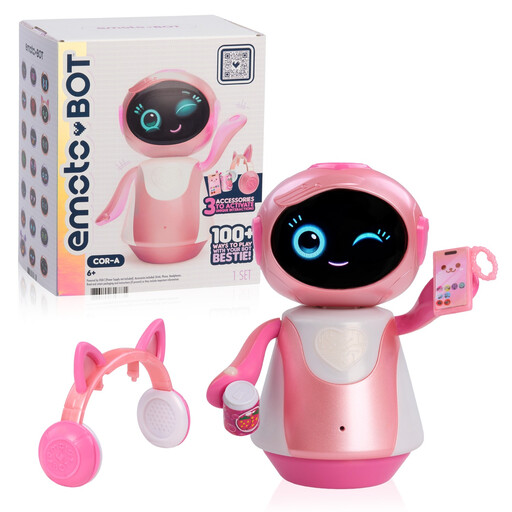
Emotobot in Pink
Its voice-led and movement features may be relevant when considering an interactive activity, but the listing does not establish care-setting suitability.
The listing describes voice control, a remote control and more than 30 dog-like movements. It specifies surface wiping for electronic components and says not to immerse the product.
View on Joybuy
 No image available
Smart Interactive Robot Dog, Silver blue
Gesture- and voice-led controls may be relevant to a facilitated interaction, but the product description does not establish suitability for shared care-setting use.
The listed features include gesture and voice control, a 2.4G remote control, stunt performances and dancing. Check the exact cleaning instructions before considering it for multiple users.
View on Joybuy
 No image available
Unitree Go2 Pro
This quadruped robot is listed with AI interaction modes, but its description does not establish a role in care-home or day-centre activities.
The product name lists a maximum speed of 4.7 m/s, up to 90 minutes of battery life, 360° panoramic vision, SLAM navigation and AI modes. The listing also describes uses including industrial inspection and security patrol; check the intended setting and operating requirements before considering it for resident activities.
View on Joybuy
 No image available
Unitree As2 Pro
Voice interaction and following are listed features, but the stated operating requirements may not fit every activity space.
Instructions call for an open, clutter-free area of at least 6 m × 6 m and say not to touch the robot while it is moving. Check the setting’s space and supervision arrangements before considering use.
View on Joybuy
 No image available
Loona KEYI Premium
This listing describes a smart family pet with interactive features; it does not establish suitability for care-home or day-centre use.
Listed features include voice and gesture control, face and gesture recognition, following, app-based games and a home-monitoring function. Check the intended use and the exact cleaning instructions before considering it for shared activities.
View on Joybuy
Frequently asked questions
Can a resident-assigned pet later be shared?
It can be considered after reassessing the resident’s preference and the proposed hand-offs. Joy for All says individual ownership is ideal and gives hand-hygiene advice for multiple users; the setting still needs to assess its own infection-prevention procedure.
Can staff immerse a furry companion cat or pup to clean it?
No, not under Joy for All’s published instructions: the manufacturer says not to soak the fur or place the pet under running water. Follow the exact model’s instructions and check the proposed cleaning method against local practice.
Do the same infection-prevention documents apply throughout the UK?
No. The Department of Health and Social Care resource cited here applies to England; Scotland has a care-home manual; Public Health Wales provides care-home infection-prevention workbooks; and the Northern Ireland Infection Control Manual says care homes may adopt its guidance. Confirm the applicable document and local procedure for the actual service before approving shared use.
Does Scottish guidance require approval when a care home’s proposed practice differs from its manual?
Yes. ARHAI Scotland’s care-home manual says that a care home using products or practices that differ from the manual is responsible for safe systems of work, including documented risk assessments approved through local governance. This applies to Scottish care homes and does not automatically determine requirements for every UK day centre.


