
24/7 Customer Support

Free returns

Same-day & Next-day Delivery

Quality Guaranteed

Unlock Your Welcome Offers: FREE Delivery | Up to 80% OFF | Free 30-day JoyPlus trial
Download the APP
By Joybuy Product Recommendation Officer
Choosing among rocking horses for toddlers can be more complicated than it first appears. Product photos may show soft fabrics, cheerful sounds and attractive details, but the important buying questions are often less visible: Is the seat suitable for your child’s height? Does the base rock safely on your flooring? Will the toy still be useful after a few months?
This guide focuses on practical details rather than marketing language, helping parents, grandparents and gift buyers compare a wooden rocking horse, plush designs and more active ride-on horse toys for children aged approximately 12 months to 5 years.
A listing may display both an “approved age” and a “recommended age”. These are not always interchangeable. A toy may technically be approved from 12 months, while its seat height, movement or design is more appropriate for a two-year-old.
Check the recommended age range, seat height, maximum load and your child’s ability to sit upright and hold the handles. For younger toddlers, a high back, raised sides and a rocking horse with seat belt may offer a more contained seating position, although adult supervision remains necessary.
A rocking horse with sounds can add variety, but sound buttons require batteries and may become less appealing than expected. Check whether batteries are included, which type is needed and whether the button is easy for a child to press.
For homes where quiet play matters, a traditional wooden rocking horse avoids battery replacement. For children who enjoy responsive or pretend-play features, animal sounds, included soft toys and musical functions may be useful additions rather than essential features.
A static rocker moves backwards and forwards within a curved base. A walking horse ride-on toy with wheels may travel across the room and requires more open floor space. This distinction is particularly important in smaller UK living rooms, flats or homes with hard flooring.
Measure the assembled dimensions, not only the parcel. Also consider skirting boards, coffee tables, rugs and nearby stairways. A wide base may improve stability, but it needs sufficient clearance to rock freely.
For a rocking horse for 18-36 months, look for a manageable seat height and a design that allows both feet to rest comfortably or reach the footrests. A high back and sides can help provide support, while handles give children something to grip during movement.
A rocking horse for ages 2-5 may have a taller seat or more active riding mechanism. The child should be able to mount and dismount with help, remain balanced while seated and follow simple safety instructions.
A wooden rocking horse generally uses a curved wooden base for a simple rocking motion. Plush models commonly combine a padded polyester or PP cotton-filled body with a steel or metal frame and a wooden base.
Look for a base that sits evenly on the floor, secure handle attachment and smooth edges. Assembly instructions should be followed carefully, with screws and fixings checked periodically. Product descriptions may state standards such as EN71 and EN62115; these references relate to toy and electrical-toy safety requirements, but they do not replace reading the product warnings and instruction manual.
Never use the maximum load as a recommendation to ignore the age guidance. A listed capacity of 40kg or 50kg is a product specification, not a guarantee that every child within that weight will find the toy suitable.
For sound-enabled products, note whether they use AA or LR44 batteries, whether batteries are supplied and how the battery compartment is secured. Keep new and used batteries away from children and dispose of used batteries promptly.
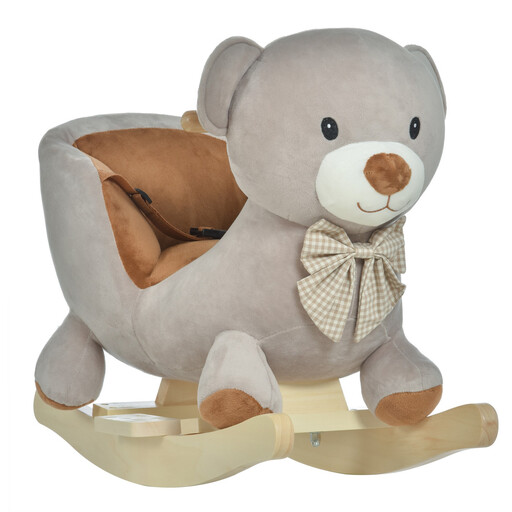
Why This Fits Their Persona: A contained plush rocker for toddlers aged 18-36 months, with a seat belt and gentle curved base for supervised indoor play.
The listing provides a defined 18-36-month range, 40kg maximum load, seat belt and dimensions, rather than relying only on appearance.
Plush padded seat, high back and sides, front handlebar, footrests and included LR44 batteries for the sound feature.
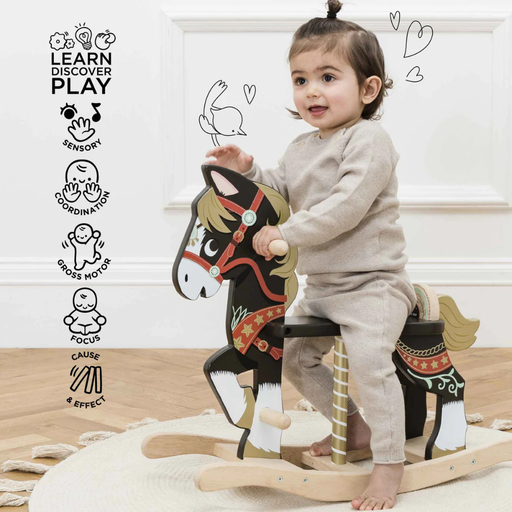
Why This Fits Their Persona: A traditional, battery-free option for playrooms where appearance, durable materials and long-term use are priorities.
It does not depend on electronic sounds or battery replacement, and its product information clearly states the 50kg maximum capacity and self-assembly requirement.
FSC-certified rubberwood and plywood are specified, with two wooden handles, a 65cm assembled length and child-safe, non-toxic paints stated in the listing.
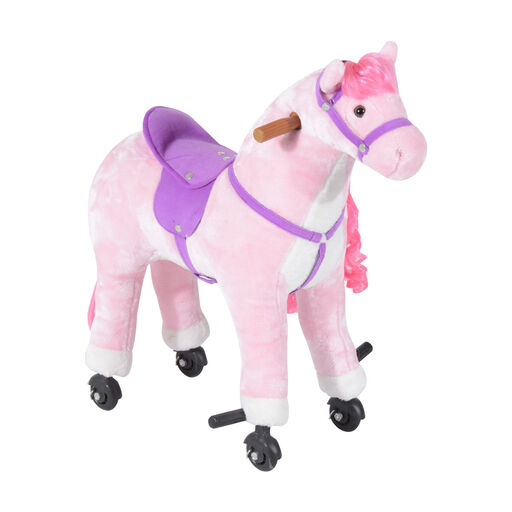
Why This Fits Their Persona: Suitable for children aged 2 and over who want movement beyond stationary rocking and have access to a clear indoor floor area.
Its movement mechanism is described clearly: pushing and releasing the head moves the wheels, so buyers can assess whether it matches their available space.
It has four PU wheels, footrests, wooden grip handles, realistic sounds and a listed 60kg weight capacity.
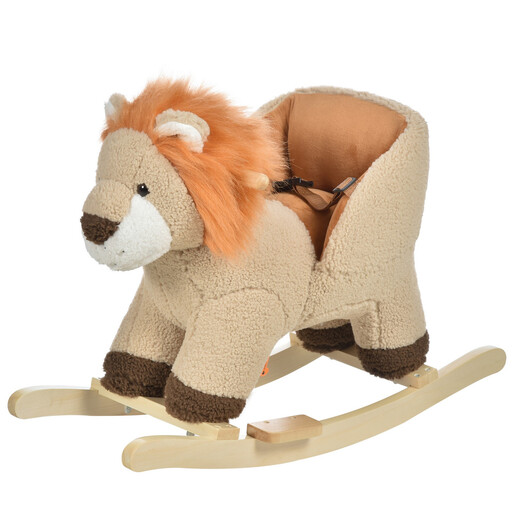
Why This Fits Their Persona: A plush lion design for toddlers who enjoy tactile seating and simple press-button interaction during supervised play.
The seat belt, high sides, high back and 18-36-month recommendation make its intended use clearer than a generic “baby” label alone.
Soft plush padding, wooden curved base, footrest, front handlebar, 40kg maximum load and three LR44 batteries included.
We have compiled a complete, real-time list of products that fully satisfy these strict selection criteria and UK safety regulations.
Some products are listed as suitable from 12 months, but suitability depends on the individual child’s balance, posture and ability to grip. Always follow the product warning and manual. If the listing also says “not suitable under 3 years”, treat that warning seriously and use the toy only with direct adult supervision as instructed.
There is no universal lifespan. Continued use depends on the recommended age range, the child’s size, the maximum load and the condition of the base, frame, seat and handles. Inspect fixings regularly and stop using the toy if parts loosen, split or become damaged.
Traditional wooden models have no battery cost. A plush rocking horse with sounds may require AA or LR44 batteries, depending on the model. Battery compartments should remain secured, and replacement batteries should match the manufacturer’s instructions.