
24/7 Customer Support

Free returns

Same-day & Next-day Delivery

Quality Guaranteed

Unlock Your Welcome Offers: FREE Delivery | Up to 80% OFF | Free 30-day JoyPlus trial
Download the APP
Round dining tables can make a kitchen or dining room feel more sociable, while removing sharp corners that often create awkward walkways. They are also useful in flats, rented homes and open-plan spaces where every centimetre matters.
However, attractive product photography can hide practical drawbacks. Before choosing a round dining table, check the usable dimensions, materials and seating claims rather than relying on phrases such as “large”, “family-sized” or “space-saving”.
A table described as seating four may technically fit four chairs, but this does not always leave sufficient elbow room for plates, serving dishes or laptops. A 90cm round table is generally more suited to compact meals for two to four, while a table around 115–120cm offers more usable room for four people.
Remember to measure the complete footprint, including chairs. Allow enough clearance for people to pull chairs out and walk behind them, particularly in a narrow kitchen or dining area.
Some tables use solid hardwood legs with an MDF or engineered-wood top. This is not automatically a disadvantage, but buyers should know exactly what they are paying for. MDF can provide a smooth, consistent surface, while solid hardwood may offer a more natural grain and substantial construction.
Check the product specification for:
An extendable round dining table can be useful, but its mechanism needs to be considered carefully. Check how the extension leaf is stored, whether the shape changes to oval and how much floor space is required when fully open.
Self-assembly is common across this category. A low price may be less appealing if the table has unclear instructions, numerous fixings or requires careful alignment. Always check the supplied instructions and ensure the finished table is stable on a level floor.
For a round dining table for 4 people, consider approximately 90–120cm depending on how much tableware and personal space you need.
A table advertised as a dining table for 4–6 people may provide flexible seating, but the larger capacity often depends on the shape, chair width and how much space diners require.
A space-saving dining table should be assessed in its smallest configuration as well as its full size. Console-style designs can sit close to a wall when not being used for dining, while pedestal or central-leg designs may allow chairs to tuck in more neatly.
For UK homes with compact kitchens or combined kitchen-living areas, measure:
A stable base is important for everyday meals, work or children’s activities. Look for features such as cross braces, solid legs, adjustable foot pads or a central support.
Surface care also affects long-term convenience. Lacquered, painted and waterproof-coated surfaces may be easier to wipe clean, but care instructions still matter. Use a soft cloth and avoid abrasive cleaners unless the manufacturer specifically permits them.
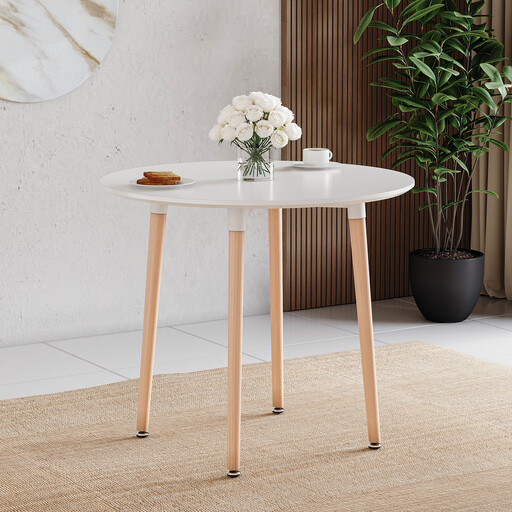
Why This Fits Their Persona: Its 90cm diameter suits a small kitchen, breakfast area or first home where floor space and a straightforward design are priorities.
The stated dimensions make its compact capacity clear, helping buyers avoid assuming that every four-seater offers generous entertaining space.
White lacquered MDF top; solid beech legs; stated 120kg weight capacity.
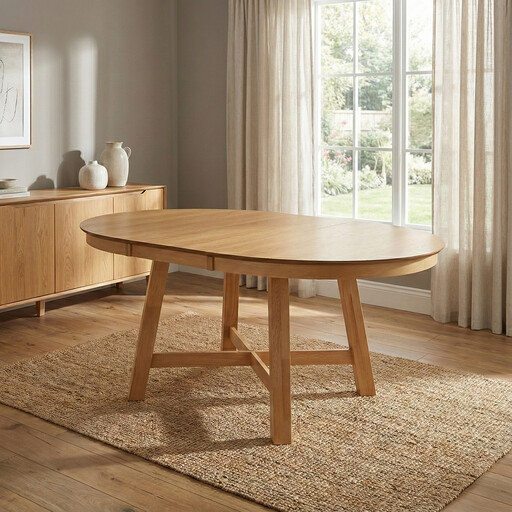
Why This Fits Their Persona: A solid hardwood oak table with an integrated extension suits households wanting a more substantial dining surface for regular meals and guests.
The butterfly leaf is stored inside the table, so there is no separate extension panel to store or misplace. Its stated capacities and dimensions are clearly provided.
Extends from 115cm round to 154cm oval; solid hardwood construction; stated 120kg capacity.
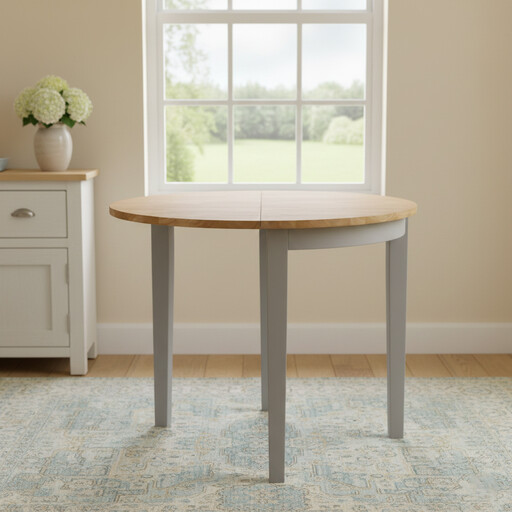
Why This Fits Their Persona: This dual-purpose design is suitable for flats, narrow hallways or renters who need a console most of the time and a dining surface when required.
Its folded depth is approximately 45cm, and the product information states that it extends to approximately 90cm wide. This gives a clearer picture of its actual space-saving function.
Solid hardwood construction; half-moon-to-round conversion; rounded tabletop edges.
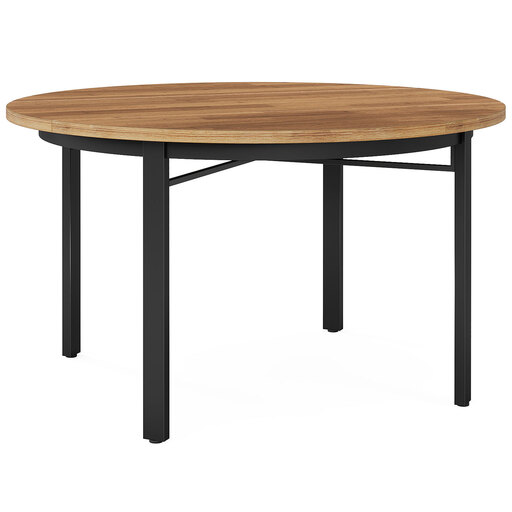
Why This Fits Their Persona: Its 118.5cm circular top is aimed at households needing a practical table for everyday meals, brunches, games or craft activities.
The dimensions and material details are stated, while adjustable foot pads address minor uneven-floor issues without replacing the need for a level, secure setup.
118.5cm tabletop; metal legs with adjustable foot pads; wipe-clean waterproof surface described in the product information.
We have compiled a complete, real-time list of products that fully satisfy these strict selection criteria and UK safety regulations.
A 90cm table can work for four people when meals are compact and chairs are relatively narrow. For more comfortable everyday dining, consider a diameter of around 115–120cm. Measure the chairs as well as the room, allowing clearance for movement around the table.
Yes. Their lack of corners can improve movement through a narrow space, and a central base may allow chairs to be positioned more flexibly. A small kitchen dining table should still leave enough room for doors, appliances and chair clearance. Console-convertible designs can be particularly useful where the table is not needed all day.
They can be worthwhile if your household usually needs a compact four-seater but occasionally hosts more people. Check the closed and extended measurements, the storage arrangement for the leaf and whether the table changes from round to oval. Also confirm that the extension mechanism aligns securely before use.