Choose the projector’s placement type before its resolution: ultra-short throw suits a position close to the wall, short throw needs some clear distance, and a conventional projector needs its required throw distance checked against the room. For daytime rugby, check the exact model’s brightness specification and any sports or motion mode, then confirm image size, sound and how you will receive the match.
Who is this for?
Viewers working around a small-room layout
If a narrow living room leaves little space between the projector and wall, measure the usable distance and wall area before choosing a throw type. BenQ and Epson publish different placement specifications for their short-throw and ultra-short-throw models.
Daytime rugby viewers
Afternoon matches may mean watching with ambient light. Check the exact brightness specification and whether the model offers a sports or motion mode, rather than choosing by its claimed maximum image size.
Match-night hosts who want a repeatable setup
If the projector comes out only for matches, check how you will align the image, access the stream and connect sound each time. Epson and XGIMI list adjustment features on particular models, but those features differ by product.
What matters when choosing?
Start with the space between the lens and the wall. Once a projector can make the image you want from that position, consider light, setup and the viewing connection.
Ultra-short throw
Choose it when: The projector needs to sit close to the wall; Epson describes the EH-LS650W as a close-wall model.
Allow for: A suitable position near the wall, and check that the image fits rather than assuming Epson’s stated maximum of 120 inches will fit your space.
Short throw
Choose it when: You have some clear distance from the wall but do not want the projector farther across the room. BenQ specifies a 0.69–0.83 throw ratio for the TK710STi.
Allow for: More lens-to-wall distance than a close-wall setup; short throw does not itself mean a model has sports picture processing.
Conventional throw
Choose it when: A shelf, table or mounting position provides the distance the exact model needs. Epson lists 1.6x zoom and vertical lens shift for the EH-TW6250.
Allow for: A longer projection path that may not work in a small room, even when image adjustment is available.
| Concern |
What to check |
Who this matters to |
| Room fit |
Measure the usable wall area and lens-to-wall distance; check the exact model’s image size at that distance. |
I want a large image without blocking the walkway or shifting the furniture every match. Roughly 36% of consumers put fitting the room first. |
| Daylight and fast action |
Check the brightness measurement label and whether the exact model has a sports or motion mode. |
If I watch afternoon rugby, I need to judge how the picture will look with light in the room and play moving quickly. For around 29% of consumers, that viewing concern comes first. |
| Quick setup |
Check the placement method and available focus, alignment or image-adjustment controls. |
I want to bring out the projector before kick-off without spending the opening minutes lining it up. Ease of setup is the main concern for roughly 21% of consumers. |
| Sound and viewing source |
Confirm the intended streaming service or external source and the connection to speakers or a soundbar. |
When friends are watching, I want everyone to hear the commentary and know how the live match will reach the projector. Around 14% of consumers make that viewing path their primary concern. |
Buying pitfalls
-
Choosing by maximum screen size alone
A stated maximum does not tell you what image a projector can produce from your available position. Optoma describes its projection-calculator results as estimates and advises testing the distance before fixing mounting parts.
Measure the wall and proposed lens position, then test the intended placement before drilling or buying a fixed screen.
If the image will not fit from that position, you may need a different screen or mount position, or to rearrange furniture.
-
Comparing brightness numbers without their labels
BenQ states ANSI lumens for the TK710STi, while XGIMI states ISO lumens for the HORIZON S Max. A larger figure on its own does not establish which will give you the clearer daytime rugby image.
Read each model’s measurement label and consider the intended image size and how much light you can control in the room.
-
Reading “4K support” as native 4K
A Joybuy HY300Pro listing uses “4K Support” in its title while giving a native resolution of 1280 × 720 in its description. Accepted video formats and native image resolution answer different questions.
Check native resolution separately from the input formats a projector accepts.
-
Assuming a projector changes live-TV licensing rules
GOV.UK states that a TV Licence is needed to watch or record live TV on any channel or service, and to use BBC iPlayer. Using a projector does not remove that requirement.
Before a live rugby match, confirm that your household has the appropriate TV Licence for the way you plan to watch.
Brands to consider for this setup
BenQ
BenQ has named short-throw and sports-oriented models worth examining when placement distance and match viewing both matter.
- BenQ specifies a 0.69–0.83 throw ratio, 3,200 ANSI lumens and 4K UHD resolution for the TK710STi.
- BenQ describes MEMC motion processing and Sports Mode for the separate TK705i; Sports Mode requires the specified OS update. Do not assume those features apply to the TK710STi or every BenQ projector.
Epson
Epson’s EH-LS650W and EH-TW6250 illustrate different placement choices: close to the wall or farther back with image-adjustment options.
- Epson describes the EH-LS650W as a 3,600-lumen ultra-short-throw model with built-in Yamaha sound, and lists 1.6x zoom and lens shift for the EH-TW6250.
- The EH-TW6250’s adjustment features do not establish that its required throw distance will fit your room; check the intended image size and position.
XGIMI
The HORIZON S Max is a feature example for viewers considering a moveable setup rather than a permanent installation.
- XGIMI lists a flexible stand, autofocus, automatic keystone correction, obstacle avoidance and screen alignment for this model.
- Check its current availability before treating the HORIZON S Max as a purchase option, and confirm that its placement produces the image size you want.
Joybuy projectors to consider
These projectors offer different approaches to a movable home-viewing setup. Check each one’s image size at your available distance before deciding whether it works for rugby in your living room.
 No image available
Magcubic HY350Max projector, native 1080P
Consider this model if you want automatic image alignment and built-in sound for an occasional match-night setup.
Its description states a 1:1 throw ratio, 900 ANSI lumens, autofocus, automatic keystone correction and a 15W speaker. Check the image size at your measured distance, the intended rugby service and whether the model has a motion mode.
View on Joybuy
 No image available
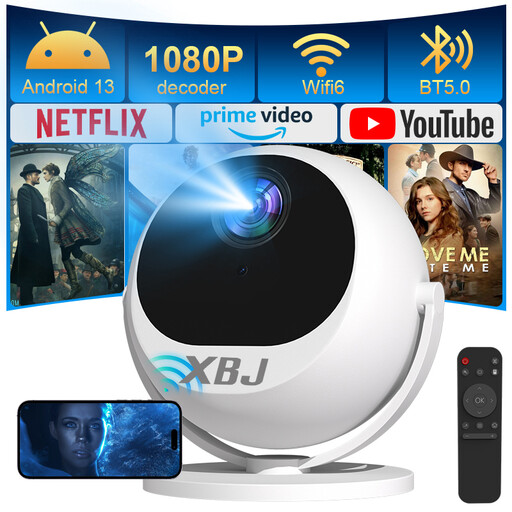
XBJ 360° portable projector, European Version
Consider this model if you expect to move the projector and want flexible aiming and automatic alignment.
Its description states native 1080P resolution, 360° rotation, autofocus, automatic keystone correction, HDMI and a 5W speaker. Confirm its image size at your available distance and how you will access the live match.
View on Joybuy
 No image available
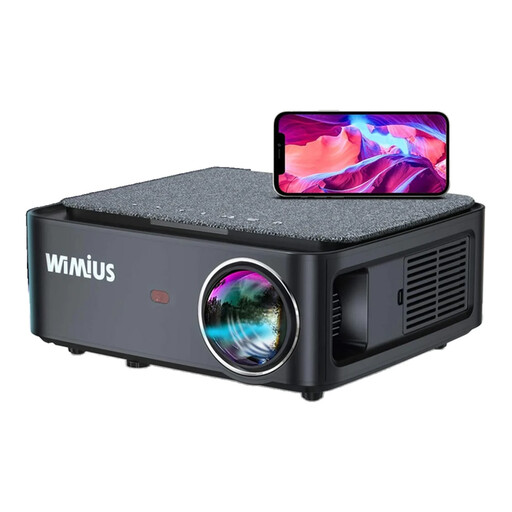
Wimius K1 projector, native 1080P
Consider this model only if your room can accommodate its intended projection position and you plan to use an external viewing source.
Its description states an optimal projection distance of about 3 metres, 1,200 ANSI lumens, HDMI and USB connections, dual speakers and 50%–100% zoom. Check the image geometry for your wall; the description says it has no built-in system, so confirm your streaming device and connection.
View on Joybuy
 No image available
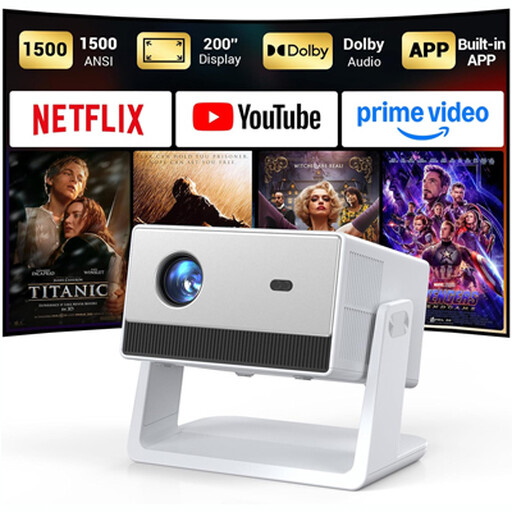
FunFlix Smart Projector, football bundle with ball, beer and stand
Consider this model if built-in viewing apps and speakers matter, but confirm that your particular rugby service is available.
Its description states native 1080P resolution, 1,500 ANSI lumens, HDMI and USB connections, and two 5W speakers. Check image size at your available distance and confirm the focus method: the title says autofocus, while the description says manual focus.
View on Joybuy
Frequently asked questions
How can I tell whether a projector will fit my small living room?
Measure from the proposed lens position to the wall, then check the exact model’s image size at that distance against your usable wall area. Test the position before fixing a mount or screen: Optoma says its projection-calculator results are estimates.
Should I choose short throw or ultra-short throw for rugby?
Choose ultra-short throw if the projector must sit close to the wall; consider short throw if there is some clear lens-to-wall distance but not enough for the conventional model you are considering. Epson describes the EH-LS650W as close-wall ultra-short throw, while BenQ specifies a 0.69–0.83 throw ratio for the TK710STi. Check the resulting image size for your own room.
Do I need a TV Licence to watch live rugby on a projector in the UK?
Yes, if you watch or record a programme as it is broadcast on any channel or service. GOV.UK also states that a TV Licence is needed for BBC iPlayer; using a projector rather than a television does not change those requirements.
Will built-in speakers be enough for a rugby watch party?
Check the particular projector and your seating arrangement before relying on its speakers for a group. BenQ lists a 5W speaker and HDMI eARC for the TK710STi, while Epson lists built-in Yamaha sound for the EH-LS650W; if you plan to use a soundbar or external speakers, confirm the required connection.


