
24/7 Customer Support

Free returns

Same-day & Next-day Delivery

Quality Guaranteed

Unlock Your Welcome Offers: FREE Delivery | Up to 80% OFF | Free 30-day JoyPlus trial
Download the APP
A standard smartphone is a fragile thing. One accidental drop on the building site, a slip into a puddle on a rainy hike or a battery that dies halfway through a long shift can mean costly repairs and serious inconvenience. For those who work and play in demanding environments, a standard device simply isn't up to the job. This is where a rugged smartphone comes in, built from the ground up to withstand the elements and the rigours of a tough day.
As the Joybuy Product Recommendation Officer, my role is to help you navigate the options. This guide will walk you through the key features to look for in a tough phone and present some of our top recommendations for 2026, helping you find a device that works as hard as you do.
Choosing the right heavy-duty mobile phone goes beyond just looking for a thick case. Here are a few key considerations to keep in mind.
You will often see codes like 'IP68' or 'MIL-STD-810H' in product descriptions. These are not marketing jargon; they are standardised ratings that tell you exactly what a phone can endure.
For tradespeople, emergency responders and outdoor enthusiasts, a dead phone is not an option. A long battery life phone is essential. Battery capacity is measured in milliampere-hours (mAh). While a typical smartphone might have a 4,000-5,000mAh battery, rugged models often feature massive batteries of 10,000mAh or more, providing several days of use on a single charge. Some even support reverse charging, allowing you to use your phone as a power bank to charge other devices.
Years ago, choosing a rugged phone meant sacrificing performance. That is no longer the case. Many modern models are equipped with powerful processors, ample RAM and high-refresh-rate displays for smooth operation. Features like 5G rugged phone connectivity ensure you have the fastest data speeds available, while high-resolution cameras and specialised tools like thermal imaging or night vision can make them invaluable tools for professionals.
Based on their specifications and features, here are a few standout models that cater to different needs.

Why It Stands Out: The Blade GT Pro challenges the idea that rugged means bulky. With a relatively slim 10.5mm profile, it combines durability with a sleek design. It's packed with an impressive 32GB of RAM and a 120Hz FHD+ display, delivering performance that rivals many flagship consumer phones.
Pros:
Who is it for? This is an excellent choice for the user who needs a durable daily driver but doesn't want to compromise on speed, display quality or modern aesthetics. It's a great all-rounder for both work and personal use.

Why It Stands Out: The S118 PRO is built for endurance and specialised tasks. Its massive 10,800mAh battery ensures it will keep going long after other phones have given up. The inclusion of a 20MP night vision camera makes it a uniquely practical tool for nocturnal work or outdoor adventures.
Pros:
Who is it for? Ideal for the outdoor phone user, night-shift workers or anyone who prioritises extreme battery life and specialised camera functions over a slim profile.
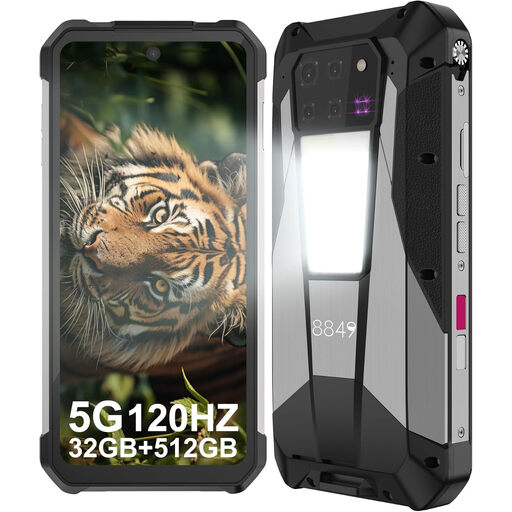
Why It Stands Out: The Unihertz Tank 3 Pro is less a phone and more a mobile command centre. Its list of features is extraordinary, headlined by a colossal 23,800mAh battery, a built-in 100 Lumens DLP projector and a powerful 1200LM camping lamp. This device is the definition of a multi-tool.
Pros:
Who is it for? This is the ultimate device for serious campers, long-distance drivers and field professionals who need a single tool for power, light, communication and even presentations in remote locations. It's the perfect phone for construction workers who need to review plans on-site.
If these specific models aren't quite what you're looking for, don't worry. The world of durable mobile technology is vast. To see a wider variety of devices that can meet your needs, explore our full collection of brand new mobile phones.
Q1: What really makes a phone 'rugged'? A rugged phone is designed from the inside out for durability. This includes a reinforced internal frame, shock-absorbent materials, sealed ports to protect against dust and water (verified by IP ratings) and screens made from toughened glass. This integrated protection is far more effective than simply putting a bulky case on a standard smartphone.
Q2: Are rugged smartphones slow and difficult to use? This is a common misconception from the past. As you can see from our recommendations, modern rugged smartphones are equipped with powerful multi-core processors, large amounts of RAM (up to 32GB) and fast 5G connectivity. They run the latest Android operating systems, so the user experience is just as smooth and intuitive as any contemporary device.
Q3: How important is an IP rating for someone working in construction? For a phone for construction workers, a high IP rating like IP68 is crucial. Construction sites are filled with fine dust, debris and the potential for water exposure from rain or site operations. An IP68 rating ensures that dust cannot penetrate the device and cause internal damage and that it can survive being accidentally dropped in water, protecting your investment and keeping you connected.