
24/7 Customer Support

Free returns

Same-day & Next-day Delivery

Quality Guaranteed

Unlock Your Welcome Offers: FREE Delivery | Up to 80% OFF | Free 30-day JoyPlus trial
Download the APP
A long UK journey with a motorhome, caravan, fifth-wheel or trailer can make tyre problems difficult to spot early. A visual check before departure may not reveal a slow leak, rising temperature or a pressure imbalance between axles. An RV tyre pressure monitoring system provides information from the wheel sensors to a cabin display, helping you decide when a tyre needs attention.
However, not every wireless TPMS for caravans is suitable for every vehicle. The product description may highlight “real-time” alerts while leaving out sensor limits, pressure compatibility or signal requirements. The following points can help you avoid paying for features that do not match your setup.
A trailer tyre pressure monitoring system designed for smaller vehicles may cover up to 87 PSI or 116 PSI. That can be unsuitable for a heavily loaded caravan, horse trailer, semi-trailer or commercial vehicle with higher recommended pressures.
Check the pressure printed on the tyre sidewall and, where applicable, the vehicle manufacturer’s recommended cold inflation pressure. Select a monitor with operating headroom above that figure. Be careful with product titles: some systems are marketed as 0-188 PSI TPMS, while their detailed specifications may show 0-14 BAR or approximately 0-203 PSI. Confirm the actual display range and measurement units in the product listing or manual before ordering.
Long vehicles place considerable distance between the towing vehicle, trailer wheels and display. A trailer TPMS with repeater can help relay data, but placement still matters. The repeater usually needs to sit between the sensors and the monitor, with a suitable power connection and minimal obstruction.
Vehicle length, metal framing, battery compartments and sensor position can affect wireless communication. A repeater is useful equipment, not a guarantee of uninterrupted reception in every installation.
External tyre pressure sensors are convenient because they screw onto the valve stems without removing the tyre. They also require routine battery replacement and may be more exposed to weather, road dirt and accidental damage.
Several products listed here recommend metal valve stems, particularly for higher-pressure or heavier applications. Inspect rubber stems for cracking and follow the fitting instructions. Check whether the sensors use CR2032 or CR1632 batteries, how replacements are accessed and whether anti-theft fittings are included.
Count every tyre you want to monitor, including the tow vehicle, caravan or trailer axles and any spare you intend to track. A four-sensor kit may suit a basic trailer, while a six-, eight- or ten-sensor system is more appropriate for combined vehicle-and-towed setups.
Some GUTA systems support up to 24 tyres with additional sensors. That is useful for fleet operators or multi-axle vehicles, but confirm whether extra sensors and repeaters are sold separately. Pre-paired, marked sensors can simplify installation because each unit is assigned to a wheel position.
A real-time tyre pressure monitor should show both pressure and temperature. Pressure readings are generally displayed in PSI or BAR, while temperature may be shown in Celsius or Fahrenheit. UK drivers should check that the chosen unit is easy to read while driving and that alarm thresholds can be adjusted.
Useful features include:
These alerts supplement regular tyre checks; they do not replace checking pressures when the tyres are cold or following the vehicle handbook.
A cabin display should be readable in changing British weather and light conditions. Colour LCD screens with automatic backlighting can make tyre positions easier to identify at night. Solar-powered tyre pressure monitors may reduce charging frequency, although a USB or 12V charging option remains useful during overcast weather or winter storage.
Also check:
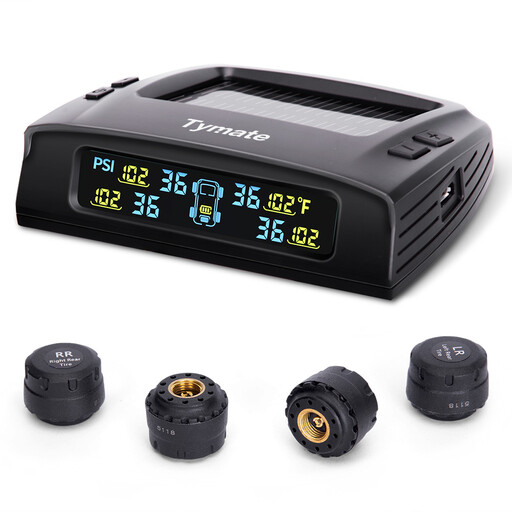
Why This Fits Their Persona: A four-sensor layout is a straightforward starting point for a smaller caravan or trailer owner who wants pressure and temperature information without a complex multi-tyre installation.
Its listed 0-116 PSI range makes the pressure limit visible, so buyers can compare it with their tyre requirements rather than assuming every RV system is suitable.
Solar-assisted display, 433.92MHz communication, automatic sleep mode and replaceable CR1632 sensor batteries.
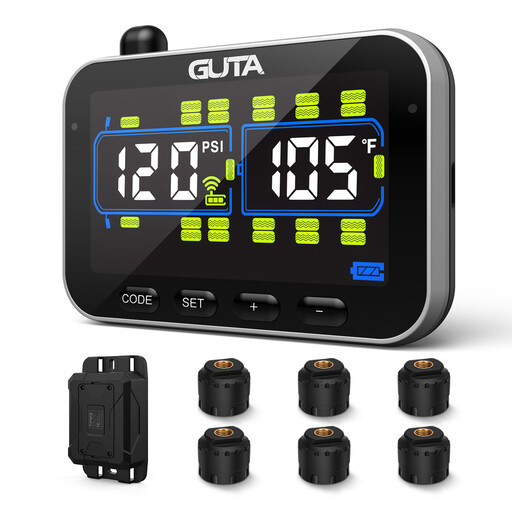
Why This Fits Their Persona: Suitable for owners who want a larger screen, a repeater and broader stated coverage for an RV, caravan or semi-trailer configuration.
The kit lists a repeater, pre-paired sensors, six alarm modes and a 2-year warranty, addressing signal, setup and after-sales uncertainties.
78mm × 44.5mm colour LCD, -40°C to 105°C temperature range and external CR2032 sensors listed at about four years of battery life.
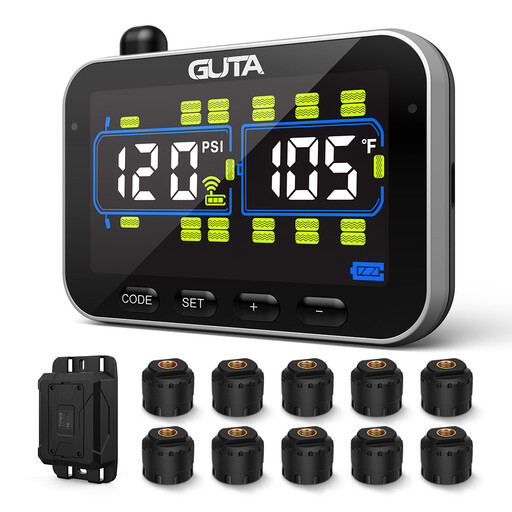
Why This Fits Their Persona: The ten-sensor configuration suits multi-axle caravans, larger RVs, trucks and fleet-style monitoring where four sensors leave too many wheels unchecked.
It makes sensor quantity explicit and includes a repeater, reducing the risk of buying a small-footprint vehicle kit for a long, multi-tyre vehicle.
0-188 PSI marketing range, 433.92MHz transmission, six alarm categories and stated support for up to 24 tyres.
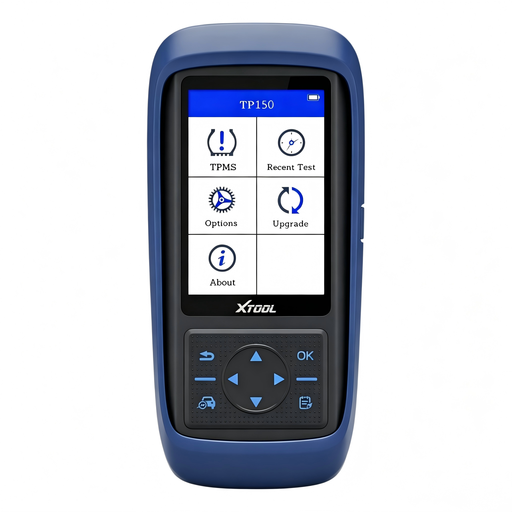
Why This Fits Their Persona: A suitable option for automotive professionals or fleet operators who need sensor activation, relearning and programming functions rather than a cabin-only monitor.
Its functions are clearly separated from a monitoring display: check compatibility with the vehicle and sensor type instead of expecting it to replace an RV alert system.
Supports 315MHz and 433MHz sensors, TPMS code reading and clearing, sensor programming for XTOOL TS100 and Wi-Fi or USB updates.
We have compiled a complete, real-time list of products that fully satisfy these strict selection criteria and UK safety regulations.
Before towing, fit each external sensor to the labelled valve position, check that the reading appears on the display and set the reference pressure according to the vehicle or tyre guidance. Do not rely on an automatic calibration function if the tyres are not correctly inflated when it is activated.
Sensor batteries are consumables. The listed products specify roughly two to four years depending on model and battery type, but cold weather, storage and usage can affect practical life. Keep spare batteries available and inspect seals when replacing them. A solar display can reduce USB charging, while rechargeable hosts still need periodic charging during storage and travel.
It can be useful for drivers who tow regularly, travel long distances or manage several axles. It provides live pressure and temperature information that a pre-trip walk-around cannot provide. It should complement, not replace, cold-pressure checks and visual inspections.
Only if its pressure range, sensor quantity, vehicle-length guidance and repeater arrangement match the trailer. Many compact systems are limited to four sensors or lower pressure ranges. Check the trailer’s tyre specification before purchase.
Some factory-installed systems require a relearn procedure after a sensor or wheel is changed. An TPMS relearn and programming tool can activate sensors, read identification data or programme compatible replacement sensors, but compatibility varies by vehicle, frequency and sensor manufacturer. Always verify the tool’s supported systems before buying.