
24/7 Customer Support

Free returns

Same-day & Next-day Delivery

Quality Guaranteed

Unlock Your Welcome Offers: FREE Delivery | Up to 80% OFF | Free 30-day JoyPlus trial
Download the APP
For motorhome, caravan, travel trailer and lorry owners, an RV tyre pressure monitoring system can make it easier to track pressure and temperature while travelling. However, not every wireless TPMS is suitable for a long vehicle, high-pressure tyre or multi-axle setup.
The right system should match your tyre pressure range, number of wheels, vehicle length and preferred power source. It should also provide clear alarms without encouraging drivers to rely on electronic readings instead of routine checks.
Some compact systems are designed for cars and SUVs rather than caravans, fifth-wheels or semi-trailers. A monitor limited to around 0–87 PSI may be unsuitable if your tyre sidewall or manufacturer guidance requires a higher operating pressure.
Before buying, check the pressure shown on the tyre sidewall and the vehicle handbook. Select a system with a suitable margin above your normal cold-tyre pressure. Do not use the monitor’s alarm range as a replacement for the vehicle manufacturer’s inflation instructions.
A wireless TPMS sends data from valve-mounted sensors to a display in the towing vehicle. Signal distance can be affected by the length of the caravan, metal bodywork, wheel position and the location of the display.
For longer vehicles, a trailer TPMS with repeater is worth considering. A repeater relays sensor information between the wheels and the cab, helping the display receive data across a motorhome, trailer or semi-trailer. Always check the stated vehicle-length guidance rather than assuming that a 433.92MHz system will work equally well on every configuration.
A multi-tyre TPMS may include four, six, eight or ten sensors, while some systems support additional sensors separately. Buying more sensors than you need can add cost and setup work. Buying too few may leave spare wheels, trailer axles or a vehicle’s rear tyres unmonitored.
Also check whether the kit uses external screw-on sensors and whether your valve stems are suitable. Metal valve stems are generally recommended by the supplied product information for heavier applications. Rubber stems should be inspected for age, cracking and movement before fitting external sensors.
A useful real-time tyre pressure and temperature monitor should display both readings for each fitted wheel. Pressure is normally shown in PSI or BAR; temperature may be shown in Celsius or Fahrenheit.
For cars and shorter trailers, a system covering up to approximately 116 PSI may be sufficient. For caravans, RVs, trucks and semi-trailers, a wider range of up to approximately 188–203 PSI offers broader compatibility. Temperature ranges also differ, so check the product specification if you regularly travel in cold weather or tow through warmer regions.
Look for alarms covering:
Some systems calibrate the current pressure as a reference and use relative thresholds, such as -15% for low pressure and +25% for high pressure. This can simplify setup, but calibration should be performed when tyres are cold and correctly inflated according to the vehicle guidance.
A colour LCD display with automatic backlight adjustment can be easier to read in changing UK light conditions. Red screen prompts or flashing wheel icons may help identify the affected tyre quickly, but the driver should pull over safely before investigating an alarm.
A solar tyre pressure monitor can reduce the need for regular charging when the display is mounted behind a windscreen. Many systems also include Type-C charging for cloudy days or overnight use.
External sensors typically use replaceable coin-cell batteries, such as CR1632 or CR2032. Stated battery life varies by model and usage, with some product specifications listing approximately two years and others approximately four years. Check the low-voltage warning and inspect sensor seals whenever a battery is changed.
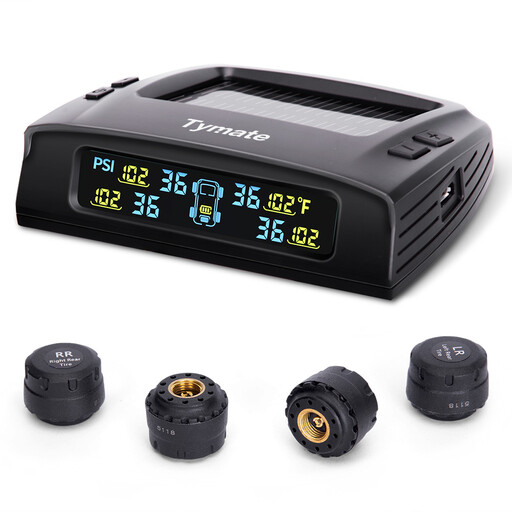
Why This Fits Their Persona: This four-sensor kit suits a driver who wants a straightforward wireless TPMS for a shorter RV, trailer, SUV or family vehicle. Its 0–116 PSI range covers many everyday towing applications, subject to your tyre requirements.
The product specification clearly states its pressure range, four-sensor configuration and vehicle-length guidance, helping buyers avoid choosing a system without checking basic compatibility.
Solar-assisted display, colour LCD screen, temperature monitoring, automatic sleep mode and replaceable CR1632 sensor batteries.
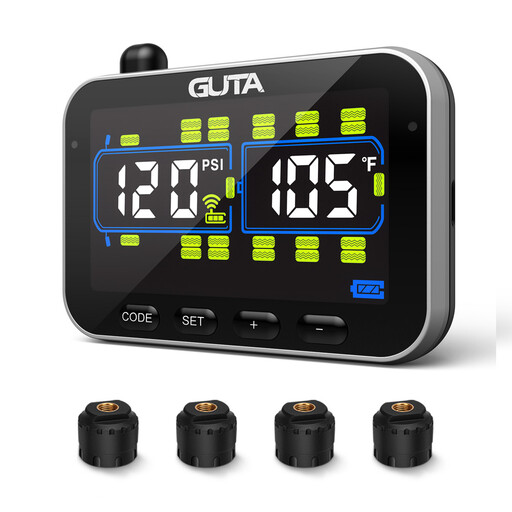
Why This Fits Their Persona: This option is suited to RV and caravan owners who want a broader pressure range, a larger colour display and a system designed around longer-vehicle use.
Its stated 0–188 PSI monitoring range is wider than compact car-oriented systems, while factory-paired sensors reduce manual pairing during installation.
0–188 PSI range, four-year stated sensor battery life, colour LCD display and six alarm categories including monitor battery status.
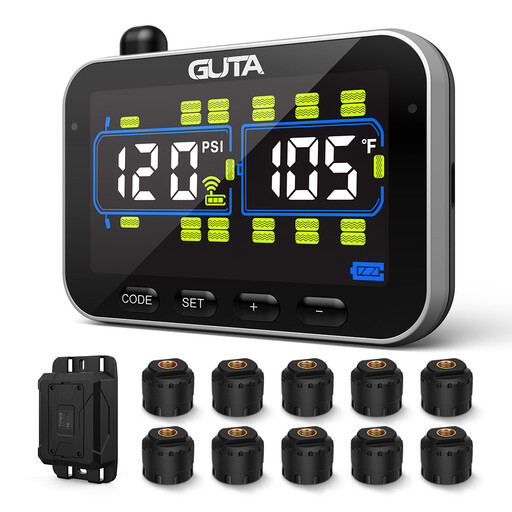
Why This Fits Their Persona: This kit is aimed at owners of larger RVs, fifth-wheels, semi-trailers and multi-axle combinations who need more wheel positions monitored at the same time.
The included repeater addresses the range limitation found in some long-vehicle installations, while ten pre-paired sensors reduce the need to configure each position manually.
Ten sensors, repeater, up to 0–203 PSI stated monitoring range, -40°C to 105°C temperature range and support for vehicle lengths under 50 feet.
We have compiled a complete, real-time list of products that fully satisfy these strict selection criteria and UK safety regulations.
Before setting off, check each tyre when cold and compare the reading with the vehicle handbook. Then:
A system with automatic sleep mode can reduce display power use while parked. Solar charging may reduce cable use, but UK winter conditions and shaded parking mean a rechargeable backup remains useful.
It can provide convenient live pressure and temperature information while towing, particularly when the trailer is difficult to see from the driving seat. It does not replace cold-tyre checks, visual inspections or correct loading.
You may need one if the vehicle and trailer combination is long, the display loses sensor data or the manufacturer specifies one for your configuration. A repeater is particularly relevant to fifth-wheels, semi-trailers and multi-axle vehicles.
The stated lifespan depends on the system, usage and weather exposure. The products above list approximately two to four years for their external coin-cell batteries. Check the low-battery alarm, inspect the sensor seal and replace batteries promptly when indicated.