Single-portion salsa makers
If you usually make salsa for one meal, a small bowl matters more than the capacity of a full-size processor. Check that your usual amount of tomato, onion, herbs and garlic fits within the model’s ingredient limits.


For salsa for one, start with a compact mini chopper with pulse control so you can stop and check the texture as you chop. Choose a compact multifunction food processor instead if you will regularly slice, grate or knead as well; its extra functions come with more parts to store and clean.
If you usually make salsa for one meal, a small bowl matters more than the capacity of a full-size processor. Check that your usual amount of tomato, onion, herbs and garlic fits within the model’s ingredient limits.
If you want to stop at a coarse chop rather than make a smooth dip, look for pulse control and a bowl you can pause and scrape down.
If salsa is only one of your prep tasks, a compact multifunction processor may be more useful than a dedicated chopper. Check which slicing, grating or other attachments come with the model and where you would store them.
Decide how much salsa you normally make, then consider texture control and whether you will use functions beyond chopping. A small bowl is convenient for a modest batch, but the stated bowl volume is not necessarily its usable processing quantity.
| Concern | What to check | Who this matters to |
|---|---|---|
| Batch size and storage | Compare bowl size with the manual’s ingredient limits and the space needed to store the appliance. | When I make only a small serving, I want a bowl that suits my ingredients without taking over a cupboard. Around 46% of consumers put small-batch size and storage first. |
| Chunky or smooth texture | Look for pulse control and instructions for coarse chopping; check whether the bowl is easy to pause and scrape down. | If I prefer chunky salsa, I want to inspect it between short bursts before it becomes too fine. Texture control is the primary need for around 36% of consumers. |
| Other prep tasks | Check which blades and discs are included for tasks you will actually do, such as slicing or grating. | When I also prepare other parts of a meal, I want the appliance to do more than chop salsa ingredients. Around 18% of consumers prioritise those additional functions. |
Extra functions matter when you will use them, but they do not replace checking whether the bowl suits a small serving. Which? assesses ease of use and cleaning alongside processing tasks.
Start with a mini chopper if chopping salsa ingredients is the main job; consider a multifunction processor when you also expect to slice, grate or knead regularly.
Additional parts also need storage and cleaning.
Total and working capacities can differ: Magimix gives the Mini Plus a 1.7 L total capacity and a 600 ml working capacity.
Check the exact model’s manual for fill levels and ingredient limits before deciding how much salsa you can make at once.
Continuous chopping makes it harder to stop at a coarse texture. KitchenAid describes pulse control on its cited choppers as an option for coarse chopping.
Use brief pulses and inspect the ingredients between them. Add liquids gradually only if the model’s instructions allow it.
Food Standards Agency guidance identifies equipment cleaning and cross-contamination control as important when preparing food.
Clean food-contact parts thoroughly after raw-food or allergen use, and follow the model’s instructions for which components can go in a dishwasher.
KitchenAid UK positions its 830 ml 5KFC3516 chopper for small quantities, including salsa. Its 1.19 L 5KFC0516 adds a whisk accessory for other mixing tasks.
Magimix presents Le Micro as a mini chopper for small batches, including salsa. Its Mini Plus is a compact multifunction processor with a stated 600 ml working capacity.
The Kenwood CH180B is a small-bowl option: its Joybuy listing specifies a 350 ml bowl and two speeds.
The Joybuy listing for the Ninja BN800UK describes a broader processor-and-blender system, including a 1.8 L processor bowl, 2.1 L jug and 700 ml cup.
This compact mini chopper is a choice to consider when you make very small batches of salsa and have limited storage space. Check the usable fill quantity against your usual recipe.
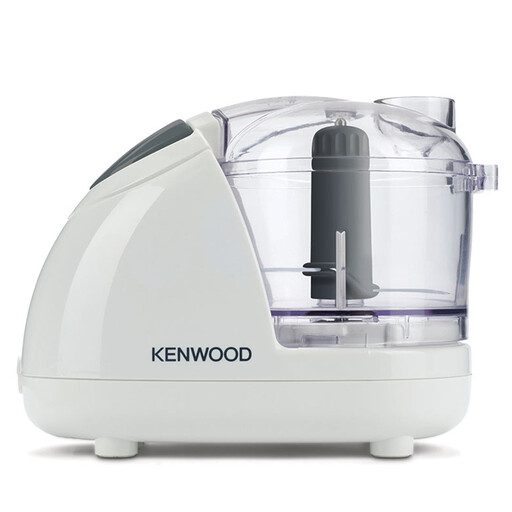 Image unavailable
Consider this model for a genuinely small serving when cupboard space matters. Its listed specifications include a 350 ml bowl, 300 W motor and two speeds; the Kenwood CH180B listing also specifies pulse control. A larger tomato-heavy recipe may require separate batches, so check the manual’s usable fill limits.
Start with a small-batch chopper and compare its usable quantity with your usual recipe. The cited models range from the Kenwood CH180B’s 350 ml bowl to KitchenAid choppers with 830 ml and 1.19 L bowls; check the exact model’s ingredient limits rather than choosing by bowl volume alone.
Choose a chopper with pulse control, use short bursts and inspect the ingredients between pulses. KitchenAid describes pulse control on its cited choppers as suitable for coarse chopping; stop and scrape down the bowl when needed.
Consider one if you regularly need tasks beyond chopping salsa, such as slicing, grating or kneading. Magimix lists those functions for its Mini Plus; check the included attachments and the space needed to store them.
Clean the bowl, blade, lid and other food-contact surfaces thoroughly before preparing ready-to-eat salsa. Food Standards Agency guidance highlights cross-contamination control and equipment cleaning; use the exact model’s instructions to identify dishwasher-safe parts.