What to check before choosing
Set the likely project size and software requirements before deciding how much shared-desk space you can give the computer. The desktop formats below address different constraints; none replaces a check of the configuration you intend to buy.
Mac mini
Consider it when: Your DAW, plug-ins and audio-interface driver support macOS, and the computer needs to occupy little desk space.
Allow for: Selecting memory for the planned template and making room for an external SSD if the library will live on one.
Windows mini PC
Consider it when: You need Windows software or drivers but have limited space on the shared desk.
Allow for: Differences between configurations; check installed memory, storage provision and connections on the exact model.
Windows tower
Consider it when: Future internal drives or expansion cards are a deciding part of the Windows setup.
Allow for: A larger placement area, including access to connections and ventilation.
| Concern |
What to check |
Who this matters to |
| Library and template capacity |
Check installed RAM against the largest planned project, then plan SSD space for sample content and a suitable drive connection. |
If I expect to keep more instruments loaded, I need to size memory and sample storage around that template. Around 33% of consumers put library capacity first. |
| Shared-desk footprint |
Measure the available space and allow clearance for connectors, cables and any external SSD. |
When the desk also holds music equipment, I need the computer to fit without crowding the workspace; around 27% of consumers prioritise its footprint. |
| Software fit and expansion |
Confirm the DAW, plug-ins and audio-interface driver for the chosen operating system; check the exact expansion provision if future drives or cards matter. |
If my software requires a particular platform or I plan to add hardware later, I cannot choose by enclosure size alone. For around 27% of consumers, compatibility or expansion is the primary concern. |
| Connections and installation |
Count connections for the interface, displays, controllers and SSD; check the library manager’s content-location guidance. |
With several devices attached and a managed library to install, I need connections and storage locations that work together. Around 13% of consumers place that integration first. |
Brands to consider
These product families illustrate the format choices, not a substitute for checking a particular configuration.
Apple
Apple’s Mac mini is a compact macOS option for a shared desk. Apple lists a 12.7 cm by 12.7 cm enclosure and configurable memory and SSD options.
- The small enclosure and front and rear ports can help with desk placement and access.
- Confirm macOS compatibility with the complete audio setup and select memory and storage for the intended library workload.
ASUS
ASUS describes its NUC 14 Pro as a less-than-one-litre Windows mini-PC family with tool-less access.
- Its compact format is relevant when work-surface space is a priority.
- Check the exact processor, installed RAM, storage and ports rather than applying family-level options to every configuration.
Lenovo
Lenovo’s ThinkStation P3 Tower is a Windows workstation family to examine when internal expansion matters more than a compact enclosure.
- Lenovo describes SSD storage options and PCIe expansion for the family.
- Specifications vary by region and model; check the individual tower’s memory, storage and connections, as well as where it will stand.
Joybuy desktop choices
These Windows desktops span a compact mini PC and larger tower formats. Compare their stated memory and storage with your planned sample library, then check software compatibility and physical placement before choosing.
 No image available
SOYO S4PLUS Ryzen 7 H 255 mini PC, 24GB RAM, 512GB SSD
Consider this Windows mini PC when the computer must occupy little space on the shared desk. Its stated configuration includes 24GB LPDDR5 RAM, a 512GB PCIe 3.0 SSD and an 8-core, 16-thread processor. Check whether that memory and storage fit your largest planned template, and confirm connections for your audio equipment and any separate sample SSD.
View on Joybuy
 No image available
CyberPowerPC JOYB1013 Ryzen 7 9800X3D, 32GB RAM, 2TB SSD
Consider this Windows tower if you have room for a larger computer and want the stated memory and SSD capacity for planning a growing library. The title specifies 32GB DDR5 RAM, a 2TB NVMe SSD and an NVIDIA GeForce RTX 5080 16GB. Check its placement and the exact DAW and audio-interface requirements; the listed components alone do not establish fit for your full project.
View on Joybuy
 No image available
Stormforce Defiance Ryzen 7, 32GB RAM, 2TB SSD, RTX5070Ti
Consider this Windows tower when you can place a larger desktop beside or under the shared desk. Its title states 32GB RAM, a 2TB SSD and an RTX5070Ti. Check space, ventilation and safe handling for the stated 24 kg tower, as well as whether your software and interface support the installed Windows version.
View on Joybuy
 No image available
Stormforce Cyclone Core i7, 32GB RAM, 2TB SSD, RTX5080
Consider this Windows tower if a full-size computer has a workable position in the shared setup. Its title lists an Intel Core i7, 32GB RAM, a 2TB SSD and an RTX5080. Allow space for the stated 22 kg tower and its cables, and confirm the ports and drivers needed by your interface, displays and sample drive.
View on Joybuy
 No image available
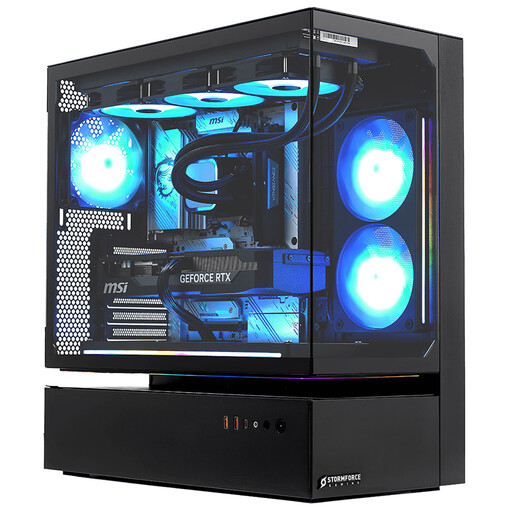
Stormforce Cyclone Ryzen 7, 32GB RAM, 2TB SSD, RTX5080
Consider this Ryzen 7 tower if you can accommodate a larger desktop and are assessing the stated memory and storage against your library plans. Its title lists 32GB RAM, a 2TB SSD and an RTX5080. Check placement and safe handling for the stated 22 kg tower, then confirm the required software, driver and peripheral connections.
View on Joybuy
Common questions
Is 16GB of RAM enough for a sample-library desktop?
It can suit lighter projects where instruments are loaded as needed, but it is not a universal target. Spitfire Audio’s workflow guidance pairs projects below roughly 30 tracks with 16GB RAM and a 500GB external SSD; for its more complex projects of up to 100 tracks, it suggests at least 32GB RAM and a 1TB external SSD. Size your own setup around the instruments and DAW you will run together.
Should sample libraries go on an internal drive or an external SSD?
An external SSD is a practical option when you want to keep sample content separate from limited internal storage. Spitfire Audio recommends SSD storage for libraries; check the capacity and connection your setup needs. If you use Native Access, keep its download and content locations separate.
Can I use one sample-library drive with both Mac and Windows?
For Native Instruments libraries, plan separate external drives rather than assuming one shared drive will suit both systems. Native Instruments warns of loading, playback and corruption risks with exFAT use across the two operating systems and recommends a drive formatted natively for each.
Will meeting a sampler’s minimum requirements cover my DAW project?
No: a sampler’s standalone requirements do not account for everything running in a full project. Native Instruments says Kontakt also needs resources for its host sequencer when used inside one. Check the DAW, plug-ins, sampler and audio-interface driver together against the desktop configuration.


