Choose a desktop around the sample libraries and audio equipment you will actually use: check software compatibility first, then allow enough memory and storage for your planned projects. A configurable Windows audio workstation gives you a way to specify components around that setup, while a Mac mini is a compact option when your DAW, plug-ins and interface support its chip and macOS version. Neither form factor establishes how quiet the finished setup will be.
Who needs this desktop?
Large-template sample-library builders
If you load several sampled instruments into a project, memory, processor capacity and room for an expanding library deserve close attention. Native Instruments Support notes that complex sampled sounds can place demands on both RAM and the CPU.
Quiet-study producers
If the computer will sit near your desk or a microphone, assess its case, cooling and other components rather than assuming a small desktop or an audio-workstation label means quiet operation.
Owners of existing audio equipment
If you already use a DAW, plug-ins, an audio interface or controllers, check each product and driver against the intended operating system and processor platform before changing desktops.
What matters when choosing?
For a sample library in a quiet study, the platform decision affects which existing tools you can keep using; memory, storage, responsiveness and noise then need checking against the exact configuration.
Configurable Windows audio workstation
Consider it when: you use a Windows-based DAW and want a builder to configure components around your library and connected audio equipment.
Trade-off: a supplier's quiet-workstation description does not establish the noise level of your chosen case, cooling and components.
Apple-silicon Mac mini
Consider it when: your required DAW, libraries, plug-ins and interface support the intended macOS and Apple-silicon setup, and you want a compact desktop.
Trade-off: choose memory and internal storage capacity at purchase, and check older software for Rosetta or macOS-version restrictions.
| Concern |
What to check |
Who this matters to |
| Memory and library storage |
Check memory capacity, SSD space and the storage requirements of the libraries you intend to use. |
If my collection is growing and I load several sampled instruments together, I need room for both the files and the active project. Around 36% of consumers put capacity first. |
| Real-time responsiveness |
Compare the exact processor and cooling configuration; consider how drives, controllers and the interface will connect. |
When instruments and effects run together, I want the desktop to keep up during playback or recording. Roughly 29% of consumers make responsiveness their primary concern. |
| Noise in the study |
Ask about the specified case, fans, cooler and graphics hardware, and seek acoustic information for that build. |
With the desktop close to my work area, audible fan noise could disturb concentration or nearby recording. Around 21% of consumers prioritise a quieter setup. |
| Software and device compatibility |
Confirm support for each DAW, plug-in, library engine, interface driver and controller on the intended operating system. |
If I already rely on particular audio tools, I need them to work after the move rather than choosing by hardware specifications alone. Approximately 14% of consumers put compatibility first. |
Buying pitfalls
-
Choosing by processor specifications alone
A capable CPU cannot remove every real-time audio bottleneck. Native Instruments Support points to memory, cooling and connected components as factors in overall system performance.
Assess the processor alongside memory, cooling, storage and the connections needed for your interface, drives and controllers.
-
Assuming any desktop tower will be quiet
Noise depends on the components and cooling in the particular build. Scan 3XS describes its audio workstations as quiet, but that supplier description is not an acoustic measurement for every configuration.
Request the case, cooler, fan and graphics details, and ask what acoustic information or return arrangements apply to the exact build.
-
Changing to Apple silicon without checking older tools
Native Instruments Support says some products need Rosetta on Apple silicon and reported that its hardware and software did not support macOS 27 Golden Gate at the time of its compatibility guidance.
Check every required DAW, plug-in, library engine, interface driver and controller against the intended Mac and macOS version before buying or updating.
A required Rosetta workflow or unsupported tool can mean time spent changing software or working arrangements.
-
Sharing one exFAT library drive between Mac and Windows
For Native Instruments libraries, the company warns that this arrangement can cause slow loading, playback glitches and a greater risk of data corruption.
If you work on both platforms, follow the library publisher's guidance. Native Instruments recommends separate drives formatted for each operating system.
Brands to consider for this setup
Apple
The Mac mini is a compact desktop route for a macOS audio workflow, provided your particular software and hardware support it.
- Apple lists configurable memory and storage options for the Mac mini with M5 Pro; check the capacity of the variant you select.
- Native Instruments Support documents Rosetta requirements for some software and macOS-version restrictions, so compatibility needs checking product by product.
Scan 3XS
A custom Windows audio-workstation route for buyers who want to discuss a studio desktop's components with the supplier.
- Scan 3XS says it tests its DAW systems with software and hardware and focuses on low-latency, quiet operation.
- Those supplier claims do not establish the acoustic performance of a particular order; request its component and noise details.
PCSpecialist
A build-to-order Windows audio-PC route for specifying storage, software and connected audio equipment.
- PCSpecialist says it considers requested software and external equipment such as audio interfaces when configuring its audio PCs.
- Confirm the final build's capacity, compatibility and cooling rather than assuming those details from the wider range.
Joybuy desktop choices
These desktops offer different starting points for a sample-library setup: two Windows towers with different listed memory capacities and a compact Mac mini. Check the demands of your own projects, software and study before choosing between them.
 No image available
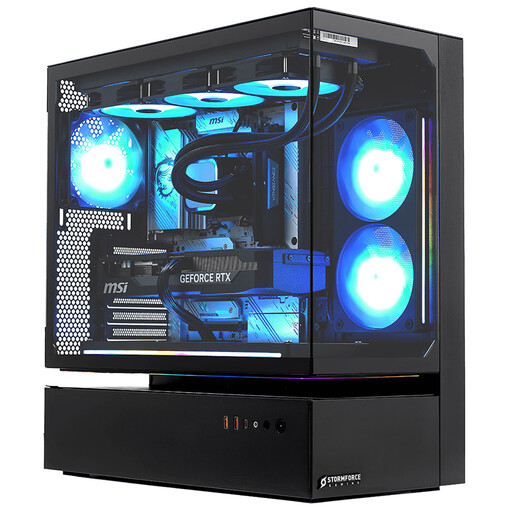
Stormforce Cyclone AMD Ryzen 7, 32GB RAM, 2TB SSD, RTX5080
Consider this tower if you want the listed memory and local storage capacity for an expanding library. Its named configuration includes an AMD Ryzen 7 processor, 32GB RAM, a 2TB SSD and RTX5080 graphics.
For a quiet study, ask about the exact cooling arrangement and acoustic performance. Check your DAW, plug-ins and audio-interface requirements separately.
Joybuy
 No image available
Apple Mac mini (2026), M5 Pro, 24GB RAM, 512GB SSD, Silver
Consider this compact desktop if your audio workflow supports Apple silicon and the intended macOS version. This variant has an M5 Pro with a 15-core CPU and 16-core GPU, 24GB RAM and a 512GB SSD.
Compare those capacities with your planned templates and library size, and confirm software, interface-driver and acoustic requirements before buying.
Joybuy
 No image available
HP M02-0005na OmniDesk, Ryzen 5 8500, 8GB RAM, 1TB SSD
Consider this Windows 11 Home tower for a setup whose memory needs fit its listed configuration. It has an AMD Ryzen 5 8500 processor, 8GB RAM and a 1TB SSD.
For larger sampled-instrument templates, check the memory requirements and supported upgrade options before choosing it. Ask about cooling and noise, and confirm compatibility with your audio software and devices.
Joybuy
Common questions
How much memory does a sample-library desktop need?
Choose memory for the libraries and project size you expect to use, rather than relying on one universal figure. Check each publisher's requirements and allow room if you load several sampled instruments together; Native Instruments Support says its Kontakt-based sounds can demand substantial RAM and CPU resources.
Can I keep a Native Instruments library on one drive for Mac and Windows?
Native Instruments recommends separate external library drives for the two operating systems. It warns that sharing an exFAT drive for this workflow can cause slow loading, playback glitches and a greater risk of data corruption; check the guidance for any other libraries you use.
Should I choose Windows or a Mac mini for existing Native Instruments software?
Choose the platform that supports your exact Native Instruments products, DAW and audio-interface driver. Native Instruments Support reports that current products were tested on Windows 11 without specific issues, while some Apple-silicon software needs Rosetta; it also reported macOS 27 Golden Gate unsupported for its hardware and software at the time of its guidance.
What should I do with an old desktop?
Check your local council or retailer for an electrical-equipment recycling route, and clear personal data before handing over the computer. Oxfordshire County Council specifically advises removing personal information from computers before taking them to a recycling centre.


