One-toastie households
If you normally make just one banana sandwich, a compact machine may be easier to accommodate than a larger maker. Judge Kitchenware specifies its JEA102 for a single sandwich; compare its plate size with the bread you use.


For one lightly filled banana toastie at a time, start with a compact single-sandwich toaster if storage space and unused capacity matter most. If you use thicker banana slices or add spreads, look instead at deep-fill, cut-and-seal plates; choose removable or interchangeable plates when easier washing or other snacks will justify the extra functions. Plate size, filling room and cleaning arrangements still need checking on the exact model.
If you normally make just one banana sandwich, a compact machine may be easier to accommodate than a larger maker. Judge Kitchenware specifies its JEA102 for a single sandwich; compare its plate size with the bread you use.
If you add thick banana slices, chocolate or nut butter, filling room and sealed edges become more important. Breville UK describes deep-fill and cut-and-seal plates designed to give fillings more room and help keep them inside.
If you want plates you can remove for washing and will also make waffles or grilled snacks, a multi-function machine may earn its cupboard space. Russell Hobbs UK specifies interchangeable sandwich, waffle and grill plates for its 26810.
For one banana toastie at a time, decide which matters most to you: a machine sized for the portion, room for soft fillings, or easier cleaning and other uses.
| Concern | What to check | Who this matters to |
|---|---|---|
| Portion size and storage | Check sandwich capacity, plate dimensions against your usual bread, and whether the appliance stores upright. Judge Kitchenware specifies a 130 × 125 mm plate for the single-sandwich JEA102. | If I make just one toastie, I want a machine that fits my portion without taking over the cupboard. Roughly 46% of consumers put portion size and storage first. |
| Filling containment | Look for stated deep-fill pockets and cut-and-seal plates, then check that your bread and filling fit without forcing the lid. Breville UK describes these features as intended to give fillings more room and help keep them inside. | Thicker banana slices or added spreads make me more concerned about filling escaping than about the smallest possible machine. Around 36% of consumers make containment their main priority. |
| Cleaning and extra uses | Confirm whether the exact model has removable, dishwasher-safe plates and which plate sets are included. Russell Hobbs UK lists sandwich, waffle and grill plates for the 26810. | When I make sticky toasties often or want waffles and grilled snacks too, plates I can wash separately matter more to me. Approximately 18% of consumers prioritise cleaning and extra uses. |
Deep-fill describes room for the sandwich filling, not whether you need the machine’s full batch capacity. Judge Kitchenware specifies a one-sandwich JEA102, which gives solo cooks a different starting point.
Check your usual portion and filling thickness before choosing capacity. Move to a larger deep-fill format when the extra room answers a need you actually have.
A larger appliance also needs more worktop or cupboard space.
Cleaning arrangements vary by model: Russell Hobbs UK describes fixed wipe-clean plates on the 26800 and removable, washable plates on the 26810.
Check the exact model for removable plates and dishwasher suitability, especially if banana or spread is likely to escape.
Deep-fill and cut-and-seal features are intended to help contain filling, but they do not make an overfilled sandwich spill-proof. Judge Kitchenware also warns that cooked sandwich contents can be extremely hot.
Spread sliced banana evenly, leave room at the edges, close the lid without forcing it and let the toastie cool before eating.
Electrical details apply to the exact variant: Judge Kitchenware lists its JEA102 at 220–240 V. A product’s appearance on a UK shopping site does not, by itself, settle the suitability of another variant.
Before checkout, check the model’s voltage, plug arrangement and product documentation against your home setup.
A compact, single-sandwich option for someone usually making one sealed toastie.
Deep-fill sealed toastie makers with different plate and cleaning arrangements.
A choice between a sealed sandwich maker and a model with interchangeable plates.
A deep-fill option to examine when filling space matters more than single-sandwich compactness.
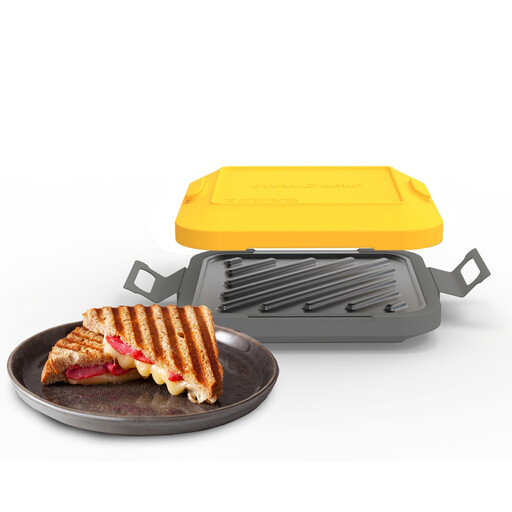
This microwave toastie-maker option is for shoppers considering a microwave-based appliance rather than a plug-in sandwich press. Check bread fit and filling room for your usual banana toastie.
 No image available
Consider this microwave toastie maker if you want to prepare a banana sandwich without a plug-in press; check that your bread and usual amount of filling fit.
Its product description lists dishwasher-safe components and a microwave limit of 1200 W. Check your microwave against that limit before use.
A one-sandwich model is the most direct capacity match if you almost always make one lightly filled toastie. Judge Kitchenware specifies the JEA102 for a single sandwich; check its plate size against your bread, and consider deeper pockets if your usual filling is thick.
Deep-fill plates are worth considering when thick banana slices or added spreads need more room. Breville UK describes deep-fill and cut-and-seal features intended to help accommodate and contain fillings, but you should still keep filling within the bread and pocket area.
Removable plates make more sense if you prepare sticky toasties frequently or will use additional plate sets. Russell Hobbs UK says the 26810’s plates can be washed separately; for occasional simple toasties, a fixed wipe-clean model may meet your needs.
Let it cool enough before eating. Judge Kitchenware warns that the contents of a cooked sandwich can be extremely hot, so take particular care with soft fruit filling.
Check the voltage and plug arrangement for the exact model against your home setup. Judge Kitchenware lists its JEA102 at 220–240 V; do not assume that a different variant has the same rating or plug.