Small-kitchen toastie makers
If the appliance needs to go away after use, compare its stored dimensions, upright-storage option and cord storage. Check that you can still open the lid fully where you plan to use it.


For sliced-bread mushroom toasties, choose cut-and-seal plates when containing the filling matters; a flat press suits ciabatta or focaccia but does not seal the edges. In a small kitchen, check storage dimensions, lid-opening clearance and where the appliance can operate safely. A microwave toastie maker is an alternative only if you have a compatible microwave.
If the appliance needs to go away after use, compare its stored dimensions, upright-storage option and cord storage. Check that you can still open the lid fully where you plan to use it.
If you usually add a substantial filling, look at deep-fill plates and the hinge design as well as whether the plates seal the bread. Leave enough room for the lid to close without forcing filling out.
If you regularly use ciabatta or focaccia rather than sliced bread, a flat press accommodates those shapes. Its plates do not create the sealed triangular pockets of a cut-and-seal toastie maker.
For mushroom toasties in a kitchen with limited worktop space, establish where the appliance can operate and be stored before choosing plate style and cleaning method.
| Concern | What to check | Who this matters to |
|---|---|---|
| Storage and operating space | Compare the exact model’s dimensions with your storage space and allow room to open the lid on a stable, heat-resistant surface. | If I need to put the toaster away after use, its stored size matters as much as its worktop footprint. Around 42% of consumers put space first. |
| Filling containment | Check for deep-fill or cut-and-seal plates, and whether the stated portion count suits your usual batch. | When I make a mushroom-and-cheese toastie, I want the lid to close without squeezing filling out. For around 33% of consumers, containment is the primary concern. |
| Cleaning | Confirm whether the plates are removable, dishwasher safe or cleaned in place; follow the model’s cooling and cleaning instructions. | If I make toasties often, dealing with residue afterwards can decide which machine I use. Ease of cleaning comes first for around 25% of consumers. |
An upright-storing toaster can still be too tall for its cupboard, while its lid needs room to open during use.
Measure both locations and compare them with the exact model’s dimensions. Confirm upright and cord storage if you need those features.
A flat press accepts breads such as ciabatta and focaccia, but its plates do not cut and seal sliced bread around a mushroom filling.
Choose cut-and-seal plates if contained, sliced-bread toasties matter more to you than bread-shape flexibility.
Filling can reach the plates or edges, and removable and fixed plates have different cleaning instructions.
Check whether the exact model’s plates can be removed and washed separately. Unplug the appliance and let it cool before cleaning it as directed.
Compact storage does not remove the need for a suitable surface during use or time to cool afterwards.
Use a stable, dry, heat-resistant surface, then unplug the appliance and allow it to cool fully before cleaning or storing it.
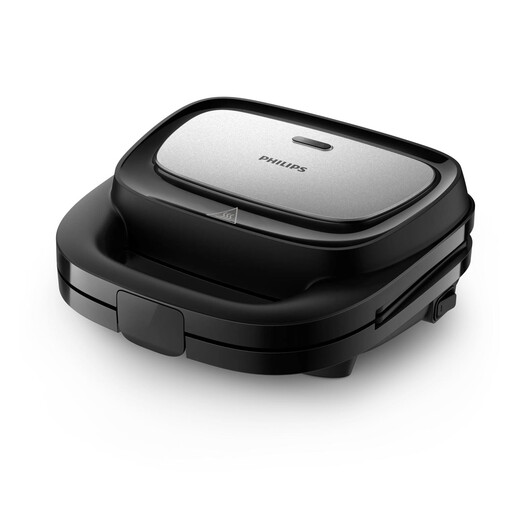
The VST101 deep-fill toastie maker and VST025 flat press illustrate different choices for sliced-bread toasties and panini-style sandwiches.
Its Creations Easy Clean 26800 is a cut-and-seal sandwich maker, while the 24540 combines sandwich, waffle and grill plates.
The EK2017S is a two-portion deep-fill option for conventional sliced-bread toasties.
These choices cover a countertop sandwich maker and a microwave toastie maker. The microwave option depends on having a compatible microwave; for either product, check that its use and storage fit your kitchen.
 No image available
Consider this countertop model for sliced-bread mushroom toasties if its cut-and-seal plates suit the amount of filling you use.
The listing indicates an EU power cord: confirm that a suitable adapter is appropriate for UK use before buying. Check lid-opening clearance and the plate-cleaning instructions for your kitchen.
 No image available
Consider this microwave toastie maker if you want to avoid operating a separate countertop press and have a suitable microwave.
Confirm microwave compatibility and check whether it accommodates your usual mushroom filling. Its product title describes it as dishwasher safe; follow the care instructions for the individual parts.
Choose cut-and-seal plates for sliced bread when containing the filling matters most. A flat press is better suited to bread shapes such as ciabatta or focaccia, but it will not seal the edges, so avoid overfilling it.
Check both where the exact model will be stored and where its lid can open during use. Salter lists the EK2017S at 24.5 × 10.5 × 29.3 cm, while the Breville VST101 is listed at 316 × 156 × 325 mm; neither set of dimensions replaces measuring your own cupboard and operating space.
Use a restrained amount of cooked mushroom filling so the lid can close without pushing it out. Draining excess moisture is especially useful with a flat press, which does not form sealed pockets.
Unplug it and let it cool fully before cleaning or storage. Follow the exact model’s instructions for its plates, and do not immerse the electrical base; dishwasher-safe removable plates are a model-specific feature, not a rule for every toaster.