Host serving sausages in batches
If several sausages need checking before you plate up, a handheld probe lets you take a separate reading from each one without setting up continuous monitoring.


For checking individual sausages just before serving, choose a handheld digital probe you can read easily while taking a core-temperature reading. A leave-in probe with an alarm makes more sense when you want to monitor an oven or covered-barbecue batch, but its cable is less convenient for moving between sausages. Whichever type you choose, check the centre of the thickest sausage rather than judging it by its browned exterior.
If several sausages need checking before you plate up, a handheld probe lets you take a separate reading from each one without setting up continuous monitoring.
The Whickham Practice NHS advises cooking minced-meat products such as sausages all the way through. A probe helps you check the centre of a thick sausage; it also needs cleaning between uses.
If you want to follow a batch while it cooks, a leave-in probe with a cable and alarm may suit you better than repeatedly taking handheld readings. Check that its cable is suitable for your cooking setup.
Choose this when: You need to check individual sausages as they come off a pan or grill.
Trade-off: You must take each reading yourself rather than monitor the food throughout cooking.
Choose this when: An alarm would help you follow an oven or covered-barbecue batch.
Trade-off: A cable is less convenient when moving the probe between individual sausages.
| Concern | What to check | Who this matters to |
|---|---|---|
| Quick final checks | Look for a stated reading time and a screen you can see clearly; a hold function can retain the reading after you withdraw the probe. | If guests are waiting, I want to check several sausages without holding up plating. Around 34% of consumers put quick final checks first. |
| Cooked-through centre | Choose a Celsius display and a probe you can position in the centre of the thickest sausage; follow the pack instructions too. | I would rather measure the middle than rely on how brown the outside looks. For around 33% of consumers, checking that sausages are cooked through comes first. |
| Handling and cleaning | Check whether the grip gives you enough reach near heat and follow the maker's probe-cleaning instructions. | When working over a hot pan, I want room for my hand and a probe I can clean between raw and cooked-food contact. Around 20% of consumers make handling and hygiene their primary concern. |
| Batch monitoring | For a leave-in model, confirm the cable's suitability for the appliance and whether it has a target-temperature alarm. | If the sausages are cooking in an oven or covered barbecue, I would find an alert useful while preparing other food. Batch monitoring comes first for around 13% of consumers. |
The Whickham Practice NHS warns that meat can be charred outside without being fully cooked inside.
Check the centre of the thickest sausage and follow its pack instructions. The Food Standards Agency describes 70°C for two minutes at the thickest part as sufficient for thorough cooking of meat.
A cable and alarm help with monitoring a batch, but moving a wired probe between sausages can make checks just before serving awkward.
Choose a handheld probe if individual final checks are your main task; consider a leave-in model when monitoring during cooking is the priority.
A display that changes in 0.1°C steps does not, by itself, establish how closely its reading matches the food's actual temperature.
When comparing models, treat display resolution and any stated accuracy tolerance as different specifications, and follow the probe's positioning instructions.
Contact between raw-meat residue and cooked food creates a cross-contamination risk. The Whickham Practice NHS advises cleaning temperature probes between uses.
Clean the probe according to its instructions before checking cooked food, and keep utensils used for raw meat separate from serving equipment.
Salter lists both a folding instant-read thermometer and a longer precision meat probe for handheld checks.
The Taylor Pro handheld probe listed by Lakeland has a larger display and a cover that doubles as an extended handle.
Its Professional Digital Timer & Thermometer is a leave-in option for cooks who want a target-temperature alarm.
Lakeland lists its own Rapid Response Thermometer as a handheld option for spot checks.
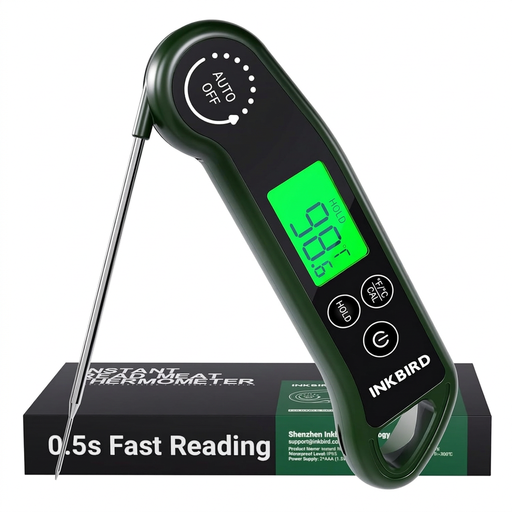
This digital meat thermometer is a choice to consider for checking sausages as you cook or before serving; confirm that its probe suits the way you take individual readings.
 No image available
Consider this model if a displayed reading matters for spot-checking sausages during cooking or before serving.
The product listing advertises a 0.5-second reading and identifies an LCD screen; treat the reading time as a product claim, not an independently tested result.
Before buying, check the probe's length and construction, whether the display shows Celsius, and the cleaning instructions against your cooking setup.
The Food Standards Agency describes 70°C for two minutes at the thickest part as sufficient for thoroughly cooking meat. The Whickham Practice NHS says minced-meat products such as sausages should be cooked all the way through; also follow the instructions on the sausage pack.
Put the probe in the centre of the thickest sausage so you check its core rather than its browned outer layer or the hot cooking surface. If the sausages differ in size, check more than one.
Yes. The Whickham Practice NHS advises cleaning temperature probes between uses; follow the thermometer's care instructions, especially when it has touched raw meat before you check cooked food.
A leave-in probe is more useful when you want an alarm to monitor an oven or covered-barbecue batch during cooking. For individual checks just before serving, a handheld probe avoids moving a cable between sausages; make sure any leave-in cable is suitable for your appliance.