Teachers scanning A4 scores
If your intact sheets fit on an A4 glass surface, a flatbed multifunction printer lets you position each page manually while also covering routine printing and copying.


Choose an A4 flatbed multifunction printer if every score fits on its glass and can be placed there safely. For full A3 sheets, look for an A3 scanning route and check whether it uses the glass or an automatic document feeder (ADF); fragile, bound or irreplaceable originals may instead need dedicated or specialist capture. For a shared classroom device, weigh those handling needs against the everyday printing and scanning workflow.
If your intact sheets fit on an A4 glass surface, a flatbed multifunction printer lets you position each page manually while also covering routine printing and copying.
If the whole score must be captured as one A3 page, check the device’s stated scan size and scan path. A3 printing alone does not establish either.
For fragile, damaged or irreplaceable scores, assess the condition and binding before choosing a scanner. The National Archives includes conservation and the safety of originals in digitisation planning.
Start with the largest original and how safely it can be handled; then decide how the device will serve the rest of the classroom’s work.
Choose when: All scores fit on the glass and can be placed there manually.
Trade-off: An A3 sheet cannot be captured in one pass on an A4 platen.
Choose when: Full A3 capture and regular shared printing or copying are both needed.
Trade-off: Its A3 scan route may use a feeder that does not suit sensitive originals.
Choose when: Condition or binding makes an ordinary feeder unsuitable for the original.
Trade-off: Capturing scores becomes a separate step from everyday classroom printing.
| Concern | What to check | Who this matters to |
|---|---|---|
| Handling and legibility | Assess condition and binding; check whether manual placement or a different capture method is appropriate. | If my annotated original is delicate, keeping it safe and its notation readable comes before batch scanning. Around 31% of consumers put handling and legibility first. |
| Full-page size | Measure the largest score and check maximum scan size separately from print size, including whether A3 capture uses the glass or feeder. | When I need the complete layout of an A3 score in one capture, an A4 scan surface will not cover it. Roughly 31% of consumers prioritise full-page size. |
| Shared workflow | Check the required network connection, scan destination and feeder limits for loose, intact sheets. | If several staff members will also scan ordinary paperwork, I need a workable way to share and save those scans. Around 23% of consumers make that workflow their main concern. |
| Printing consumables | Check supplied and replacement ink, stated yield conditions, maintenance items and your expected colour-printing mix. | Once the scores can be handled appropriately, I need to plan for the handouts and copies the classroom regularly uses. About 15% of consumers put printing consumables first. |
Print and scan limits are separate. Canon UK specifies an A4/Letter platen for the MAXIFY GX7050, while Epson states that the EcoTank Pro ET-16685 scans and copies up to A3.
Check the maximum scan size and whether the required A3 capture uses the platen or an ADF.
A feeder intended for loose sheets may be inappropriate for fragile, damaged or bound originals. Restore Information Management describes using a different scanner for sheets too fragile for high-volume equipment.
Inspect each original before choosing manual glass placement or a specialist capture service.
Manufacturer-stated yields do not tell you how your own mix of notation, colour handouts and maintenance will affect replenishment.
Compare the stated yield conditions with your likely printing pattern and check which consumables the model uses.
Canon UK lists a user-replaceable maintenance cartridge for the MAXIFY GX7050 in addition to its ink bottles.
A scan that identifies a pupil can contain personal data. The Information Commissioner’s Office says electronic personal data falls within UK GDPR processing and calls for security measures appropriate to the risk.
Agree where scans will be saved, who can access them and how they will be retained before setting up shared scanning.
Its cited range includes an A4 flatbed PIXMA model and an office-focused MAXIFY model with both glass and feeder scanning.
Its cited products include an A3-scanning EcoTank multifunction printer and a separate scanner for considering glass capture.
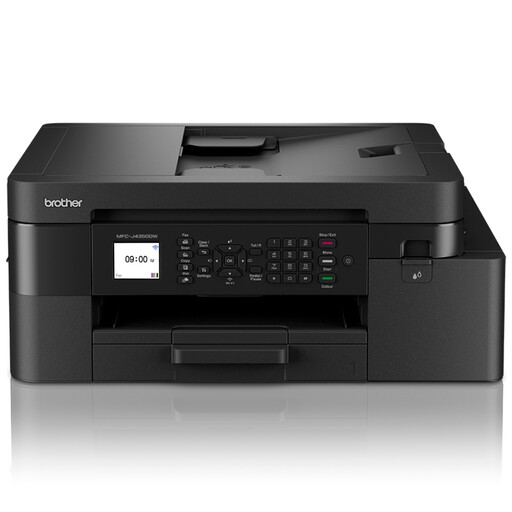
The cited MFC-J6959DW is an office-oriented multifunction model with A3 functions and network connections.
These multifunction printers are choices to assess for classroom printing and manuscript scanning. Match each one to your largest score and the capture method its condition requires before deciding.
 No image available
For a classroom that needs one device for printing and scanning, check whether its glass, maximum scan size and feeder media limits suit your scores.
 No image available
For classrooms considering an A4 multifunction printer, confirm the scanner’s maximum document size and whether pages can be placed manually on glass; the A4 description alone does not settle scan coverage.
 No image available
If full-page A3 manuscripts are the priority, confirm this model’s maximum scan size and whether the required capture uses glass or a feeder. Do not use its printing format as a substitute for the scan specification.
 No image available
For everyday printing alongside occasional score capture, check the glass-scanning option, maximum scan size and supported feeder media before using it with manuscripts.
Only when a full A3 original needs to be captured as one page. Canon UK gives the PIXMA MG3650S flatbed a maximum document size of 216 × 297 mm; Epson states that the EcoTank Pro ET-16685 scans and copies up to A3. Check the scan size rather than relying on the print format.
Use a feeder only for loose, intact pages that meet its supported media conditions. For fragile or damaged scores, assess the original first; Restore Information Management describes using a different scanner when sheets are too fragile for high-volume equipment.
Optical resolution is worth checking for the capture method you intend to use, but it does not by itself settle whether a score can be captured suitably. Epson specifies 1,200 dpi from the DS-1730 glass and 600 dpi from its ADF, so check which figure applies to your chosen scan path as well as the page’s size and condition.
A scan that identifies or can identify a pupil can contain personal data. The Information Commissioner’s Office says UK GDPR covers electronic processing of personal data and calls for security appropriate to the risk; agree staff access, storage and retention arrangements for shared classroom scans.
Check the supplied ink, replacement consumables and the conditions behind manufacturer-stated page yields against your expected black-and-white and colour printing. Yield figures alone cannot tell you how frequently your classroom will need to replenish supplies.