What matters when choosing a scanner?
Check the journals’ condition and largest page size before comparing feeder capacity or file-transfer options. Keep the workflow for robust loose sheets separate from decisions about vulnerable originals.
| Concern |
What to check |
Who this matters to |
| Handling bound originals |
Check condition and opening angle; test individual capture on a small part of the collection. |
If a journal is fragile or unique, I need to protect it even if placing pages individually takes longer. Around 40% of consumers put careful handling first. |
| Loose-page batches |
Compare ADF capacity and supported paper sizes; check for duplex scanning if both sides matter. |
When most of our work is robust loose sheets, I want to avoid placing every page by hand. For around 30% of consumers, batch handling is the primary concern. |
| Colour files and sharing |
Check colour scanning, output formats and the required PC, USB, mobile or cloud destination. |
I need annotations and photographs captured in files the group can organise and share appropriately. That file workflow comes first for around 20% of consumers. |
| Oversized pages |
Compare the maximum scan area with the largest original, not just the printer’s paper size. |
If our maps or fold-outs exceed A4, I need a way to capture the whole page. Around 10% of consumers chiefly need oversize coverage. |
Joybuy multifunction printers to consider
These printers are choices to examine for group printing and loose-page scanning. Before choosing one for travel journals, confirm its maximum scan area, whether it has a suitable platen, and how scans reach the group’s chosen storage.
 No image available
Brother MFC-J6760DW All-in-One Inkjet Printer
Consider it if the group needs to process robust loose pages as well as print. Check the maximum scan size before choosing it for large inserts, and assess bound originals separately.
Joybuy
 No image available
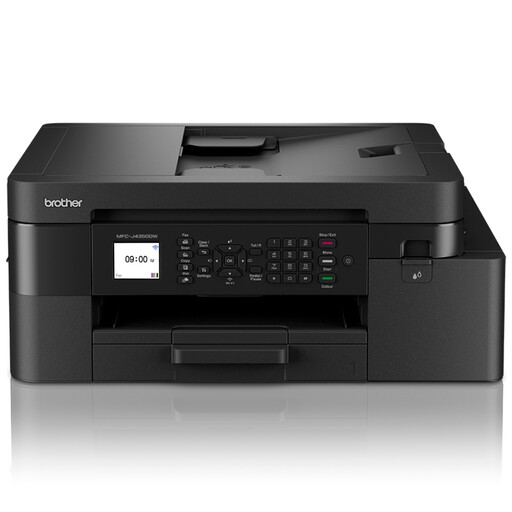
Brother MFC-J4350DW All-in-One Inkjet Printer
For a group planning loose-page scanning and app-based sharing, check device compatibility and the transfer process. Confirm the supported scan size and assess journals that cannot be fed as loose sheets.
Joybuy
 No image available
Canon MAXIFY GX6150
Consider it for a group working mainly with loose pages. Compare its feeder specifications and maximum scan area with the collection; check platen suitability before planning to scan bound journals.
Joybuy
 No image available
Epson EcoTank ET-5150 +Ink A4 Multifunction Printer
Its A4 designation makes it relevant to an A4-focused printing and scanning setup. Confirm the maximum scan size, file destinations and platen suitability before assigning it bound or oversized originals.
Joybuy
Common questions
Do we need both a platen and an ADF?
Both are useful if the group has individually placed A4 items as well as robust loose sheets. Canon UK specifies a platen and a 20-sheet A4 ADF for the PIXMA TR4750i, but an ADF rating is not permission to feed bound journals; test the workflow on a small part of the collection first.
Can an A4 multifunction printer scan every travel journal?
No: the journal must fit the model’s scanning area, and its condition must permit the intended handling. Canon UK specifies an A4/Letter platen maximum for the PIXMA TR4750i, while Brother UK specifies A3 scanning for the MFC-J6955DW. Assess fragile or difficult-to-open volumes individually rather than choosing by page size alone.
Can we publish scans because our group owns the journals?
Physical ownership alone does not establish permission to publish scans. Norfolk Record Office advises establishing rights before digitisation, and UK Intellectual Property Office guidance describes the non-commercial research and private-study exception as covering limited extracts. Check the rights and intended sharing terms for each collection before publishing whole journals or photographs.
What if a journal includes information about living people?
Decide who may access the files separately from deciding how to scan them. The National Archives notes that archive collections can contain personal data about living people; set access arrangements for working files and any public versions before putting scans into shared storage.


