Who needs which scanning workflow?

People archiving fragile clippings

If you scan cut or aged newspaper one piece at a time, prioritise control over placement, a scan area large enough for the original and a way to save the file you need. Epson’s scanning guidance describes placing an original on scanner glass; check the workflow for the model you intend to buy.

Home users with a small desk

If one machine must handle occasional printing, copying and scanning, look beyond its closed dimensions. Check where paper goes, how the scanner opens and how much working space remains around the printer.

People scanning mixed paper batches

If you also scan intact, similarly sized documents, an automatic document feeder may reduce repeated loading. Canon describes a batch-scanning workflow for its PIXMA TS7450 Series; keep individual clippings separate from that feeder decision.

What should you check before buying?

Start with the originals: confirm how the exact printer scans a loose clipping and whether its usable glass area fits yours. Next, measure the working space on your desk; give feeder capacity weight only if you also handle intact document batches.

Concern What to check Who this matters to
Handling cut originals Confirm scanner-glass placement and a usable scan area that fits your largest clipping. Check that the app saves your required file format. If my clippings are irregular or fragile, I want to position each one myself and inspect the scan before saving it. Roughly 42% of consumers put controlled handling first.
Working footprint Compare desk space with the printer’s dimensions in use, including lid clearance and paper-tray direction. With little room to spare, I need printing, copying and scanning in one device that I can still use comfortably on my desk. Around 33% of consumers make working space their primary concern.
Intact document batches Check whether the model has a feeder, what sheets it accepts and whether you can also scan individual originals on the glass. When I have several ordinary sheets to scan as well as occasional clippings, loading them one by one takes time. About 25% of consumers prioritise the batch-document workflow.

Buying pitfalls

  • Assuming a feeder will handle every clipping

    Feeder capacity describes a workflow for suitable sheets, not the handling of small, torn or folded newspaper pieces. Canon’s PIXMA TS7450 Series, for example, has a stated batch capacity, but that does not establish suitability for irregular cuttings.

    Check the exact model’s instructions before feeding an original. For non-standard pieces, confirm a scanner-glass workflow instead.

  • Measuring only the closed printer

    A machine can fit on a desk while closed yet leave too little room to open the scanner or move paper through its trays.

    Measure the available width, depth and space above the desk, then compare them with the exact model’s operating arrangement.

  • Assuming separate inks settle the running-cost question

    Replacing individual colours does not, by itself, establish which printer will cost less to use.

    For the model you are considering, compare the correct cartridges, their stated page-yield basis and any optional subscription terms against your likely printing.

  • Overlooking the scanner glass

    Residue on the glass can affect a scan, making it harder to judge whether the problem lies with the original or the machine.

    Follow the manufacturer’s cleaning instructions. Canon advises a clean, soft, lint-free cloth; Epson warns against letting liquid pass the edge of the scanner glass.

Relevant printer brands

Brother

Brother’s DCP-J1050DW is an example of a compact A4 home print-copy-scan machine for buyers who also want enclosed paper storage.

  • Brother UK lists a 150-sheet enclosed tray and 1,200 × 2,400 dpi optical scanning for the DCP-J1050DW.
  • Those specifications do not establish the usable scan area or safe handling of a particular aged clipping. Check the exact scanner-glass instructions and your available space.

Canon

Canon offers different home-printer workflows, including the ADF-equipped PIXMA TS7450 Series and five-ink PIXMA TS6350a Series.

  • Canon says the PIXMA TS7450 Series can scan or copy 35 pages at a time through its automatic document feeder, a feature relevant to intact document batches.
  • That feeder capacity does not establish suitability for loose newspaper cuttings. Check the scanner-glass workflow separately, and confirm current availability of any model you select.

Epson

Epson describes the Expression Home XP-2200 and XP-5200 as compact A4 multifunction printers with individually replaceable ink colours.

  • Epson lists a 150-sheet front-loading cassette and A4 duplex printing for the XP-5200.
  • Individual inks do not establish a lower total running cost. Compare the exact replacement options and measure the printer’s working footprint before choosing.

Joybuy products to consider

This wireless inkjet printer is an option to assess if you need a machine for a small desk and clipping scans. Confirm its scanner-glass workflow, usable scan area and operating clearance before deciding whether it fits your originals and workspace.
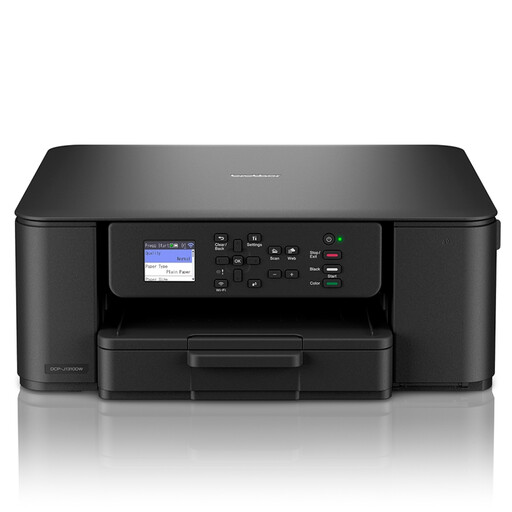
Brother DCP-J1310DW Wireless Inkjet Printer

Brother DCP-J1310DW Wireless Inkjet Printer

For individual newspaper cuttings, check that this model lets you position each original as needed and that its usable scan area fits your largest piece.

Measure the space required while scanning and handling paper, rather than relying on the closed footprint alone.

View on Joybuy

Frequently asked questions

Should I put newspaper clippings through an automatic document feeder?

Use a feeder only for originals the exact model’s instructions say it can handle; for cut or fragile clippings, confirm a scanner-glass workflow. Canon’s stated 35-page feeder capacity for the PIXMA TS7450 Series concerns batch scanning and does not establish that irregular cuttings can be fed safely.

Which scan settings and file types matter for clippings?

Check that the exact model’s scanning app can save the format you need and lets you inspect the result before filing it. Brother UK lists 1,200 × 2,400 dpi optical scanning for the DCP-J1050DW, but that model-specific figure does not establish how another printer will handle an aged original.

How should I clean the scanner glass?

Follow the instructions for your printer. Canon advises wiping the platen glass with a clean, soft, lint-free cloth, while Epson warns against allowing liquid past the edge of the scanner glass.

What should I do if a printer is faulty after purchase?

Keep your order details and a description of the fault, then contact the retailer. Citizens Advice says buyers of faulty goods may be entitled to a refund, repair or replacement; check its guidance for the part of the UK that applies to your purchase rather than treating a change-of-mind returns policy as the answer to a fault.