Organisers offering a sugar-free option
Make it clear which item is sugar-free, and keep its packet available so families can check sweeteners, ingredients and product-specific age warnings.


For a school bake sale, offer sugar-free marshmallows as a clearly identified option if you can pass on the product’s ingredient and age-warning information; do not assume they suit every child or anyone avoiding animal products. The de Bron sugar-free listing includes gelatine and says the product is unsuitable for children under four because of its sweeteners, while M&S Vegan Marshmallows contain 66.6 g sugars per 100 g. Keep ingredient and allergen details available for every item, including bakes made with several products.
Make it clear which item is sugar-free, and keep its packet available so families can check sweeteners, ingredients and product-specific age warnings.
Check animal ingredients separately from sugars. The de Bron sugar-free marshmallows list gelatine, whereas M&S describes its Vegan Marshmallows as free from animal products but lists 66.6 g sugars per 100 g.
Keep track of the ingredients in each finished bake, not just its marshmallows, so ingredient and allergen information is available when visitors choose an item.
Decide whether the item needs to be sugar-free or free from animal products, then check the exact packet and the ingredients in the finished bake.
| Priority | What to check | Your needs |
|---|---|---|
| Sweeteners and age warnings | Read the sweetener ingredients and any age or consumption warnings on the exact packet. The de Bron listing names maltitol syrup and isomalt and says the product is unsuitable for children under four because of its sweeteners. | I want a sugar-free option, but need families to see the product-specific warnings before choosing it for a child. |
| Animal ingredients | Check the ingredient list and dietary statement separately from the sugar-free label. The de Bron sugar-free product lists gelatine; M&S describes its Vegan Marshmallows as free from animal products. | If an attendee avoids animal products, I need to identify a suitable item without assuming that sugar-free means vegan. |
| Sugars and recipe choice | Compare sugars per 100 g on the packs being considered, and check every ingredient in an assembled bake. M&S lists 63.1 g sugars per 100 g for its Soft Marshmallows and 66.6 g per 100 g for its Vegan Marshmallows. | For a conventional bake such as rocky road, I can consider marshmallows described for that use; a vegan label alone will not meet a sugar-free requirement. |
| Ingredient information | Keep the source packets and a record of ingredients added to each bake. Check how the items will be packaged and presented so allergen information can be supplied appropriately. | Visitors need to be able to ask what is in a portion, particularly when it combines marshmallows with other ingredients. |
The de Bron sugar-free listing names maltitol syrup and isomalt and states that the product is unsuitable for children under four because of its sweeteners.
Identify it as a separate option and keep its packet at the stall so the age statement and ingredients can be checked.
The de Bron sugar-free product lists gelatine. M&S Vegan Marshmallows are described as free from animal products, but their nutrition information lists 66.6 g sugars per 100 g.
Check animal ingredients and sugars separately before describing a finished bake or offering it for a particular dietary requirement.
A finished bake can contain ingredients from several packets. Without those details, volunteers may be unable to answer questions about what is in a portion.
Keep the original packets and record all ingredients used in each recipe before items are portioned or sold.
GOV.UK says food supplied or sold at school fetes and fundraisers must comply with food law and be safe to eat.
Plan how food will be prepared, presented and identified, and check which requirements apply to the event’s activities.
These product examples distinguish sugar-free, vegan and conventional marshmallows; a brand name alone does not establish the ingredients of every product it sells.
A sugar-free marshmallow option listed by UK retailer Sweetswithout.
Tesco lists Free'ist Sugar Free Marshmallows in a 75 g pack.
M&S provides separate conventional and vegan marshmallow examples for comparing dietary requirements.
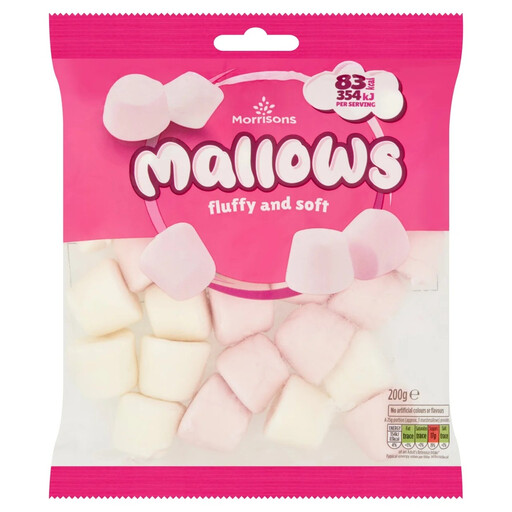
This marshmallow option is for a bake-sale recipe that does not require a sugar-free product; check the finished bake’s ingredients before presenting it to visitors.
 No image available
A conventional marshmallow option for a bake-sale recipe that does not need to be sugar-free. Check the current packet for ingredients, allergens and any age warnings before serving or selling the finished bake.
No. The de Bron sugar-free marshmallows listed by Sweetswithout contain maltitol syrup and isomalt. GOV.UK’s food-labelling guidance also identifies wording for foods containing sweeteners, so read the exact packet rather than treating “sugar-free” as “unsweetened”.
Not necessarily: the de Bron sugar-free product lists gelatine. M&S describes its Vegan Marshmallows as free from animal products, but lists 66.6 g sugars per 100 g, so check vegan suitability and sugars as separate questions.
Keep the ingredients for each finished item accessible and check the rules that apply to how it is supplied and packaged. Food Standards Scotland says food businesses must provide allergen information for prepacked and non-prepacked food and drink in Scotland; GOV.UK says food supplied at school fetes and fundraisers must comply with food law and be safe to eat.
Yes, keeping it available lets volunteers check the product’s ingredients and any sweetener or age statements. If marshmallows go into a mixed bake, also record the other ingredients so the packet is not mistaken for information about the whole item.