For repeated labels on shared school equipment, choose a printer and compatible label material together: the label must fit the information you need and suit the surface it will be attached to. A connected desktop model makes more sense for repeatable asset IDs and wider layouts, while a portable maker suits occasional short labels made around the community centre. For high-value items that need tamper-evident identification, compare printed tape with purpose-made asset labels before choosing a printer.
Who needs which labelling approach?
Shared-equipment coordinators
If several groups use the same equipment, consistent asset IDs and reusable label layouts can make identification easier to manage. Brother UK describes barcode and QR-code creation in P-touch Editor for asset-tracking workflows.
Volunteer-led occasional label makers
For a modest number of short labels made in different rooms, standalone operation and portability may matter more than a wide label. DYMO UK lists its LabelManager 280 as a portable maker for 6 mm, 9 mm and 12 mm D1 tapes.
High-value asset custodians
For devices that need fixed identification or evidence of attempted label removal, compare in-house labels with specialist asset tags. Data Label describes custom numbering and codes, while Asset Labels for Schools describes labels designed to fragment on attempted removal.
What matters when choosing?
Decide what the label must survive and contain before choosing between a desk-based workflow, a portable maker and ordered asset tags.
Connected desktop printer
Choose when: The centre regularly produces repeatable asset IDs, multi-line labels or codes from a computer.
Trade-off: Label makers need access to the desk and any required computer or mobile setup.
Portable label maker
Choose when: Volunteers make occasional short labels near equipment stored in different rooms.
Trade-off: Check that its tape width leaves enough space for the intended identification.
Specialist asset labels
Consider when: High-value items need sequential numbering or tamper-evident identification.
Trade-off: Ordered labels give less flexibility to create or change an identifier on the spot.
| Concern |
What to check |
Who this matters to |
| Durability and adhesion |
Check the exact compatible tape or roll against the equipment surface and its exposure to handling or cleaning. |
When equipment is handled repeatedly, I need its identifier to stay legible and attached. Around 33% of consumers put label durability and adhesion first. |
| Repeatable asset IDs |
Check the required label width and whether the model and its software can produce the codes or layouts used by the asset register. |
If I am marking a run of shared items, I want consistent IDs without re-entering each layout. Around 27% of consumers prioritise repeatable asset identification. |
| Room-to-room labelling |
Check how the printer is powered and whether labels can be made without returning to a workstation. |
Bulky items are easier to mark where they are stored; around 20% of consumers place portability first. |
| Occasional short labels |
Check whether standalone operation and the available tape widths cover simple names or ownership labels. |
For a small number of cupboard or equipment labels, I would rather keep the setup straightforward. Around 20% of consumers put ease of occasional use first. |
Mistakes that can undermine equipment labels
-
Choosing the printer before checking its labels
A printer family can use its own tape or roll system. Brother UK describes resistance properties for laminated TZe labels, while DYMO describes its permanent D1 tape for several clean, flat surfaces; neither description establishes adhesion to every piece of equipment.
Identify the main surfaces first, then check a compatible label material. Where practical, try it on a non-critical item before marking the whole inventory.
A label that lifts or becomes illegible also takes time to replace.
-
Trying to fit a detailed asset record onto narrow tape
A short item name may fit where a centre name, asset ID and readable code will not. DYMO UK lists a 12 mm maximum D1 tape width for the LabelManager 280; Brother UK lists wider tape options for its PT-D410 and PT-D610BT models.
Draft the longest label you expect to print, including any code, before deciding which widths you need.
-
Treating an inspection sticker as proof of electrical safety
The Health and Safety Executive says electrical equipment must be maintained in a safe condition and that annual portable appliance testing is not a blanket legal requirement. A printed identifier or check date does not replace appropriate inspection, maintenance or testing.
Keep the asset ID linked to separate safety records, with checks appropriate to the equipment and its use.
-
Assuming listed tape means a printer is current
Epson United Kingdom lists LabelWorks supplies, but identifies the LW-C610 printer as discontinued. A compatible tape listing alone does not establish that a particular printer remains a suitable purchase.
Check the exact printer model, its support arrangements and compatible supplies before choosing it.
Relevant label-printer brands
Brother
Brother UK offers P-touch models for desktop and connected label-making workflows, including asset IDs and codes created with P-touch Editor.
- Brother UK describes its laminated TZe labels as resistant to water, sunlight, chemicals and abrasion.
- Capabilities vary by model: Brother UK lists tape up to 24 mm and automatic cutting for the PT-D610BT, but tape up to 18 mm and a manual cutter for the PT-D410. Check the printer and cassette together.
DYMO
DYMO LabelManager models are worth considering for short labels made with a portable printer. The LabelManager 280 can be used on its own or connected to a PC or Mac.
- DYMO UK lists 6 mm, 9 mm and 12 mm D1 tapes for the LabelManager 280 and describes water and UV resistance for its permanent D1 tape.
- Its 12 mm maximum width may constrain a detailed asset ID or prominent code. Check the specific D1 cassette and intended surface.
Epson
Epson LabelWorks provides a tape-system comparison when considering equipment labels. Epson United Kingdom describes resistance to water, scratching, chemicals and temperature changes for a listed matte tape.
- LabelWorks supplies include tape-width options that may suit different label layouts, subject to printer compatibility.
- Epson United Kingdom identifies the LW-C610 printer as discontinued. Confirm a current printer and its compatible supplies rather than choosing from a tape listing alone.
Joybuy printers for equipment identification
These printers offer portable and desk-based ways to create equipment identifiers. Before choosing one for frequently handled school equipment, check the exact compatible labels against the surfaces you need to mark; a wider label or code-making feature alone does not establish durability.
 No image available
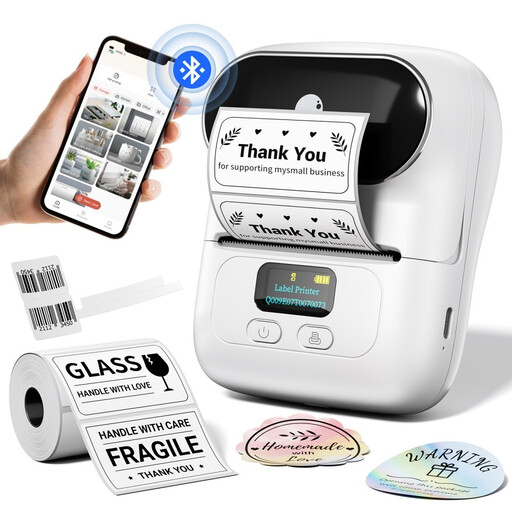
Phomemo M110 portable label maker with 1 label roll
Consider this portable model for making equipment identifiers away from a desk. Check the compatible roll type, the layout needed for your IDs and how the labels adhere to the intended surfaces; the included roll should not be assumed suitable for every item.
View on Joybuy
 No image available
Brother QL-600B label and address printer
Consider this desk-based printer for repeated equipment identifiers. It uses direct-thermal printing rather than the laminated tape route discussed above, so check the exact compatible DK roll and its suitability for handled equipment before relying on it for long-term marking.
View on Joybuy
 No image available
Phomemo D30 portable label maker, 0.59 inch
Consider this portable maker for simple identifiers created near the equipment. Confirm the compatible label width and material for the layout you intend to print, then check adhesion on the equipment surface before marking multiple items.
View on Joybuy
Questions about labelling school equipment
Does every equipment label need a barcode or QR code?
No code is needed for a simple visual identifier; use one when it serves the centre's asset-register or scanning process. Check that the chosen printer and software can produce the format that process uses. Brother UK says P-touch Editor can create barcode and QR-code labels.
Can an annual PAT sticker serve as the centre's electrical-safety system?
No. The Health and Safety Executive says electrical equipment must be maintained in a safe condition and that annual testing is not a blanket legal requirement. Use labels to identify items or link them to records, while arranging visual checks and any inspection or testing appropriate to the equipment and environment.
Who is responsible for equipment provided in a community hall?
In Great Britain, the Health and Safety Executive says those controlling a community hall have responsibilities concerning equipment provided for expected use. Assign responsibility for the asset register, damage reports and appropriate equipment checks; putting an ID sticker on an item does not transfer that responsibility.
What should I check when buying a mains-powered label printer?
Choose a printer intended for the location where it will be supplied and keep its supplier documentation. Product-marking arrangements differ between Great Britain and Northern Ireland, so consult the applicable GOV.UK guidance for the delivery location rather than assuming the same requirements apply in both.


