Families managing coeliac disease
Look for an explicit gluten-free label, then check the filling and prepare the lunch on clean surfaces with clean utensils. Coeliac UK also advises telling the school that the child needs a gluten-free diet.


If a child has coeliac disease, choose a wrap labelled gluten-free and prepare the whole lunch without gluten cross-contact; an ordinary wheat wrap is not a substitute. For a wheat allergy, check the ingredients and precautionary information separately, because a gluten-free label does not by itself confirm that a product is suitable. Then choose a size that works for the filling, follow the pack’s storage directions and check the school’s arrangements for the child.
Look for an explicit gluten-free label, then check the filling and prepare the lunch on clean surfaces with clean utensils. Coeliac UK also advises telling the school that the child needs a gluten-free diet.
Read the purchased pack for wheat ingredients and precautionary statements, rather than relying on its gluten-free claim. Check the child’s allergy arrangements with the school.
When there is no need to avoid gluten or wheat, a conventional wrap is an option. Compare its size with the filling and the space available in the lunchbox.
Start with the child’s dietary requirements, then compare wrap formats and the practicalities of making and storing the lunch.
| Priority | What to check | Your needs |
|---|---|---|
| Gluten-free suitability | Look for an explicit gluten-free claim on the purchased wrap. Read its ingredients and precautionary information; check the filling and keep preparation surfaces and utensils clean. | I’m packing for a child with coeliac disease, so the finished lunch needs to avoid gluten cross-contact as well as use a suitable wrap. |
| Wheat allergy | Check for wheat in the ingredients and read any wheat precautionary statement against the child’s allergy advice. A gluten-free claim answers a different question. | A gluten-free label alone does not settle whether I can pack this for a child with a wheat allergy. |
| Size and format | Compare the size of each tortilla with the filling. Old El Paso UK lists its regular gluten-free tortilla at 36 g each and its separate large variant at 54 g each; small corn tortillas are another format. | For a rolled lunch, I want a wrap that holds the intended filling. Smaller filled portions may call for a different tortilla. |
| Storage and packing | Follow the exact wrap and filling labels after opening. Old El Paso UK directs buyers to refrigerate its opened large gluten-free wraps and use them within three days; Norfolk and Norwich University Hospitals NHS Foundation Trust advises using a cool bag and ice pack for a lunch that needs to stay cool. | If I’m preparing lunches across several days, I need a pack I can use within its storage directions and a way to keep the filled lunch appropriately cool. |
| School arrangements | Tell the school about the child’s relevant dietary needs and check the arrangements that apply to their packed lunch. | I need the lunch I pack to fit the school’s arrangements for my child, rather than assuming every school follows the same approach. |
An ingredient or broad product description does not establish whether the finished wrap meets a gluten-free requirement or is suitable for a wheat allergy.
Check the claim, full ingredients and precautionary information on the pack you buy against the child’s particular needs.
A suitable tortilla can be paired with an unchecked filling or prepared where wheat crumbs remain.
Check every filling and component. For gluten-free preparation, Coeliac UK advises cleaning surfaces and utensils with hot soapy water and avoiding contaminated shared spreads.
Old El Paso UK lists distinct regular and large gluten-free tortillas. Their stated sizes affect how much tortilla is in each filled portion, while opened-pack directions affect when the remaining wraps need to be used.
Compare the exact variant with the lunches you plan to make, and follow that pack’s storage instructions.
These examples distinguish documented wrap ranges; a brand name alone does not establish whether a particular pack meets a dietary requirement.
Old El Paso UK lists separate regular and large gluten-free tortillas, while Sainsbury’s lists its small gluten-free white-corn tortillas.
Mission Original Wraps are a conventional-wrap comparison, not a gluten-free choice.
Sainsbury’s lists an own-label Free From white tortilla wrap described as gluten-free.
These two options cover a wrap labelled gluten-free and a flour-tortilla format for school lunches. Check each purchased pack against the child’s dietary requirements.
 No image available
The gluten-free label makes this a wrap to consider for a gluten-free school lunch. The pack is 216 g; check its current ingredients, precautionary information and storage directions, and check the filling separately.
 No image available
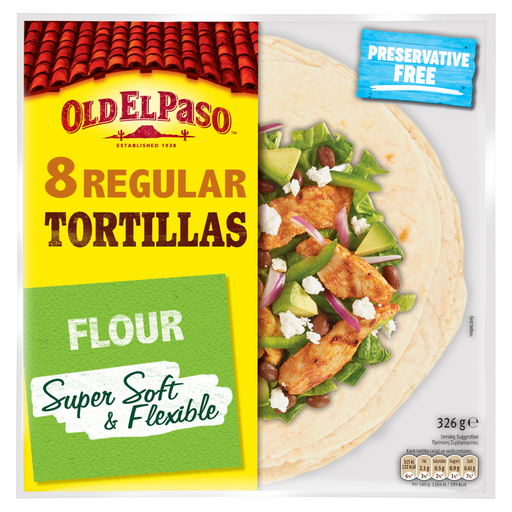
This 326 g flour-tortilla pack is an option to examine when gluten or wheat does not need to be avoided. It is not labelled gluten-free in its product name; read the purchased pack’s ingredients, allergen information and storage directions before packing it.
No. A gluten-free product can contain specially processed wheat starch. Read the purchased pack for wheat ingredients and precautionary information, and assess it against the child’s allergy advice rather than treating coeliac disease and wheat allergy as the same condition.
Check the wrap and every filling, then use clean preparation surfaces, utensils and spreads. Coeliac UK advises washing surfaces and utensils with hot soapy water and avoiding shared spreads contaminated by breadcrumbs.
Follow the storage directions for both the wrap and its filling. Norfolk and Norwich University Hospitals NHS Foundation Trust advises keeping a lunch made the night before in the fridge, then using a cool bag and ice pack when it needs to stay cool.
Check the arrangements that apply to your child’s dietary needs and packed lunch. Coeliac UK advises informing the school when a child needs a gluten-free diet; for a wheat allergy, coordinate the child’s allergy arrangements with the school rather than assuming that a gluten-free label settles the question.
Use the label on the pack you purchase for its current ingredients, allergens and storage directions. Check the exact variant each time rather than relying on an earlier description of a similar wrap.