Who is printing?

Editors producing regular colour issues

If you print A4 newsletters repeatedly, a refillable ink supply may be more relevant than it is for a one-off project. Compare black and colour yields separately: figures published by Brother and Epson describe their stated ink yields, not the number of finished newsletters a particular layout will produce.

Clubs making multi-page handouts

If newsletters use both sides of each sheet, look for automatic duplex printing and a paper tray suited to the batch. An ADF helps when you also scan or copy several-page originals; it does not feed sheets for newsletter printing.

Occasional project printers

For a short, infrequent run, an A4 printer that also copies and scans may cover the project without a larger paper-handling setup. Check that its size, connection options and two-sided printing capability suit where and how the club will work.

What matters when choosing?

Start with how often the club prints, then decide whether the main interruption will be handling two-sided batches or managing an occasional print, copy and scan task.

Concern What to check Who this matters to
Ink for recurring colour issues Compare the exact model’s included black and colour ink yields and the replacement bottles needed for future issues. When issues go out regularly in colour, I need to plan for ink used by both text and artwork. Roughly 42% of consumers put ongoing ink use first.
Handling two-sided batches Confirm automatic duplex printing and paper-tray capacity; consider an ADF only for multi-page scanning or copying. A batch of double-sided copies is harder to manage if I keep reloading sheets or turning pages by hand. Around 33% of consumers chiefly prioritise print handling.
Fit for an occasional project Check A4 print, copy and scan functions, device compatibility and the space available for the printer. For a short project run, I want one device that fits the workspace and covers the other tasks we actually do. About 25% of consumers put compact, straightforward use first.

What is easy to overlook?

  • Planning for the printer but not future ink supplies

    A club that publishes repeatedly will use ink beyond what comes in the box, while the amount used depends on each issue’s layout and colour coverage.

    Estimate issues, pages and copies per term, then check the exact included ink and compatible replacement-bottle range.

  • Treating page yield as a newsletter count

    HP notes that actual ink yield varies significantly with printed content and other factors. A page with large colour images need not use ink like a text-heavy page.

    Use stated yields to compare supplies, not to promise a number of finished issues. Try a representative newsletter page before a large run.

  • Choosing an ADF for a print-only task

    An ADF feeds originals during scanning or copying; it does not replace automatic duplex printing or a suitable paper tray.

    If the club will only print newsletters, assess duplex printing and paper handling before treating ADF capacity as important.

  • Reusing third-party material without checking permission

    Permission to reproduce articles, images or extracts depends on the material, intended use and applicable school licence. The Department for Education’s copyright-licence guidance concerns state-funded schools in England, not every school across the UK.

    Use original pupil work where possible, and ask the school to check the relevant licence or permission before including third-party material.

Relevant brands to consider

Epson

The EcoTank ET-2950 is an A4 print, copy and scan option for modest newsletter runs; the ET-5150 is a separate model with more paper-handling features.

  • Epson lists automatic two-sided printing for the ET-2950 and states included-ink yields of up to 8,500 black and 6,500 colour pages.
  • Those yields do not predict output for a particular colour newsletter. The ET-5150’s 250-sheet tray and 35-page ADF should not be assumed to be ET-2950 features.

Brother

The TankBenefit DCP-T780DW is relevant when regular newsletter printing is combined with scanning or copying multi-page source material.

  • Brother lists automatic two-sided printing, a 150-sheet tray and a 20-sheet ADF, alongside manufacturer-rated included-bottle yields of 15,000 black and 5,000 colour pages.
  • The ADF assists scanning and copying rather than print output, and the stated ink yields are not a guarantee for a club’s newsletter design.

Canon

The MAXIFY GX2051 is an option to examine when a shared club printer needs a larger paper cassette, multi-page scanning and a wired-network connection.

  • Canon lists a 250-sheet cassette, 35-sheet ADF, Wi-Fi and Ethernet for the GX2051.
  • Check the exact bundle and replacement supplies rather than applying the GX2051’s included-ink figures or features to other MAXIFY models.

Joybuy printer choices

This printer is relevant to recurring A4 colour newsletters, particularly when the club also scans or copies multi-page originals.
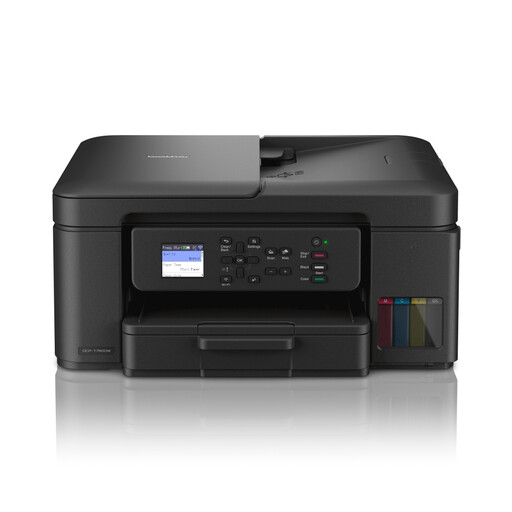
Brother DCP-T780DW 3-in-1 Wireless Ink Tank Printer

Brother DCP-T780DW 3-in-1 Wireless Ink Tank Printer

Consider this model for repeated two-sided newsletter runs when scanning or copying multi-page material is also part of the club’s work.

Brother lists automatic duplex printing, a 150-sheet paper tray and a 20-sheet ADF. The ADF is for scanning and copying, not faster newsletter printing.

Brother rates the included bottles at 15,000 black and 5,000 colour pages; the number of finished newsletters will depend on their content and colour coverage.

View on Joybuy

Common questions

Do we need automatic two-sided printing for a school newsletter?

Choose automatic duplex printing if the newsletter is designed for both sides of each sheet, especially for repeated runs that would otherwise need manual re-feeding. Epson lists it for the ET-2950 and ET-5150, and Brother lists it for the DCP-T780DW; check the exact model you intend to use.

Will an ADF make the newsletters print faster?

No: an automatic document feeder handles multi-page originals for scanning or copying, not the sheets used for print output. If the club only prints finished newsletters, focus instead on automatic duplex printing and paper-tray capacity.

Can we put material from books or other publications in the newsletter?

Check permission or the school’s applicable licence before reproducing third-party material. The Department for Education says it buys copyright licences for state-funded primary and secondary schools in England, but coverage depends on the material and intended use; its England-specific guidance should not be assumed to apply unchanged elsewhere in the UK.

What should we do with an old printer we replace?

Check the relevant local authority or retailer for an electrical-equipment recycling or take-back route. Collection arrangements vary, so confirm the available route before disposing of the printer.