Text-rota organisers
If most sheets are black-and-white A4 timetables, prioritise straightforward text printing and decide whether automatic two-sided output would help with rota packs.


For mainly black-and-white A4 rotas, start with a mono laser printer that has automatic two-sided printing, provided you do not need colour, copying or scanning. If the project regularly produces colour notices or handles paper sign-up sheets, consider a multifunction printer instead; check whether you need a refillable ink tank, an automatic document feeder or simply occasional flatbed scanning.
The deciding task is not just printing the rota: colour materials and paper sign-up sheets can change which functions the project needs.
If most sheets are black-and-white A4 timetables, prioritise straightforward text printing and decide whether automatic two-sided output would help with rota packs.
If rotas accompany recurring colour notices or handouts, compare colour-printing supplies as well as the functions needed for the paperwork.
If sign-up sheets or amendments arrive on paper, look for copying and scanning; an automatic document feeder matters most when originals regularly run to several pages.
Choose it when: Rotas are predominantly black-and-white text and printing is the only required task.
Trade-off: A print-only mono model cannot produce colour notices or capture paper forms; check the functions of the exact model.
Choose it when: The project repeatedly prints colour materials and also needs copying or scanning.
Trade-off: Ink-tank printers need ink-level and printhead attention, particularly if they sit unused; manufacturer page yields do not guarantee output for a particular rota layout.
For this school-project purchase, decide which task would drive the choice if needs overlap: text printing, recurring colour materials or capturing paper paperwork. Then compare the checks for that task.
| Concern | What to check | Who this matters to |
|---|---|---|
| Black-and-white rotas | Confirm A4 support, automatic rather than manual two-sided printing, and a tray suited to your print batches. | If I mainly distribute text rotas, I want to print the required copies without paying for functions the project will not use; around 40% of consumers put straightforward black-and-white output first. |
| Recurring colour materials | Check the ink system and compare the specified supplies for the exact model; treat stated yields as ratings, not guaranteed rota counts. | When colour notices accompany the rota repeatedly, I need to account for how those pages use ink; roughly 30% of consumers make recurring colour printing their primary concern. |
| Paperwork capture | Confirm print, copy and scan functions. For multi-page originals, check whether an automatic document feeder is fitted and whether two-sided scanning is needed. | If volunteers return paper sign-up sheets, I need a manageable way to copy or scan them; about 30% of consumers place paperwork capture first. |
Paper capacity and scanning features solve different problems. Brother UK lists a 250-sheet input tray on the print-only HL-L2445DW and a 20-sheet automatic document feeder with a 150-sheet input tray on the DCP-T780DW. A larger paper tray helps with print batches; a document feeder handles originals being scanned or copied.
A print-only model may handle text rotas but will not take on the project's copying or scanning tasks. Brother UK lists the HL-L2445DW as a mono print-only printer.
Write down whether the project needs printing alone, occasional flatbed scanning or regular capture of multi-page originals before choosing a model.
Page-yield figures depend on defined test conditions; the colour and coverage of your actual sheets affect how far the ink goes. Epson's figures for the ET-2950 are manufacturer ratings, not a guaranteed number of project printouts.
Check which ink bottles come with the exact printer and compare the specified replacement supplies against the kinds of pages you expect to print.
Brother UK notes that inkjet printheads can dry out or clog during inactivity. That matters if the printer will be used only around occasional project events.
For rare, text-only printing, consider a mono laser. If you choose an ink-tank model, follow its ink-level and maintenance instructions.
Electrical-item disposal needs a suitable local route. Lewes and Eastbourne Councils advise residents not to put electrical items in household waste or normal recycling bins.
Check your own local authority's electrical-waste arrangements or an eligible retailer take-back option before replacing a printer.
These brands have model lines relevant to different rota tasks; the features below belong to the named models, not to every printer from each brand.
Brother UK lists both the HL-L2445DW mono laser for text-focused A4 printing and the DCP-T780DW ink-tank all-in-one for colour output and paperwork handling.
Epson United Kingdom lists the EcoTank ET-2950 as an A4 refillable-ink multifunction printer for projects that need colour materials as well as rota sheets.
Canon UK lists the MAXIFY GX1051 as a refillable-tank A4 print, copy and scan option with Wi-Fi and Ethernet connectivity.
These options cover text-focused mono laser printing and colour inkjet choices for rotas and project paperwork. Decide whether printing alone is enough before weighing copying, scanning and the type of ink supply.
 No image available
Consider this for a project that prints rota packs and handles paper forms. Check the feeder and paper capacities against your usual batches, and confirm two-sided scanning separately if originals are printed on both sides.
 No image available
Consider this if the project needs an inkjet all-in-one for rotas and supporting paperwork. Check whether its A3 capability would be used and compare cartridge supplies for your expected printing; it is not a refillable ink-tank model.
 No image available
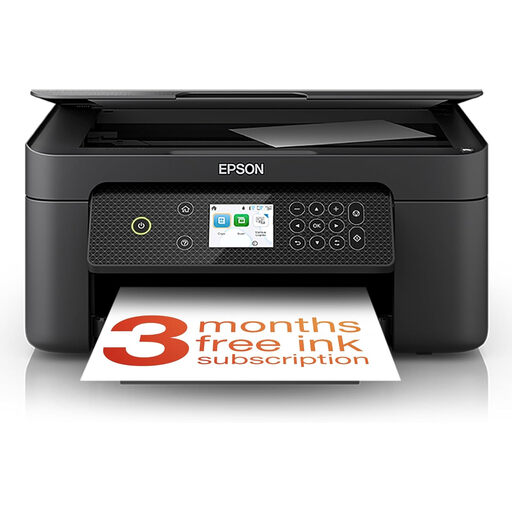
Consider this for A4 rota printing with occasional paperwork to scan or copy. The product name specifies Wi-Fi and 5760 × 1440 DPI; check whether handling originals individually on a flatbed suits your workflow. Its ink supply uses individual cartridges rather than refillable tanks.
 No image available
Consider this for text-focused rota printing rather than colour notices. Its product name specifies two-sided printing and a 150-sheet input tray; confirm whether two-sided printing is automatic and check the exact model's copy and scan functions before relying on them.
 No image available
Consider this for black-and-white rota printing when occasional paperwork capture also matters. Check whether manual page turning for two-sided printing and handling originals one at a time would suit your project.
A mono laser can cover the task when rotas are mainly black-and-white text and the printer does not need to produce colour or capture paperwork. If you want automatic two-sided printing, check that it is specified for the exact model rather than assuming every mono laser includes it.
Consider one when the project repeatedly prints colour notices or handouts, especially if copying and scanning are useful too. Compare the exact ink supplies and upkeep requirements; Epson's stated ET-2950 page yields are manufacturer ratings, not guaranteed output for your rota design.
An automatic document feeder is useful if you regularly scan or copy multi-page paper forms; it adds little to a workflow where rotas stay digital until printing. Brother UK lists a 20-sheet feeder on the DCP-T780DW, but its automatic two-sided printing should not be taken as evidence of automatic two-sided scanning.
Follow the model's ink-level and printhead-maintenance instructions, particularly if there will be long gaps between project print runs. Brother UK notes that inkjet printheads can dry out or clog when a printer sits idle.
Check your local authority's electrical-waste route or an eligible retailer take-back option before disposing of it. Lewes and Eastbourne Councils advise residents in their area not to put electrical items in ordinary household waste or recycling bins.