Repeat schedule printers
If you expect several revisions or batches of handouts, paper capacity and automatic two-sided printing can cut down on reloading and manually turning sheets.


If room schedules will be revised or handed out repeatedly, choose an A4 printer with automatic two-sided printing and a paper tray that fits your likely batch. A refillable ink-tank model is more relevant if you will keep printing after the project; for a small one-off run, weigh the purchase cost and included ink against the work you need it to do. Confirm device and network compatibility before relying on wireless printing.
If you expect several revisions or batches of handouts, paper capacity and automatic two-sided printing can cut down on reloading and manually turning sheets.
If you need colour-coded A4 schedules and occasional copies or scans, focus on the functions you will actually use rather than choosing a larger office printer by default.
If several people will send files or you need to copy supporting paperwork, check device connectivity and whether a document feeder would save you handling sheets individually.
Start with the number of sheets and revisions you expect, then consider whether ink refills and printing from several devices will matter beyond this project.
| Concern | What to check | Who this matters to |
|---|---|---|
| Repeat printing | Check A4 paper capacity and automatic two-sided printing against your largest likely batch. | When room allocations keep changing, I want to print revised schedules without repeatedly loading paper or turning sheets by hand; around 37% of consumers would put uninterrupted batch printing first. |
| Ink replenishment | Compare the included ink, the stated yield conditions and the availability of replacement ink for the exact model. | If the printer will still be used after this project, I want refilling it to be manageable; roughly 36% of consumers would make ongoing ink replenishment their primary concern. |
| Device sharing and paperwork | Confirm compatibility with your devices and network, then decide whether copying, scanning or a document feeder is needed. | When schedules come from several devices and supporting sheets need handling, I want a workable way to print and copy them; about 27% of consumers would prioritise that workflow. |
Epson, Canon and Brother publish ink-yield or savings claims for their printers, but those figures do not tell you how many of your particular schedules you will print.
Consider the supplied ink and your likely printing after the project, and check the conditions attached to any yield figure.
A document feeder helps when several source sheets need copying or scanning, while a larger tray matters most for repeated print batches. Neither function is automatically necessary for a few final schedules.
Estimate your largest batch and the number of sheets you will need to scan or copy before choosing those features.
A printer's Wi-Fi feature does not by itself establish that a managed school network will allow it to connect.
Ask the school's IT contact about permissions and check whether your chosen model offers a connection method you can use.
GOV.UK guidance for state schools in England describes licences for certain copying and sharing within schools for non-commercial educational purposes; the applicable licence terms still matter.
Use your own schedule content where possible. Before distributing third-party images, maps or text, confirm the school's permissions and the rules applicable where the project takes place.
Epson's EcoTank ET-3956 is a reference point for a shared schedule-printing workflow with repeated batches and paperwork to scan or copy.
Canon's PIXMA G3590 offers a refillable option for colour schedules when a smaller paper tray is sufficient.
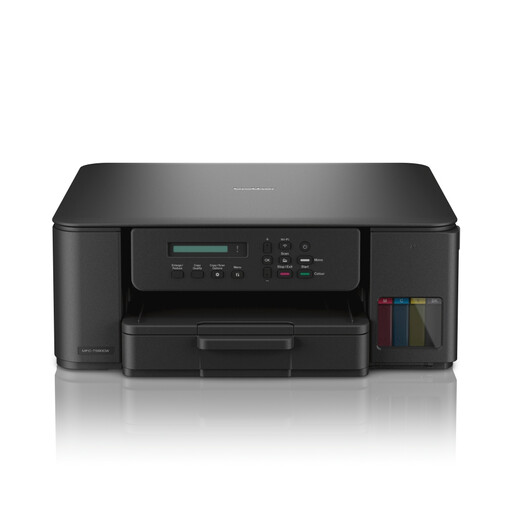
Brother's DCP-T580DW is a refillable option to consider for repeated schedules when a 150-sheet input tray fits the workload.
These choices relate to repeated room-schedule printing and, where needed, handling shared project paperwork. Compare the features you will use with the space and printing needs of this project.
 No image available
If you expect repeated schedule batches and paperwork to handle, check the paper capacity, two-sided printing and document-feeding functions of the exact GX6150 configuration before choosing it.
 No image available
Consider this refillable model if you expect to keep printing schedules or other documents after the project.
Brother UK lists a 150-sheet input tray, automatic two-sided printing, Wi-Fi and USB for the DCP-T580DW. If you need to scan several sheets at once, confirm whether the configuration includes a document feeder.
 No image available
For schedule batches alongside other shared paperwork, check whether this all-in-one inkjet's paper handling and desk-space requirements suit the project.
Confirm the two-sided printing and document-feeding functions of the exact configuration if they are important to your workflow.
Not always: it is useful when schedule packs or instructions can be printed on both sides, because you will not need to turn the sheets manually. For schedules displayed one page at a time, paper capacity may matter more to your workflow.
It is more relevant if you expect several rounds of printing or will keep using the printer afterwards. For a small one-off run, compare the purchase cost, supplied ink and likely future use rather than choosing by a manufacturer's headline yield claim.
You can consider a wireless printer for that workflow, but check support for each device and whether the network will permit the connection. A school's managed network may require approval before a personal printer can be added.
Permission depends on the material, the use and the applicable licence or legal conditions. GOV.UK guidance for state schools in England describes licences covering certain copying and sharing for non-commercial educational purposes, subject to their terms; confirm your school's permissions and the rules applicable where the project takes place.