Parents packing school-day drinks
If a smoothie is going into a lunchbox or being served at breakfast, decide on the portion before choosing a bottle. The NHS counts sugars in smoothies as free sugars, even when no sugar has been added.


For an everyday school-day drink, choose water or milk rather than making a smoothie the default. If you choose a fruit smoothie, the NHS advises limiting fruit juice and smoothies to a combined 150ml a day and having them with meals. Check the sugars per serving as well as the portion size: ‘no added sugar’ does not mean zero sugar, because the NHS counts sugars in smoothies as free sugars.
If a smoothie is going into a lunchbox or being served at breakfast, decide on the portion before choosing a bottle. The NHS counts sugars in smoothies as free sugars, even when no sugar has been added.
A bottle that is convenient to carry may contain more than one intended serving. Check its volume against the NHS combined 150ml daily limit for fruit juice and smoothies rather than treating the whole bottle as one portion.
If reducing sugar in drinks matters more than having a smoothie, compare the nutrition panel with the front-of-pack wording. Water or milk may suit an everyday drink better than a fruit smoothie labelled ‘no added sugar’.
Decide whether the drink is for everyday thirst or an occasional smoothie with food, then check the portion, sugar information and storage instructions.
| Priority | What to check | Your needs |
|---|---|---|
| Serving size | Compare the bottle volume with the stated serving size. The NHS advises a combined maximum of 150ml of fruit juice and smoothies per day, taken with meals; include any juice already consumed that day. | I want to serve a measured smoothie portion, not hand over a larger bottle as a single drink. |
| Sugar wording | Read the ingredients and sugars per 100ml or 100g, then check the amount for the intended serving. Tesco Groceries lists 15g sugars per 150ml serving for its no-added-sugar Innocent mango smoothie. | ‘No added sugar’ matters to me, but I also want to know how much sugar the drink contains. |
| Everyday drink | Decide whether a smoothie is wanted at all. For routine thirst, consider water or milk rather than using a smoothie in addition to other juice or smoothie servings. | I need a regular school-day drink, rather than a fruit smoothie at every break. |
| Role at breakfast | Check the stated fruit-and-vegetable serving claim, if present, without treating it as a description of the whole meal. The Department for Education’s school-food guidance for England describes a balanced diet as including several food groups. | If I serve a smoothie at breakfast, I want to consider what else is being eaten with it. |
| Storage | Read the pack’s refrigeration and after-opening instructions, particularly for a bottle that will be split into portions. Plan how the drink and any remainder will be stored. | The drink needs to fit the journey to school and what I can do with a partly used bottle. |
The claim concerns added sugar, not the drink’s total sugar content. The NHS counts sugars in smoothies as free sugars; Tesco Groceries lists 15g sugars per 150ml serving for its no-added-sugar Innocent mango smoothie.
Check the ingredients and nutrition panel for the portion you intend to serve.
Bottles sold in 250ml, 300ml, 350ml and 750ml formats are larger than the NHS combined daily 150ml limit for fruit juice and smoothies.
Measure a portion, account for any juice consumed that day and serve the smoothie with a meal.
A stated vitamin, fibre or fruit-and-vegetable contribution does not remove the free sugars in a fruit smoothie. Those claims answer a different question from how much to serve.
Consider the claim alongside the serving size, sugars per serving and the rest of the school-day food and drink plan.
These ranges illustrate the pack formats and label details worth comparing; a brand name alone does not establish a suitable serving size or sugar content.
Tesco Groceries and Waitrose & Partners list Innocent fruit smoothies in several bottle and multipack formats.
Tesco Groceries lists own-label 750ml smoothies alongside branded smoothies and children’s multipacks.
M&S lists smoothies in 350ml and 750ml bottles, including selected blends with yoghurt, dates or oats.
Waitrose & Partners identifies Naked Blue Machine Super Smoothie as a 750ml product.
Waitrose & Partners lists Innocent smoothies in 250ml and 750ml formats, as well as selected 300ml super-smoothie bottles.
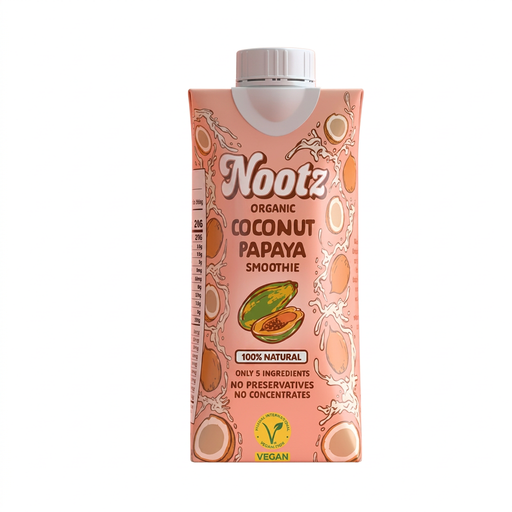
This 180ml papaya-and-coconut smoothie is an option to assess if you plan to measure a school-day portion rather than serve the whole pack.
 No image available
For a school-day smoothie portion, the full 180ml pack is larger than the NHS combined daily 150ml limit for fruit juice and smoothies. Measure the amount you intend to serve and have it with a meal.
Check the current ingredients, sugars per serving and storage instructions before choosing it for a lunchbox or keeping any remainder.
No. The NHS counts sugars in smoothies as free sugars even when no sugar is added. For example, Tesco Groceries lists 15g sugars per 150ml serving for its no-added-sugar Innocent mango smoothie; check the figures on the product you choose.
The NHS advises a combined maximum of 150ml of fruit juice and smoothies a day, with meals. That is a combined amount, so include any juice as well as the smoothie when planning the day’s drinks.
Yes, if you divide it into appropriate portions and follow its storage instructions. Tesco Groceries labels its 750ml Innocent mango smoothie as five 150ml servings; do not treat the full bottle as one school-day drink.
The Department for Education’s school food standards guidance addresses food and drink provided to pupils by state-funded schools in England. For a parent-packed lunch, check the individual school’s policy rather than assuming those standards specify a smoothie choice for every UK school.
Do not assume that a smoothie supplies the range of foods in a breakfast. The Department for Education’s guidance for schools in England describes a balanced diet using several food groups, including fruit and vegetables, starchy foods and protein sources; consider the smoothie alongside what else is being served.