Renters cleaning full-height tiled walls
If upper and lower tiles mean repeated stretching or bending, compare long-handled models by their stated reach and how securely the handle locks. A longer tool also needs somewhere practical to be stored.


Choose a long-handled cordless scrubber if reaching high, low or broad sections of tiled wall is the main difficulty; choose a compact handheld model if you chiefly need control around grout, taps and edges. Before using either in a rented flat, check the supplied heads against the tile and sealant, follow the exact model’s water-use and charging instructions, and test a discreet area without pressing hard.
If upper and lower tiles mean repeated stretching or bending, compare long-handled models by their stated reach and how securely the handle locks. A longer tool also needs somewhere practical to be stored.
For grout lines, corners, taps and narrow wall sections, a compact head and suitable interchangeable attachments may matter more than handle length. Bosch describes its UniversalBrush as intended for tiles, joints and narrow areas.
In a damp utility area, check the exact model’s water-protection rating and instructions rather than treating a cordless design as permission to rinse or immerse it. Keep charging separate from wet cleaning; Electrical Safety First warns that wet conditions increase electric-shock risk.
Decide whether wall reach or close control is the harder problem, then check wet-use instructions and the attachments that will touch the rented surface.
Choose it when: high, low or broad tiles make repeated reaching or bending the main obstacle.
Trade-off: the extended tool takes more storage space and can be harder to control beside fittings or narrow grout lines.
Choose it when: small wall sections, grout, corners and taps need close-in control.
Trade-off: upper or lower tiles may still require another safe way to reach them.
| Concern | What to check | Who this matters to |
|---|---|---|
| Wall reach | Compare stated reach with your wall height; check that the extended handle locks and remains controllable. | I want to clean upper and lower tiles without repeatedly stretching or bending. Around 31% of consumers would put reach first. |
| Grout and edge control | Check which detail heads and pads are supplied and whether their intended uses match the wall. | When grout lines and fittings take most of my attention, a broad head alone will not address the awkward spots; roughly 25% of consumers would prioritise detailed control. |
| Water and surface protection | Read the exact model’s water-use and charging instructions, and check head and cleaner suitability for tile, grout and sealant. | I need to work in a damp area without misusing the tool or damaging a rented surface. About 25% of consumers would make safe use and surface protection their primary concern. |
| Storage and equipment | Check tool size, supplied heads and whether a battery and charger are included if the model uses a separate battery platform. | With limited cupboard space and only occasional wall cleaning, I would rather have a manageable tool with the equipment needed to use it; around 19% of consumers would put that practical fit first. |
Extra reach helps only if the head stays controllable where you need to clean; an extended handle can make work beside fittings more awkward.
Compare the stated reach with your wall, and check the handle lock, balance and supplied heads before choosing an extension model.
Water protection differs by model. Bosch states IPX5 splash protection for UniversalBrush, while Ryobi specifies IPX7 for RSCR4-120G; neither rating replaces the model’s use and charging instructions.
Follow those instructions, keep charging separate from wet cleaning and do not assume that a general water-resistant description permits immersion.
Grout, sealant and tile finishes may need different treatment. The Health and Safety Executive warns that some cleaning products are corrosive and can damage skin and eyes.
Follow the tile, cleaner and tool instructions, start with the least aggressive compatible attachment and test discreetly. Stop if the finish, grout or sealant appears to deteriorate.
Ryobi offers scrubber variants both with and without a supplied battery. A bare tool cannot be used until you have a compatible battery and charger.
Check the exact contents of the kit, including the heads needed for broad tiles or detail work.
Lakeland offers both a compact cordless scrubber and a longer Turbo Scrubber for household tile and bathroom cleaning.
Bosch’s UniversalBrush is a compact cordless option for tiles, joints and narrow spaces.
Ryobi offers compact and telescopic scrubber formats within its cordless-tool range.
This oscillating-brush route is worth considering when work around taps and other tight areas matters more than wall reach.
BLACK+DECKER describes cordless powered scrubbers with brush and pad shapes intended for different cleaning tasks.
These choices include long-handled cordless scrubbers for wall access and handheld models for smaller tiled sections. For any of them, match the supplied heads and wet-use instructions to your wall before cleaning.
 No image available
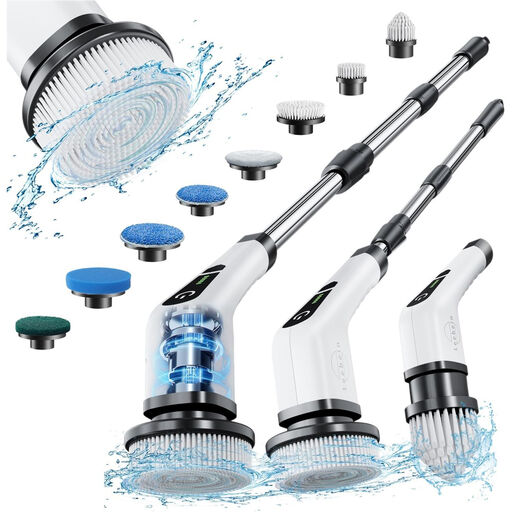
Consider the adjustable handle if high or low wall tiles are difficult to reach with a handheld tool.
The title specifies a 137 cm adjustable handle and eight interchangeable heads. Check handle stability and head suitability for your tile, grout and sealant; follow the model’s instructions before rinsing or charging.
 No image available
The extendable-handle format is relevant when reaching across a tiled wall matters more than close-in precision.
The title specifies seven heads, two speeds and an IPX7 rating. Check the handle lock and which heads suit the surface, and follow the exact wet-use and charging instructions rather than treating the rating as unrestricted use.
 No image available
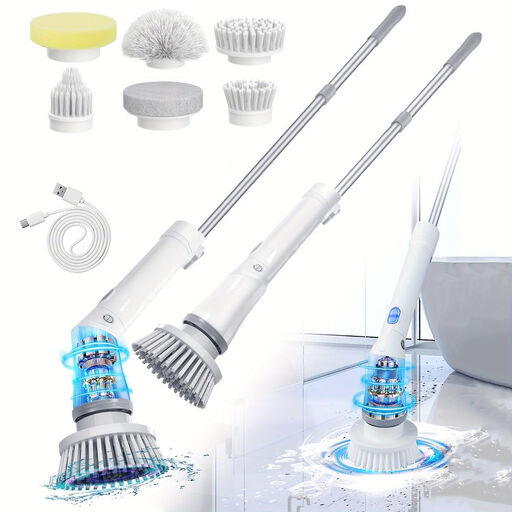
The extension handle offers a long-handled option for tiled sections beyond comfortable handheld reach.
The title specifies eight interchangeable heads and two speeds. Check control when the handle is extended and whether a supplied head suits the wall. Follow the exact manual before rinsing: the product information describes rinsing but also warns against submersion.
 No image available
This handheld option is more relevant to small tiled sections and work around grout than to covering a full-height wall.
Check the exact heads against the tile and sealant, and read the wet-use instructions before using or rinsing it in a damp area. Plan how you will safely reach tiles beyond comfortable handheld reach.
 No image available
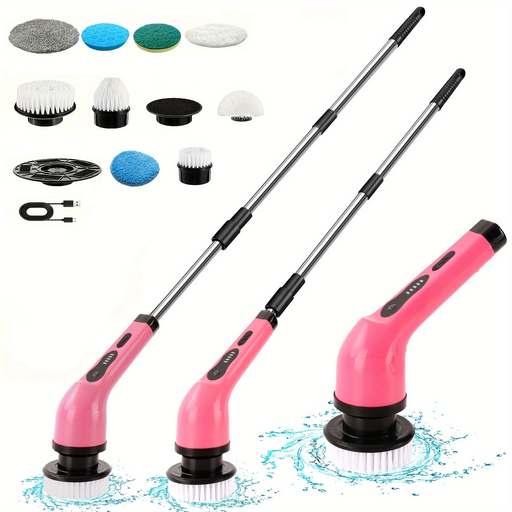
Consider this handheld format for smaller tiled areas and grout work when extended wall reach is not the priority.
The title specifies two speeds and nine replacement heads. Confirm which heads suit the particular tile, grout and sealant, and follow the model’s wet-use and charging instructions.
Choose a long-handled model if high, low or broad tiled sections make repeated reaching or bending your main difficulty. A compact handheld brush can be easier to control around grout and fittings; check the handle lock and supplied heads before deciding.
Follow the exact model’s instructions for rinsing, and keep charging separate from wet cleaning. Bosch specifies IPX5 splash protection for UniversalBrush and Ryobi specifies IPX7 for RSCR4-120G, but those model-specific ratings do not replace their instructions. Electrical Safety First warns that wet conditions increase electric-shock risk.
Start with the least aggressive compatible head or pad, test discreetly and stop if grout, sealant or the finish begins to deteriorate. Follow both the surface and cleaner instructions: the Health and Safety Executive warns that some cleaning products are corrosive and can harm skin and eyes.
Check that you have a compatible battery and charger, or choose a kit that includes what you need. Also check which broad and detail heads come with the exact variant rather than assuming that all versions have the same attachments.
Treat the scrubber as electrical waste rather than putting it in general household rubbish. GOV.UK says waste electrical products can be taken to a household waste recycling centre; check the local service’s instructions for a removable battery.