What to check before buying
Start with the connection your computer can make, then decide whether a fixed or portable screen suits the workspace. Check mounting and desk dimensions before adding an arm or choosing a larger display.
| Priority |
What to check |
Your needs |
| Computer connection |
Identify the computer’s HDMI, DisplayPort, Thunderbolt or USB-C video output. Match it to the monitor input and confirm supported external-display count and resolution. USB-C shape alone does not confirm video output. |
I need a connection that works with my exact laptop or desktop, rather than relying on a USB-C cable, dock or adapter that cannot carry a display signal. |
| Fixed or portable setup |
Measure the available desk area for a fixed screen. For a portable monitor, compare weight, stand arrangement, video inputs and the power route needed for the intended connection. |
I want the second screen to suit where I actually work: a repeatable desk setup at home, or a display I can carry between locations. |
| Screen positioning |
Compare height, tilt, swivel and pivot functions on the supplied stand. For an arm, match VESA mounting and monitor weight, then measure the desk edge and clear space below the clamp point. |
My screen, keyboard and mouse need to fit the available desk arrangement. The Health and Safety Executive advises positioning the top of the screen around eye level and roughly an arm’s length away. |
Joybuy product options
Joybuy options for adding a second screen to a home or hybrid work setup, including fixed desk monitors and portable displays.
 No image available
ASUS ZenScreen MB249C IPS USB-C
A 23.8-inch option for hybrid or hot-desk work where a larger second screen and flexible placement are useful.
Stated features include IPS, USB-C, HDMI, 60 W USB-C power delivery, a kickstand, C-clamp arm and partition hook kit. One-cable USB-C video requires a computer with DisplayPort Alt Mode; check that the supplied mounting accessories suit the intended desk or divider.
View on Joybuy
 No image available
Dell P2425H 24-inch Full HD Monitor
A fixed desk-monitor route for documents, calls and everyday home-office work.
This 24-inch IPS monitor states 1920 × 1080 resolution, 100 Hz, and HDMI, DisplayPort, USB-C and VGA connections, with height, tilt and swivel adjustment. Confirm whether its USB-C connection supports video, laptop charging or both for the exact setup.
View on Joybuy
 No image available
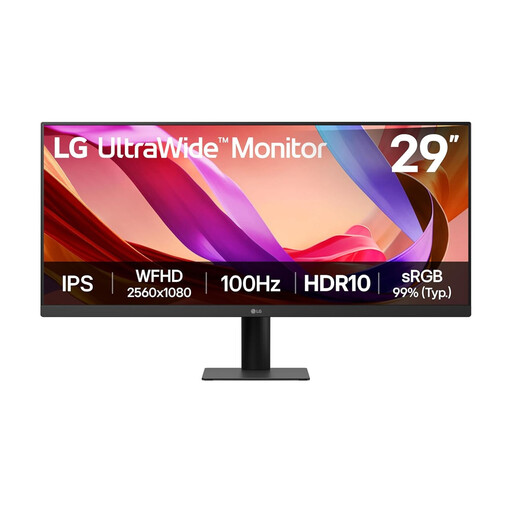
LG UltraWide 29U511A 29-inch Monitor
A fixed-screen option for viewing documents and applications side by side at a desk.
The stated 29-inch 21:9 IPS panel has 2560 × 1080 resolution, HDMI and DisplayPort inputs, and VESA 100 × 100 mm mounting. Allow for the stated 688.5 mm monitor width; the supplied stand is stated to adjust for tilt.
View on Joybuy
 No image available
ASUS ZenScreen Go MB16AHP Full HD
A portable 15.6-inch display for recurring hybrid work and travel between locations.
It states an IPS panel, built-in battery, Smart Case stand, USB-C and Micro-HDMI connectivity, and a weight of about 860 g. USB-C video-and-power use depends on compatible output and power from the source device.
View on Joybuy
 No image available
ASUS ZenScreen MB166CR Full HD
A lightweight portable second-screen route for workers who prioritise a compatible one-cable laptop setup.
This 15.6-inch display states a Full HD IPS panel, 780 g weight, 11.8 mm thickness and USB-C DisplayPort Alt Mode connection. HDMI is not supported on this SKU, so it needs a compatible USB-C video output and sufficient host-device power.
View on Joybuy
Frequently asked questions
Do I need an adapter to connect a laptop to a second monitor?
Not if the laptop and monitor already share a video connection, such as HDMI-to-HDMI or DisplayPort-to-DisplayPort. If the connectors differ, choose a cable or adapter that supports the required video standard; a USB-C connector alone does not prove that the laptop can output video.
Can every USB-C laptop run a portable monitor with one cable?
No. A one-cable portable-monitor setup requires the laptop USB-C port to support video output, commonly DisplayPort Alt Mode. ASUS advises checking DP Alt Mode for USB-C use of the MB16FC, while Lenovo specifies DP 1.2 Alt Mode and PD 2.0 for the ThinkVision M14 setup.
When should I use HDMI plus separate power for a portable monitor?
Use this route when the laptop lacks USB-C DisplayPort Alt Mode but the portable monitor has HDMI input and a separate power-capable USB-C input. ASUS states that the MB16FC can use HDMI for video and USB-C DC-in for power in that arrangement.
Can any MacBook use two or more external displays?
No universal answer applies. Apple says the number of external displays supported at the same time depends on the exact Mac model and on the connected displays’ resolution and refresh rate. Check the technical specification for the specific Mac before buying a dock or multi-display adapter.
What should I check before fitting a clamp-on monitor arm?
Check that the monitor has a compatible VESA mounting interface, that its actual weight is within the arm’s supported range, and that the desk edge and underside meet the installation requirements. Ergotron lists the LX Pro with VESA MIS-D support, a 1.8–10.0 kg capacity, a 10–60 mm desk-edge range and a 70 mm under-desk clearance requirement.


