
24/7 Customer Support

Free returns

Same-day & Next-day Delivery

Quality Guaranteed

Unlock Your Welcome Offers: FREE Delivery | Up to 80% OFF | Free 30-day JoyPlus trial
Download the APP
A semi-automatic espresso machine can offer more control than a pod-only brewer while requiring less equipment than a separate grinder, boiler and steam system. You can adjust the coffee dose, tamping pressure and extraction time, then texture milk for cappuccinos, lattes or flat whites.
However, shopping by headline specifications alone can lead to wasted money. A machine described as a 20 bar espresso machine is not automatically more suitable than a 15 bar model, while a compact coffee machine may have a water tank or drip tray that feels inconvenient in daily use. The right choice depends on how much control you want, how often you make coffee and how much worktop space is available.
By the Joybuy Product Recommendation Officer
Pressure figures such as 15 bar espresso machine and 20 bar espresso machine are commonly used in product descriptions. These figures usually refer to the pump’s maximum capability, not necessarily the pressure reaching the coffee puck throughout extraction.
For home use, other factors also matter:
A 20-bar pump may be useful as part of the machine’s system, but it should not be the only reason to choose one model over another.
A manual milk frother steam wand gives you greater control, but it also requires practice. You need to position the wand correctly, introduce air gradually and avoid overheating the milk. A machine may include a powerful steam function without making milk texturing automatic.
If you mainly drink black coffee, a steam wand may add cleaning and learning time without much benefit. If you regularly prepare cappuccinos or lattes, it can be more useful than a machine with a basic hot-milk function.
Coffee grounds, milk residue and scale can affect operation if routine cleaning is neglected. Check whether the water tank, drip tray, portafilter and filter baskets are removable. After steaming, wipe the wand and purge it according to the manual.
Also measure the available space, including room above the machine for filling a hopper or removing a tank. A machine that fits its width may still be awkward beneath low kitchen cupboards.
Most semi-automatic models use a portafilter filled with ground coffee. This is the usual format for a ground coffee espresso machine, and it allows you to change beans or pre-ground blends.
Some machines also accept ESE pods, which are pre-portioned coffee discs designed for compatible filter baskets. This can be convenient for quick preparation and less mess, but compatibility must be stated in the product specification. For example, the De’Longhi Stilosa models listed below support both ground espresso and ESE pods.
An integrated grinder, as found on the De’Longhi La Specialista Arte, reduces the need for a separate grinder. It also adds more settings to manage, including grind adjustment, dosing and tamping.
A 1-litre to 1.7-litre removable water tank can be suitable for several drinks, although actual usage depends on espresso volume, rinsing and steaming. Larger tanks reduce refilling, while smaller tanks can help keep a compact coffee machine lightweight and easier to clean.
Consider:
Look for the stated dimensions and confirm that the machine is designed for a 220–240V UK mains supply. Product descriptions may list power from around 1,050W to 1,450W. Higher wattage does not, by itself, confirm better espresso, but it may support faster heating or steam performance.
A stainless steel espresso machine can be straightforward to wipe clean, but the housing material should be considered alongside the internal components, warranty and maintenance instructions.
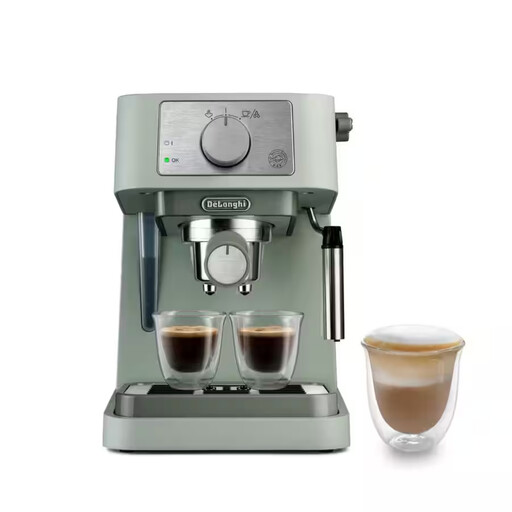
Why This Fits Their Persona: Its compact format, manual controls and compatibility with ground coffee and ESE pods suit beginners in flats or smaller UK kitchens.
The specification identifies a 15-bar pump, removable parts and two filter sizes, rather than relying on pressure alone.
Manual stainless steel steam wand; approximately 1-litre water tank; ESE pod compatibility.
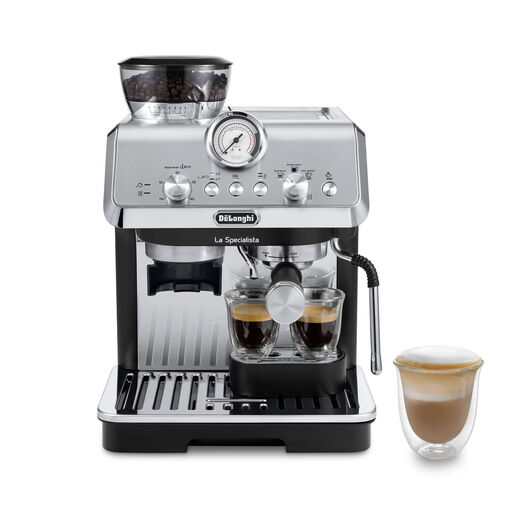
Why This Fits Their Persona: It suits home baristas who want control from grinding through to steaming without buying a separate grinder.
Its specification lists three infusion temperatures and eight grind settings, providing more measurable adjustment than a simple pressure headline.
Integrated burr grinder; 1.7-litre removable tank; professional steam wand and included dosing accessories.

Why This Fits Their Persona: The 1.5-litre tank and separate coffee and milk temperature controls are practical for households or small offices preparing several drinks.
The product information gives practical capacity and control details alongside its 20-bar pump rating, making comparison less dependent on one headline number.
Stainless steel housing; removable drip tray; automatic standby or shut-off; manual steam wand.
We have compiled a complete, real-time list of products that fully satisfy these strict selection criteria and UK safety regulations.
There is a learning curve because you control dosing, tamping and milk frothing. A model with simple controls and ESE pod compatibility can make the first stage easier, while an integrated grinder provides more control but adds additional settings.
Lifespan depends on construction, frequency of use, water quality and maintenance. Removable tanks, accessible drip trays and regular descaling can make routine care easier. Always check the manufacturer’s care guidance and warranty before purchase.
Power consumption varies by heating system, wattage, warm-up time and standby behaviour. A 1,050W machine does not necessarily use that amount continuously. Automatic standby or shut-off can reduce idle operation, while switching the machine off after use avoids unnecessary heating.