Families using milk every day
Milk for breakfasts, drinks and cooking can add up quickly. Choose a bottle size around the amount your household can refrigerate and use before its labelled deadline.


For a family that uses fresh milk regularly, a larger standard semi-skimmed bottle makes sense only if it fits in the fridge and can be finished within its labelled storage period. Filtered semi-skimmed milk is worth considering when use is less predictable, but check the bottle’s freshness and storage instructions rather than assuming it will prevent waste. For older children and adults seeking a further reduction in milk fat, the NHS suggests 1% or skimmed milk; neither should be a main drink for children under five.
Milk for breakfasts, drinks and cooking can add up quickly. Choose a bottle size around the amount your household can refrigerate and use before its labelled deadline.
Semi-skimmed is not the lowest-fat cow’s milk option. The NHS suggests 1% or skimmed milk for older children and adults who want to cut down further, but says neither should be a main drink for children under five.
If one week’s milk disappears quickly and the next week’s does not, compare smaller standard bottles with filtered milk’s stated freshness and storage instructions before choosing a larger pack.
Start with how much milk the family will use, then check the fat level and the instructions on the particular bottle.
| Priority | What to check | Your needs |
|---|---|---|
| Bottle size | Compare the volume with your expected use after opening. Sainsbury’s lists standard semi-skimmed bottles in both 2.27L and 3.4L sizes. | We use milk throughout the day, but a larger bottle still has to fit in our fridge and be finished in time. |
| Fat level | Read the nutrition panel for fat and saturates on a consistent basis. The NHS identifies 1% and skimmed milk as further lower-fat options and says they should not be main drinks for children under five. | If reducing milk fat further matters to us, we need to consider who will drink it rather than switching every family member to the same type. |
| Freshness and storage | Check the use-by date, refrigeration instructions and period after opening. The examined Waitrose Duchy Organic and M&S bottles each state a three-day period after opening; follow the label on the bottle you buy. | Our milk use varies, so I want a quantity we can store and finish within its labelled period. |
| Filtered or organic | Check what the specific filtered bottle says about freshness, or what the organic label says about production. Compare nutrition panels separately; neither description alone establishes a lower fat content. | A filtered format or a stated production approach matters to us only if it addresses a preference we actually have. |
Unused milk makes a large pack impractical, even for a busy household. The examined M&S semi-skimmed bottle states that it is best consumed within three days of opening.
Estimate how much the family will use after opening, check the bottle’s own instructions and make sure there is room to refrigerate it.
The practical burden is storing a larger bottle and potentially discarding milk that cannot be used within its labelled period.
For someone seeking a further reduction in milk fat, the NHS identifies 1% and skimmed milk as alternatives. It also says neither should be a main drink for children under five.
Compare the fat figures on the labels and consider the ages of the people who regularly drink the milk.
Those descriptions address freshness or production, not necessarily the fat figure. Waitrose lists its Duchy Organic semi-skimmed milk at 1.8g fat and 1.1g saturates per 100ml.
Choose a format for the characteristic you want, and use the nutrition panel when comparing fat levels.
The carton provides the instructions and allergen information for the milk you will use.
Check its use-by date, storage directions, nutrition panel and allergen statement before use, particularly when an allergy or specific dietary requirement is involved.
These ranges illustrate different pack formats and product descriptions; check the particular bottle when deciding what suits your household.
Tesco and Sainsbury’s list Cravendale filtered fresh semi-skimmed milk in 2L and 3L formats.
Tesco lists standard British semi-skimmed milk in a 2.272L, four-pint bottle, alongside filtered, organic and UHT options.
Sainsbury’s lists British semi-skimmed milk in 2.27L four-pint and 3.4L six-pint bottles, as well as filtered and organic options.
Asda lists standard British semi-skimmed milk and an Arla Farmers semi-skimmed four-pint product.
M&S lists a 2.272L four-pint semi-skimmed milk and describes it as sourced from M&S Select Farms.
Waitrose lists Essential British Free Range, filtered and Duchy Organic semi-skimmed milk.
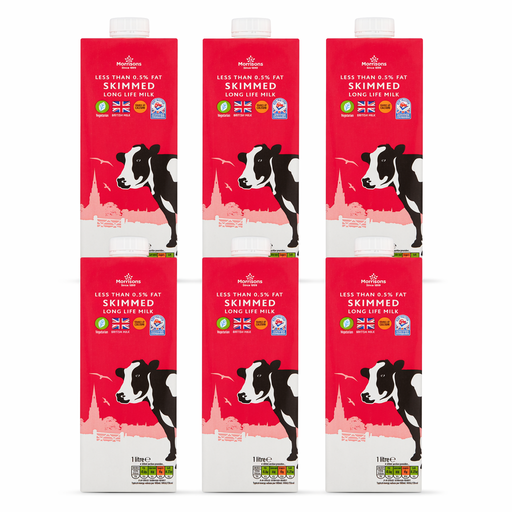
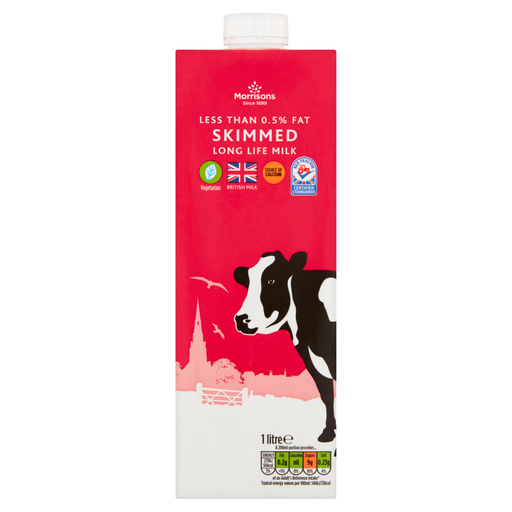
These Morrisons UHT skimmed cartons are options for households considering a further reduction in milk fat, rather than standard fresh semi-skimmed bottles. The choice here is between six 1-litre cartons and one 1-litre carton.
 No image available
Six separate 1-litre cartons may suit a household planning to use several cartons over time. This is UHT skimmed milk, not semi-skimmed; check each carton’s storage and after-opening instructions. The NHS says skimmed milk should not be a main drink for children under five.
 No image available
A single 1-litre carton suits a smaller planned quantity; decide how many cartons the family would actually use. It is UHT skimmed milk rather than semi-skimmed. Check the carton’s storage and after-opening instructions; the NHS says skimmed milk should not be a main drink for children under five.
No. The NHS identifies 1% and skimmed milk as options for older children and adults who want to cut down further on fat. Compare the nutrition panels if fat level is the deciding factor, and remember that the NHS says 1% and skimmed milk should not be main drinks for children under five.
No. Choose a size the household can refrigerate and finish within the bottle’s use-by date and instructions after opening. A 3.4L fresh bottle may be practical for frequent use, but a smaller bottle may better match an uneven week.
Follow the instructions on that bottle and do not exceed its use-by date. The examined M&S semi-skimmed and Waitrose Duchy Organic semi-skimmed product pages each state a three-day period after opening and refrigerated storage; check the label rather than applying that period to every milk product.
Not necessarily. Retailers describe Cravendale filtered milk as “Fresher for Longer”, but whether it helps your household depends on when you open it, how you store it and how quickly you use it. Check the specific bottle’s dates and instructions before choosing it over standard fresh milk.
Check the current carton’s ingredient and allergen statements rather than treating a different fat level as milk-free. For example, Sainsbury’s skimmed milk listing explicitly states “Contains milk”.