People measuring carbohydrate in drinks
A splash in tea and a larger pour for cereal use different amounts of your carbohydrate allowance. Check the serving you actually use rather than judging semi-skimmed milk by its fat description.


Semi-skimmed milk is lower in fat than whole milk, but that does not make it low in carbohydrate: Tesco, ASDA, Cravendale and Waitrose listings give 4.8–5.0g carbohydrate per 100ml. If you want dairy, measure the amount you pour against your own carbohydrate allowance; if reducing carbohydrate in a milk-like drink matters more, the listed unsweetened almond drinks contain less per 100ml, but almond allergies and nutritional differences matter.
The useful choice depends on whether you need to keep dairy, reduce carbohydrate in each pour, or consider a significant dietary change alongside diabetes medication.
A splash in tea and a larger pour for cereal use different amounts of your carbohydrate allowance. Check the serving you actually use rather than judging semi-skimmed milk by its fat description.
If you want to retain cow's milk, a measured serving may fit your individual plan. Diabetes UK generally describes low-carb eating as less than 130g carbohydrate a day; that definition does not establish whether any particular serving fits your circumstances.
Diabetes UK advises speaking to your diabetes healthcare team before significant dietary changes. South West London Integrated Medicines Optimisation Committee guidance specifically advises people taking an SGLT2 inhibitor not to start a very-low-carbohydrate or ketogenic diet without discussing it with a healthcare professional.
Start with carbohydrate per 100ml, then consider the amount you use and whether the alternative's ingredients and nutrition suit you.
Consider it: If keeping cow's milk matters to you and a measured pour fits your carbohydrate allowance.
Trade-off: Its lower fat content does not remove the carbohydrate in milk.
Consider it: If reducing carbohydrate in a milk-like drink matters more than keeping dairy.
Trade-off: It contains almond and the listed examples have less protein per 100ml than the semi-skimmed milks compared here.
| Priority | What to check | Your needs |
|---|---|---|
| Carbohydrate per pour | Compare carbohydrate per 100ml, then calculate it for your usual pour. Tesco, ASDA, Cravendale and Waitrose listings give 4.8–5.0g per 100ml for the named semi-skimmed milks; 200ml at those values contains 9.6–10g. | I want to know what my actual serving contributes, particularly when a drink or bowl of cereal uses more than a small splash. |
| Alternative ingredients | Sainsbury's lists less than 0.5g carbohydrate per 100ml for its unsweetened almond drink; ASDA lists 0g per 100ml for Alpro Almond No Sugar. Check the current allergen statement: both are almond drinks. | Reducing carbohydrate matters more to me than retaining dairy, provided almond is suitable for me. |
| Protein and other nutrition | Compare like-for-like values per 100ml and check any fortification on the pack. The Sainsbury's and Alpro almond drinks list 0.6g and 0.5g protein per 100ml respectively, against 3.4–3.6g for the cited Tesco, ASDA, Cravendale and Waitrose milks. | If I change drinks, I want to understand the nutritional difference rather than assume every milk-like option is interchangeable. |
| Use after opening | Read the instructions for the exact pack. Tesco and ASDA state 3 days after opening for their cited semi-skimmed milks; the filtered Cravendale and Waitrose listings state 7 days. | I use milk occasionally and want a pack whose stated opened life fits how quickly I will use it. |
| Diabetes medication | Discuss significant dietary changes with your diabetes healthcare team, as Diabetes UK advises. South West London Integrated Medicines Optimisation Committee guidance says people taking SGLT2 inhibitors should discuss a very-low-carbohydrate or ketogenic diet with a healthcare professional before starting. | If I take diabetes medication, I need advice about a major change in carbohydrate intake, not just a different drink. |
The term describes fat content. The cited Tesco, ASDA, Cravendale and Waitrose semi-skimmed milks still contain 4.8–5.0g carbohydrate per 100ml, so repeated top-ups count towards the amount you consume.
Read carbohydrate per 100ml and work it out for the quantity you normally pour.
The cited Cravendale and Waitrose filtered milks each list 4.8g carbohydrate per 100ml. Their listings state a longer opened life than the cited Tesco and ASDA standard milks, not a carbohydrate reduction.
Choose by carbohydrate value for that concern; use the storage instructions separately to decide which pack suits your rate of use.
The cited unsweetened almond drinks contain less carbohydrate per 100ml than the cited semi-skimmed milks, but they contain almond and list less protein. Sainsbury's also warns that its product is unsuitable for customers allergic to other nuts because of manufacturing methods.
Check the current allergen declaration, carbohydrate and protein values, and any fortification for the drink you intend to buy.
A different milk choice can be part of a much larger change in carbohydrate intake. Diabetes UK advises consultation before significant dietary changes, while South West London Integrated Medicines Optimisation Committee guidance gives a specific warning for people taking SGLT2 inhibitors who are considering a very-low-carbohydrate or ketogenic diet.
If these circumstances apply, speak to your diabetes healthcare professional before starting that dietary change.
These examples show how nutrition and storage instructions vary between named semi-skimmed milks; a brand name alone does not settle keto suitability.
The ASDA listing for Cravendale filtered semi-skimmed milk describes a chilled dairy option with a stated longer storage life.
Tesco's listed 1L semi-skimmed milk is a standard fresh dairy option.
ASDA lists a British semi-skimmed dairy milk in a 2-pint size.
The Marks & Spencer semi-skimmed milk listing is another fresh dairy reference; its nutrition values are expressed per 100g.
Waitrose lists a filtered, free-range British semi-skimmed milk with a stated longer opened life.
These almond and soya drinks are options to consider if you are comparing a plant-based pour with semi-skimmed dairy milk. Check the nutrition and allergen information on the product you choose against your intended use.
 No image available
Consider this almond drink if you want to compare a plant-based option with your usual dairy pour. The listed pack is 8 × 1L; it contains almond, so check the allergen statement. Compare carbohydrate per 100ml on the product label with the amount you intend to use.
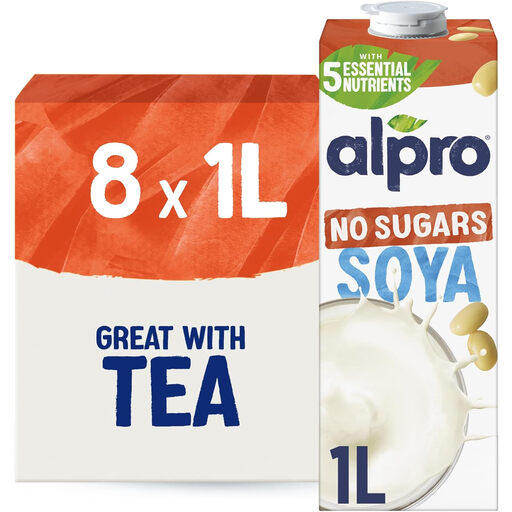 No image available
Consider this soya drink if you are comparing plant-based options for drinks or cooking rather than choosing cow's milk. The listed pack is 8 × 1L; it contains soya, so check the allergen statement. Check carbohydrate and protein per 100ml on the product label for your intended serving.
Not automatically. Tesco, ASDA, Cravendale and Waitrose listings give 4.8–5.0g carbohydrate per 100ml for the named semi-skimmed milks, equivalent to 9.6–10g in 200ml. Whether your serving fits depends on the amount you pour and your own carbohydrate allowance; semi-skimmed describes fat content, not carbohydrate content.
Compare unsweetened alternatives by their current per-100ml labels. Sainsbury's lists less than 0.5g carbohydrate per 100ml for its unsweetened almond drink, and ASDA lists 0g for Alpro Almond No Sugar. Both contain almond; Sainsbury's also warns that its product is unsuitable for people allergic to other nuts because of manufacturing methods.
Do not assume it does. The cited Cravendale and Waitrose filtered milks each list 4.8g carbohydrate per 100ml, the same listed value as ASDA's cited standard semi-skimmed milk. Their listings state 7 days after opening, compared with 3 days for that ASDA product; follow the instructions on the pack you buy.
Discuss significant dietary changes with your diabetes healthcare team, as Diabetes UK advises. South West London Integrated Medicines Optimisation Committee guidance specifically says people taking an SGLT2 inhibitor should not start a very-low-carbohydrate or ketogenic diet without first discussing it with a healthcare professional.
Follow the instructions for the exact product. The cited Tesco and ASDA milks state 3 days after opening, while the cited filtered Cravendale and Waitrose milks state 7 days. Keep milk refrigerated as directed on its pack and observe its date and storage instructions.