Beginners with a small table
You want to make straightforward laundry-bag seams, set the machine up without much fuss and put it away afterwards. Compare published dimensions as well as the stitch controls and bobbin arrangement.


For lightweight laundry bags, start with a compact mechanical machine whose stitches suit your seams and whose dimensions leave room to handle the fabric. If you plan to sew canvas-like fabric or bulky reinforced seams, look for model-specific thicker-layer guidance, then check that the machine still fits your table.
You want to make straightforward laundry-bag seams, set the machine up without much fuss and put it away afterwards. Compare published dimensions as well as the stitch controls and bobbin arrangement.
Folded hems, handles and several seam allowances can make the thickest point of a bag quite different from a flat seam. Look for guidance for the exact machine and fabric, including suitable needles and presser feet.
You need a machine for laundry bags now but want useful stitch adjustments or a free arm for other sewing later. Check that any additional features are worth the space the machine takes up in use and storage.
Start with the usable table area and the bag’s thickest seam; then decide how much stitch choice you need for other projects.
| Concern | What to check | Who this matters to |
|---|---|---|
| Table fit and storage | Compare the machine’s published width and depth with your clear table area, leaving working room for fabric, the pedal and the power lead. | If I put the machine away after sewing, I need room to guide a bag across the table and a manageable place to store it. Around 50% of consumers put table fit and storage first. |
| Bulky seams | Count the layers at folded hems and handle ends; check the exact model’s thicker-fabric guidance and recommended needle and foot. | Reinforced handles or layered corners make the thickest seam my deciding test, rather than the number of stitches on the dial. For around 30% of consumers, handling those overlaps is the primary need. |
| Simple operation and future use | Confirm the stitch types your bag needs, the threading and bobbin arrangement, and any adjustments you want for later repairs. | I want to get started with bag seams but also use the machine for household repairs without complicated controls. Ease of use and everyday versatility come first for around 20% of consumers. |
Extra stitch choices do not establish how a machine will handle several layers meeting at a hem or handle. Brother makes a model-specific canvas-layer claim for the HF37; that claim should not be extended to other machines or fabrics.
Make a sample stack from your planned fabric, including folds and seam allowances, and compare it with the exact model’s guidance on needles, feet and thicker material.
Singer Store UK lists the Start 1306 at 35 cm wide, while Couling Sewing Machines lists the Brother L14S at 44.5 cm wide. Neither machine width tells you how much clear space you will have left to guide the bag.
Measure your usable table surface and compare both the width and depth of the model you intend to buy, with extra room for fabric and the pedal.
The Office for Product Safety and Standards has reported serious fire and electric-shock risks involving plug pins on particular sewing machines. A small machine’s appearance does not settle whether its electrical supply is suitable.
Check the exact product’s GB supply details, plug, voltage and instructions. Inspect the plug and cable before use, and do not use damaged equipment.
I Want Fabric marked the Toyota Super Jeans 26 out of stock on its listing. Its stated features can still help you assess a thicker-fabric machine, but they do not establish current availability.
Confirm the exact model, current stock and seller support before making it your purchase choice.
The L14S and HF37 illustrate different Brother mechanical-machine options for this project.
The 2200XT and 423S are general-purpose mechanical options to assess if the machine will also serve other household projects.
The Start 1306 offers a published size to compare against a particularly small work surface.
The Super Jeans 26 is a model to compare when reinforced or denim-type bag seams are central to the project.
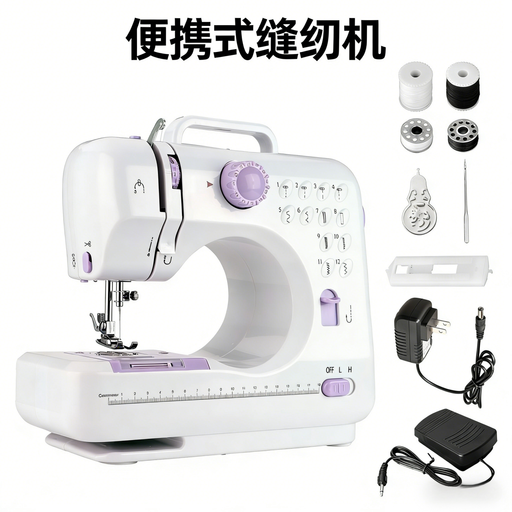
This compact machine is a choice to assess for basic laundry-bag seams where table space is limited. Confirm that its stitch types suit your design before buying.
 No image available
Consider this model for basic seams on a limited table if its available stitches suit your bag design.
The product name specifies 12 stitches, dual power and an LED light. Check the exact stitch types, the supplied plug and the space needed around the machine before buying; do not assume it will handle bulky reinforced seams.
Check the machine’s width and depth, then allow room to move the fabric and position the pedal and cable. Singer Store UK lists the Start 1306 at H29 × W35 × D18 cm; Couling Sewing Machines lists the Brother L14S at H35.5 × W44.5 × D19 cm.
A compact machine can be a sensible choice if it has the stitches your design requires and can handle the thickest seam you plan to sew. Check the exact stitch types and the machine’s fabric guidance rather than relying on its size or total stitch count.
No; the stronger-machine question matters most when folded canvas-like fabric, webbing or reinforced handles create bulky overlaps. Brother’s up-to-ten-layer canvas claim concerns its HF37, while I Want Fabric’s up-to-12-layer denim-type claim concerns the Toyota Super Jeans 26; neither claim applies to every seam or machine.
Check that the machine’s plug, voltage and instructions suit its intended GB supply, and inspect the plug and cable for damage. The Office for Product Safety and Standards has reported hazardous plug-pin problems on particular sewing machines; the Health and Safety Executive recommends a simple visual check of new electrical equipment for damage.
Follow the manual for your exact model and check the needle, threading and stitch-length setting before continuing. Brother’s sewing-machine troubleshooting guidance notes that a very short stitch length may prevent fabric from feeding through enough.