For ordinary cotton aprons, start by comparing straightforward mechanical machines with the stitches and controls your pattern requires. A sturdier model is worth considering if you regularly sew bulky joins or heavier fabrics; computerised controls make more sense when you will use their additional functions. In a small craft room, check the machine’s dimensions, weight and storage arrangement before choosing.
Who is this for?
First-time apron makers with limited space
If you are learning to sew cotton seams and hems, straightforward controls and a machine you can put away between projects may matter most. John Lewis & Partners advises newcomers to consider entry-level mechanical machines.
Frequent makers sewing thicker joins
If your aprons regularly have layered pockets, straps or reinforced seams, check how the exact machine handles the fabric and joins you intend to sew. Presser-foot clearance and construction may matter more to you than stitch count.
Sewists planning projects beyond aprons
If aprons are only the beginning, decide which garment, quilting or decorative functions you expect to use. That gives you a reason to assess additional stitches and controls rather than choosing them for their number alone.
What matters when choosing?
Start with the seams and details in your apron pattern, then consider how often you will sew bulky joins and where the machine will live between sessions. Compare extra functions only against projects you expect to make.
| Concern |
What to check |
Who this matters to |
| Storage and lifting |
Check the complete dimensions, weight and available storage space; confirm whether a cover is included. |
If I need to clear my work surface after sewing, I want a machine I can move and store comfortably. Around 33% of consumers put storage and lifting first. |
| Ordinary cotton seams |
Check the available straight and zigzag stitches, stitch-length adjustment and reverse sewing; look for a buttonhole function if your pattern needs one. |
For hems, ties and straightforward seams, I would rather learn the controls I need than navigate functions I will not use. Roughly 33% of consumers prioritise basic apron construction. |
| Bulky joins and heavier fabric |
Compare the exact model’s presser-foot clearance and fabric guidance against the layers you plan to sew. |
Repeated pocket or strap joins make me concerned about whether the fabric will fit and feed as intended. Around 17% of consumers put thicker joins first. |
| Further sewing projects |
Identify the additional stitches or controls you would use, and confirm them on the exact model offered. |
If I also plan garments or decorative work, I want functions that serve those projects. Roughly 17% of consumers prioritise that wider range. |
What should you avoid?
-
Choosing by stitch count alone
Extra stitches can serve decorative or later projects, but a larger selection does not by itself address ordinary cotton seams and hems.
Read your apron pattern before comparing machines. Check the stitches and adjustments it calls for, along with how you will thread and store the machine.
-
Leaving storage until after the choice
A machine that fits the work surface may still be awkward to lift or put away. John Lewis & Partners advises considering weight and storage when a machine will be packed away.
Measure both the work surface and storage spot, then check the exact model’s dimensions, weight and included cover.
-
Assuming heavy-duty means suitable for every apron
Features intended for bulky fabric may be useful at repeated layered joins without being necessary for every ordinary cotton project. Singer describes extra presser-foot clearance on its Heavy Duty 4432; that feature alone does not establish how another model will handle your fabric.
Match the manufacturer’s guidance for the exact machine to the fabrics and seam layers you expect to sew.
-
Using an overseas model page to choose a UK machine
Brother’s CS7000X specification describes a US-market model. Its features and mains requirements should not be assumed to apply to a similarly named machine offered in the UK.
Confirm the exact model code, mains specification, plug, included accessories and warranty with the seller or manufacturer before ordering.
Brands to consider for these sewing routes
Janome
Janome UK & Ireland lists the 2200XT as a mechanical model with 22 built-in stitch choices and variable stitch width and length. It describes the HD2200’s solid metal body as intended for heavy users.
- The two models offer a way to compare everyday controls with a sturdier construction route.
- Check each model’s dimensions, weight and included accessories against your work and storage space; neither model suits every apron project automatically.
Singer
Singer lists adjustable stitch length and a four-step buttonhole on the mechanical M2405. It describes an extra-high presser-foot lifter on the Heavy Duty 4432 for clearance beneath the foot.
- These model descriptions give buyers specific basic-sewing and bulky-layer features to compare.
- Check the exact model’s fabric guidance and included equipment rather than relying on the Heavy Duty name as a performance guarantee.
Brother
Brother is relevant if you are considering computerised controls for projects beyond basic aprons. Its US-market CS7000X description illustrates functions such as adjustable speed control and automatic needle threading.
- A computerised model may be worth comparing when particular controls or additional stitches match your planned projects.
- The CS7000X’s US specification does not establish the features, accessories or electrical requirements of a UK model; confirm the exact version offered.
Joybuy product choices
This mini machine is a compact option to consider for basic apron projects in a limited workspace. Before choosing it, confirm that its stitch settings, mains connection and handling of your intended seam layers meet your needs.
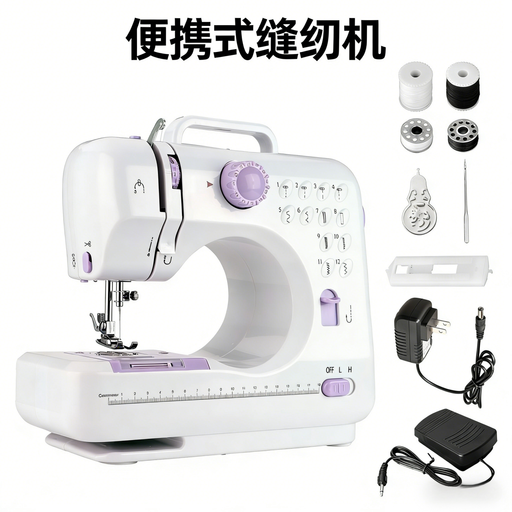 Image unavailable
IAGREEA Mini Portable Electric Sewing Machine, 12 Stitches, Dual Power, Purple
For cotton-apron seams in a small workspace, consider this mini model if its controls match your pattern. Its product name specifies 12 stitches, dual power and an LED light. Check the individual stitch types, stitch-length adjustment, UK mains compatibility and suitability for bulky joins before buying.
View on Joybuy
Common questions
Do I need a computerised machine for cotton aprons?
No, not solely to sew ordinary cotton aprons. John Lewis & Partners recommends considering entry-level mechanical machines for newcomers; compare computerised functions when you have additional projects or a specific control you expect to use.
Which functions should I check for an apron pattern?
Check that the machine can make the seams and hems in your pattern, including the stitch choices, stitch-length adjustment and reverse sewing you require. If the design has buttons, check its buttonhole function; a free arm is more relevant if you will also sew narrow garment sections.
When is a sturdier machine worth considering?
Consider one when you regularly sew thick seam intersections or plan to work with heavier fabrics as well as cotton aprons. Janome describes the HD2200’s solid metal body for heavy users, while Singer lists extra presser-foot clearance on the 4432; check the exact machine’s fabric guidance against your projects.
What should I do with an unwanted electric sewing machine?
Check the electrical-recycling services available locally or ask whether a retailer offers a suitable take-back route. The UK Office for Product Safety and Standards and Department for Environment, Food & Rural Affairs describe the WEEE framework as intended to reduce electrical waste sent to landfill or incineration.


