Occasional maker with limited space
If you put the machine away after each session, manageable weight, straightforward threading and the stitches your woven-fabric pattern needs may matter more than decorative options.


For glasses cases made mainly from ordinary woven fabric, start with a domestic machine that offers controllable straight stitching, zigzag and controls you are comfortable using; a long decorative-stitch list need not drive the choice. If your cases regularly combine canvas, dense interfacing or padding, check presser-foot pressure, clearance and how the machine handles your exact layers. In a small room, weigh those requirements against the machine’s size and weight.
If you put the machine away after each session, manageable weight, straightforward threading and the stitches your woven-fabric pattern needs may matter more than decorative options.
If your design combines lining, interfacing, batting or canvas, pay particular attention to feeding control, presser-foot clearance and whether the machine can handle your actual seam intersections.
If you make cases repeatedly or vary their closures and finishes, speed control, a lock stitch and an easy-to-monitor bobbin may make repeated work more convenient.
Decide what your case’s thickest seam demands, then consider how easily you can operate and store the machine. Extra controls are worth considering when they serve the way you sew.
| Concern | What to check | Who this matters to |
|---|---|---|
| Handling layered seams | Check presser-foot pressure and clearance; seek a test or model-specific advice for your exact fabric and padding stack. | If I combine canvas, lining and padding, I need control where several layers meet. Around 31% of consumers put handling the material stack first. |
| Easy basic sewing | Look for the stitches and seam-reinforcement method your pattern requires, plus threading guidance and a bobbin you can inspect. | When I am learning to sew small seams and corners, I want controls I can understand without relying on decorative settings. Roughly 31% of consumers prioritise straightforward operation. |
| Storage and handling | Measure your work surface and storage space; compare the model’s dimensions, stated weight and supplied cover. | If the table is needed for other crafts, I must be able to put the machine away comfortably. Around 25% of consumers place small-room practicality first. |
| Repeated-work convenience | Consider speed control, lock stitch and a buttonhole function only if your planned closures call for one. | When I make several cases or change closure styles, I value controls that suit those repeated steps. About 13% of consumers put this convenience first. |
A large decorative-stitch list does not tell you how the machine will feed your case fabrics. The Sewing Studio highlights feed, workspace and weight as useful checks when comparing machines.
Start with the straight stitch, zigzag and seam-finishing method your pattern needs, then assess how controllably the machine sews your materials.
A portable design does not establish how a machine will handle a particular combination of outer fabric, lining and padding.
Check guidance for the model and, where possible, test a swatch that includes the thickest seam in your pattern.
Speed and stitch controls may suit frequent work, but Good Housekeeping UK found that its tested Brother Innov-is A65 took more familiarisation than a mechanical machine.
Compare the threading sequence and everyday controls before deciding whether computerised functions would help with your own case designs.
A sewing machine is electrical equipment. Coventry City Council tells residents not to put electrical appliances in household bins.
When you need to dispose of a machine, check your own local authority’s current recycling or collection arrangements.
Janome’s Sewist 725S, 230DC and HD2200 illustrate different domestic-machine approaches to case-making.
The Heavy Duty 4423 is a model to investigate if your cases regularly use firmer materials.
The Innov-is A65 is relevant if you want to assess a guided, computerised domestic machine.
The Smarter 160s may interest someone who also wants a machine for mending and general domestic sewing.
These IAGREEA portable machines are options to consider for basic glasses-case sewing in a small workspace. Check your pattern’s stitch and seam requirements, especially if it includes padding or firmer fabric.
 No image available
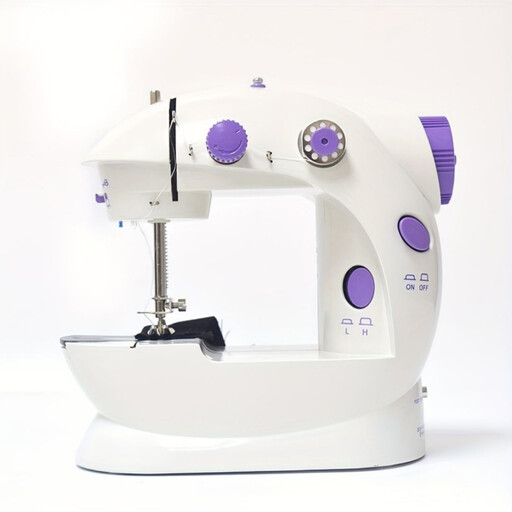
Consider this mini machine for basic case seams if its stitch options suit your pattern.
The purple variant lists 12 stitches, dual power and an LED light. For padded or firmer cases, confirm that it can handle your thickest seam.
 No image available
Consider this portable mechanical model for basic sewing if its stitches and controls meet your case pattern’s needs.
Its name specifies battery or plug-in power, with 4 AA batteries for battery operation, plus a spare needle and threading device. Check its dimensions for your storage space and whether it offers the seam reinforcement and material handling your pattern requires.
Usually not for ordinary woven-fabric cases: a domestic sewing machine can make the standard seams. Sewing Street describes an overlocker as a way to trim, stitch and neaten edges in one step, a function to consider if your projects also extend substantially into stretch garments.
No; the relevant question is whether the machine can handle your case’s thickest combination of outer fabric, lining and padding. Check presser-foot clearance and pressure adjustment, and seek a swatch test or model-specific advice before choosing a machine for repeated bulky work.
Measure both the work surface and the place where the machine will be stored, then compare each model’s dimensions, weight and cover. Janome UK & Ireland states weights of 6.7 kg for the Sewist 725S and 8.0 kg for the HD2200, illustrating why ease of moving a machine needs a model-by-model check.
Check your local authority’s instructions instead of putting an electrical machine in household waste. Coventry City Council directs its residents to recycling and reuse facilities or available collection arrangements; the route for your address may differ.