Makers of padded or tough-material cases
If your design uses canvas, vinyl, synthetic leather or bulky stabiliser, focus on feeding the thickest seam rather than counting decorative stitches.


For occasional glasses cases made from lightly stabilised fabric, start by considering a basic domestic machine; padded layers, canvas or vinyl may call for a heavy-duty domestic model, while repeated work with genuinely heavy materials may justify a straight-stitch semi-industrial machine. Choose the route only after checking the thickest finished seam, the stitches the design needs and how the shared workshop will maintain and instruct users of the machine.
If your design uses canvas, vinyl, synthetic leather or bulky stabiliser, focus on feeding the thickest seam rather than counting decorative stitches.
If you mainly make fabric sleeves or pouches with modest stabiliser, straightforward threading and stitch controls may matter more than specialist heavy-material features.
When several people use the machine, decide who will provide instructions, check its condition and arrange maintenance. If the machine is provided for use at work, the Health and Safety Executive’s work-equipment guidance is also relevant.
Choose a machine route from the finished case construction and expected use, then check that its controls and upkeep arrangements work for the people sharing it.
Consider it when: Cases are occasional fabric projects with modest seam bulk; Janome describes its J3-18 as a starter and occasional-use model.
Trade-off: Do not assume a basic model can handle dense padding, thick leather or repeated production.
Consider it when: Small-batch cases involve canvas, multiple fabric layers or vinyl, and the design needs domestic utility stitches; Brother specifies a non-stick foot and a levelling button for its HF37.
Trade-off: Those features do not establish capacity for every leather thickness or bulky seam junction.
Consider it when: Repeated production with confirmed heavy materials or thick thread calls for a specialist route; JUKI UK specifies its TL-2300 Sumato for leather, synthetic leather, denim and canvas.
Trade-off: It sews straight stitches only, so it will not replace a machine needed for zigzag or other stitches.
| Concern | What to check | Who this matters to |
|---|---|---|
| Material and seam bulk | Test the actual outer material, lining, stabiliser and closure at the thickest folded seam; check the needle, thread and foot guidance for that material. | If my case has a bulky seam or a tough outer layer, I need to know the machine can sew the finished stack, not just one piece of fabric. Around 40% of consumers put that material-and-seam need first. |
| Small-project controls | Check the stitches and stitch-length control your design requires, then try a prototype with its intended stabiliser. | For occasional fabric pouches, I want controls I can use without choosing a specialist heavy-material machine. Around 30% of consumers prioritise that small-project usability. |
| Shared use and upkeep | Confirm who controls the machine, how users receive instructions, and who checks its electrical condition and arranges maintenance. | When several people share a machine, I need clear setup and fault-reporting arrangements so its condition does not depend on the previous user. Around 30% of consumers place shared-workshop operation first. |
Lining, stabiliser, folded edges and a closure can make the finished seam very different from a single layer of outer fabric.
Sew a sample through the exact layers at the thickest intersection before relying on a general fabric claim or stitch count.
Brother states different HF37 warranty periods for general and commercial use. A shared workshop’s arrangement needs to be classified under the applicable terms rather than assumed to fit either category.
If the machine will support paid, organisational or business activity, ask the retailer or manufacturer how that intended use is treated and keep the answer with the workshop records.
The Health and Safety Executive says annual portable appliance testing is not a blanket requirement in low-risk environments. A test label does not replace attention to damage, suitability and maintenance.
Set up proportionate visual checks and fault reporting, with appropriate inspection or testing where needed and competent repair of damaged equipment.
The HF37 Strong and Tough is a domestic mechanical option to examine for cases involving varied fabrics and some tougher surfaces.
The Heavy Duty 4423 is a domestic mechanical model to compare for fabric-based cases with multiple layers.
The TL-2300 Sumato represents a straight-stitch semi-industrial route for a confirmed heavy-material project.
The J3-18 is an occasional-use domestic model to consider for simpler fabric glasses cases.
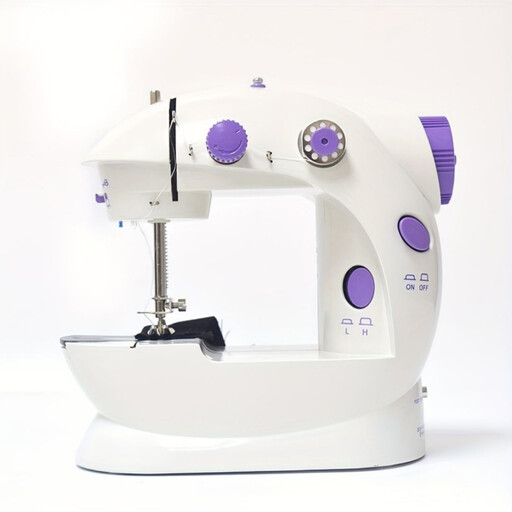
These portable IAGREEA machines are choices to examine for occasional, simple fabric cases. Test the planned seam stack and confirm that the supplied power arrangement suits the workshop before relying on either for shared use.
 No image available
Consider this model for an occasional fabric case if a sample of the finished seams sews as intended.
Its product title specifies 12 stitches, dual power and an LED light. Confirm the supplied power equipment suits the workshop’s electrical supply and establish instructions and maintenance arrangements before shared use.
 No image available
Consider this model for a simple fabric case only after checking its available stitch controls against the design and sewing the thickest seam as a sample.
Its product title specifies battery or plug-in power using 4AA batteries, plus included thread shuttle cores, a spare needle and a threading device. Confirm power-supply compatibility and shared-use arrangements before use.
No blanket annual testing rule applies to every portable appliance in a low-risk workplace, according to the Health and Safety Executive. Electrical equipment still needs to be maintained to prevent danger; choose checks and any testing according to the equipment and how it is used.
If the sewing machine is work equipment, the Health and Safety Executive says the Provision and Use of Work Equipment Regulations require it to be suitable for its intended use, maintained in a safe condition and used by people with adequate information, instruction and training. The person or organisation controlling it should also consider when inspection is appropriate.
Where the machine is used for work, the Health and Safety Executive advises checking that it suits the task and electrical supply and is in good condition. Look for visible damage to the plug, cable and outer cover, report faults, and have damaged cables dealt with by a competent person.