First-time curtain maker
If you are learning to sew lightweight curtains, straightforward threading and adjustable stitches give you ways to practise hems on offcuts before making pieces for sale.


For lightweight curtains made for a craft fair, prioritise adjustable stitching and a setup you can test on the actual fabric. A mechanical machine can suit occasional hems; for repeated panels, speed control, fabric-feeding options and more space beside the needle may be more useful. If you regularly move the machine, weigh those features against how much you need to carry.
If you are learning to sew lightweight curtains, straightforward threading and adjustable stitches give you ways to practise hems on offcuts before making pieces for sale.
If you expect to sew several long hems, consider whether speed control, fabric-feeding options and room to support each panel would make the work easier to manage.
If the machine must travel between workspaces or fit into limited storage, compare its stated weight and cover with the stitching and fabric-handling features you need.
Start with the finish your curtain fabric needs, then consider how often you will sew long panels and whether you must carry the machine.
| Concern | What to check | Who this matters to |
|---|---|---|
| Lightweight-fabric hems | Check stitch adjustment and use an offcut of your curtain fabric to try a suitable needle and hem. | I want the hems on fine curtains to look neat before I sew pieces for sale; around 42% of consumers put this finish first. |
| Repeated long panels | Compare speed control and the available support for fabric beside the needle, including any extension table. | When I make several panels, I need a pace and work area I can manage throughout the batch. For around 33% of consumers, that workflow is the main concern. |
| Moving and storing the machine | Compare stated weight and whether the exact package includes a cover; check that its stitch settings suit your fabric. | I need to put the machine away or take it to another workspace without giving up the controls my curtains require; portability and simple setup come first for around 25% of consumers. |
A machine described as capable of sewing multiple layers still needs an appropriate needle, stitch and hem setup for lightweight fabric. The Sewing & Craft Alliance identifies Sharp/Microtex needles for finely woven fabrics and turned-and-stitched hems for most lightweight fabrics and crisp sheers.
Try the planned needle and hem on an offcut of your actual curtain fabric before sewing a batch.
Carrying weight matters when the machine moves regularly, but repeated panels may also call for space to support fabric and controls that suit your sewing pace.
Compare the stated weight with the work area and speed controls you will use most often.
An even-feed foot, extension table or cover can affect how you handle long panels or move the machine, and packages can differ.
Check the accessory list for the exact model and listing before ordering.
Online cancellation and remedies for a faulty machine are separate protections; the reason for returning it affects which process applies.
Read the seller’s return instructions, keep your order details and document any fault promptly. GOV.UK’s consumer returns guidance and the Consumer Rights Act 2015 address these situations separately.
Janome UK & Ireland lists mechanical, computerised and larger-workspace machines with different approaches to curtain-making tasks.
The Innov-is A16 offers an electronic-control option for makers who prefer guided stitch selection to dial-only operation.
The M1605 and M3305 illustrate different mechanical setups for buyers balancing carrying weight against stitch adjustment.
The passport 3.0 combines a portable format with upper-and-lower fabric feeding.
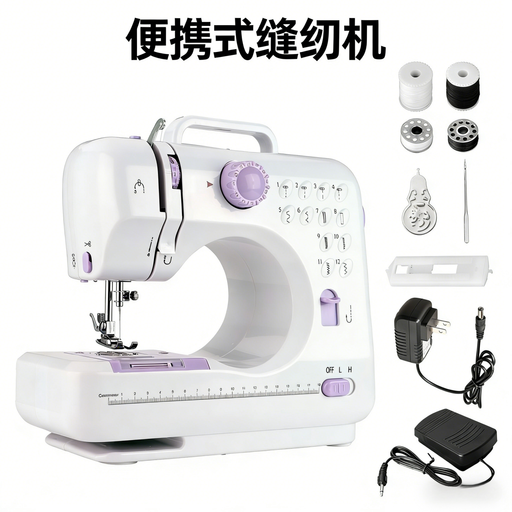
This compact machine is a choice to consider for practising basic seams and hems before making lightweight curtains for sale. Check how it handles your fabric and the length of your planned panels.
 No image available
Consider this machine for practising basic hems on offcuts before making saleable curtains.
The product name specifies 12 stitches, dual power and an LED light. Before choosing it for long curtain hems, check whether its stitch length and width can be adjusted and whether its work area suits your panels.
Not necessarily: for lightweight woven curtains, start with controllable stitching, a suitable needle and a test hem on the actual fabric. The Sewing & Craft Alliance identifies Sharp/Microtex needles for finely woven fabrics and turned-and-stitched hems for most lightweight fabrics and crisp sheers.
Sew an offcut first to check the needle, thread tension, stitch length and appearance of the intended seam and hem. Decide the hem construction and allowance for your fabric before cutting and sewing the saleable panels.
Check the seller’s instructions for an eligible change-of-mind cancellation, and treat a faulty machine as a separate matter. GOV.UK’s returns guidance and the Consumer Rights Act 2015 distinguish cancellation from faulty-goods remedies; keep the order details and record any fault so you can explain which issue you are raising.
Confirm that the exact machine is supplied for your destination, has suitable electrical specifications and comes with clear product and support information. GOV.UK’s product-marking guidance addresses Great Britain and notes that Northern Ireland follows different processes, so check the applicable requirements with the seller if delivery is to Northern Ireland.